



The Celebrity Traitors shows that when TV plays the game, we all watch
Opinion
The draw of The Celebrity Traitors proves there’s life in linear TV yet, as Jon Manning explains.
This time last month, if I’d told you the sound of Celia Imrie farting would be rejoiced in living rooms up and down the country, you wouldn’t have believed me.
But such has been the lure of The Celebrity Traitors – with an average of 12.6m viewers across the first eight episodes, peaking at 13m according to Barb 7-day consolidated data – that you’d be hard-pressed to find someone unaware of the show, even in such a fragmented media landscape.
As for the final, as of 10 November, the numbers currently stand at a staggering 13.78m, and they are only likely to grow as people continue to catch up.
There’s life in linear yet – even as viewing habits evolve
These figures prove there’s life in linear TV yet. With audiences comparable to England’s Women’s Euro final earlier this year (12.2m), it’s clear that TV remains unmatched when it comes to uniting mass audiences. What’s changed is how people are watching.
Around 53% of viewing is happening via iPlayer, peaking at over 60% for episode two. Data from Virgin Media suggests many viewers are saving episodes to binge later, showing that while linear still sparks cultural conversation, BVOD now sustains it.
Interestingly, much of the show’s momentum builds over time. Viewers increasingly discover The Traitors through word-of-mouth, catching up via iPlayer rather than tuning in live — a reminder that reach today isn’t about a single broadcast moment, but cumulative exposure across days and platforms.
Harking back to the aforementioned 12.6m average, this increases to 13.1 m when looking beyond seven days to include eight-28 day viewing post transmission, according to Barb.
And for advertisers, that’s the real story. BVOD and CTV aren’t replacing linear – they’re extending their reach and relevance, ensuring these cultural moments last far beyond the live broadcast.
The Celebrity Traitors’ broad appeal underlines the power of format and familiarity
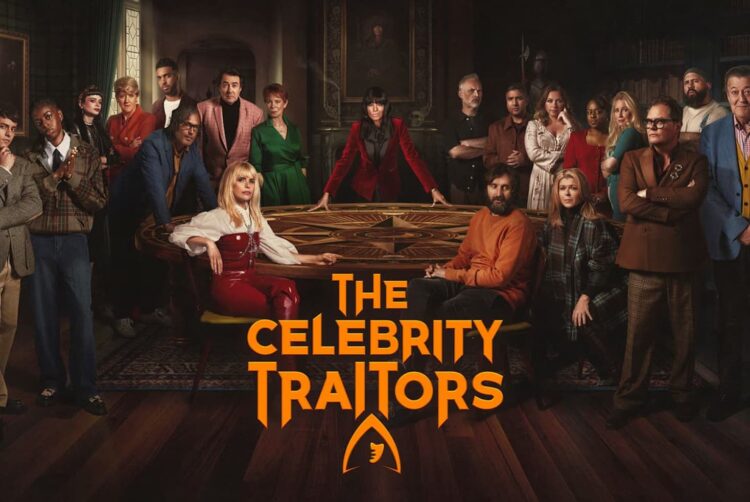
A big part of The Celebrity Traitors’ success lies in its casting. From comedians and actors to musicians and sports stars, it’s a genuinely multi-generational line-up that brings different audiences together.
It’s a reminder that when you mix a trusted format with recognisable faces, you create appointment-to-view TV – even in an on-demand world.
It’s also a testament to the format’s strength. Having been tried and tested through three non-celebrity series, the show entered this celebrity edition with a blueprint that already worked – proof that the right creative foundation can still command national attention in a fragmented landscape.
While the BBC’s lack of advertising means brands can’t appear in the show, The Traitors has still fuelled brand activity around it – from themed retail tie-ins to social activations and sponsorships that tap into its iconography. This illustrates how broadcast TV can still ignite cross-platform participation, sparking engagement across social, digital and retail spaces alike.
Evolving viewer habits demand smarter AV planning
Taking a step back, The Celebrity Traitors reflects broader shifts in viewing behaviour. The boundaries between linear, BVOD and CTV continue to blur. Live sports and major entertainment events show that while linear builds instant cultural scale, digital environments offer precision and accessibility – even for smaller advertisers through programmatic buying.
When executed well, AV planning that integrates BVOD and CTV with linear delivers the best of both worlds: the reach of broadcast with the targeting and measurement of digital.
With BARB now reporting on total video – from linear to YouTube – planners have the data they need to build truly audience-led campaigns.
And as initiatives like CFlight and Lantern evolve, the industry is finally moving closer to joined-up measurement across screens, giving advertisers the tools to connect exposure to outcome.
Takeaway: plan for how people really watch TV
When the nation’s eyes are drawn to a show like The Celebrity Traitors, advertisers can’t afford to plan in silos. The most effective campaigns are those that recognise how people actually watch TV today – combining linear, BVOD and CTV in proportion to audience behaviour.
As viewing habits evolve, advertisers must recognise that BVOD and CTV are no longer secondary touchpoints — they’re often the first choice for audiences. Linear still sparks the conversation, but digital viewing now sustains it.
The show is a reminder that while the way we watch may have changed, the desire for shared, collective viewing hasn’t. For advertisers, success now lies in planning for both — the mass moments that television still commands, and the digital environments that sustain them.
 Jon Manning is director of advanced TV at Medialab