



2025 in OOH: Strength is starting to shine through
2025 in Review
Out-of-home (OOH) has reported steady growth of 1.4% this year. Despite a Q2 decline, the sector has bounced back in the latter part of the year, indicating shifting perceptions of the channel’s strength and role.
For instance, in Q3, OOH advertising reported growth of 4.4%, totalling £376.6m according to industry trade body, Outsmart.
This marked a significant uptick in growth from Q2, where ad revenue fell by 1.2% to £350.4m
Interestingly, in Q3, classic OOH overtook Digital out-of-home (DOOH), reporting 6.5% growth compared to digital’s 3.3%. However, according to AA/Warc, digital is set to continue driving growth in 2026, with ad spend forecast to increase 5.3% and OOH growth at 4.1%.
The market saw some changes at the beginning of the year when Bauer Media Group announced it would be acquiring Clear Channel Europe-North. The company later renamed the unit Bauer Media Outdoor, posing as a challenger to the market leader, Global.
The ever-shifting ad landscape, hit this year by an AI storm, an unpredictable geopolitical context, and increased ad avoidance, may explain why the industry is awakening to OOH’s unique strengths and why growth is the trajectory.
Entering its prime
Brand-building strategies have become increasingly central over the last year, especially amid misinformation, AI, and audience fragmentation.
The strength of OOH as a trusted, attention-grabbing, brand-building medium was compounded by the release of Rapport’s Standing on the Shoulders of Giants report, released in November at its annual DPAA Town Hall event.
Notably, the report found that brands that allocated 15% or more of their budget to OOH saw a 17% increase in sales value, a 25% increase in profit, and a 100% increase in market share compared with brands that didn’t invest in OOH.
Commissioned by the IPA and Peter Field, the research assessed 40+ years of advertising effectiveness and 2,000 IPA databank case studies, and marks the second iteration of the study, first launched in 2018.
It compared 41 brands that dedicate 15%+ of budget to OOH, or “OOH power-users”, with 41 non-users of OOH to assess the impacts on long-term and short-term business results.
Importantly, the research acknowledged the amplifier effect OOH can have on other channels, such as social, display, TV, video-on-demand (VOD) and search.
The OOH power-users saw a 3% boost in display, a 17% boost in social effectiveness, a 21% boost in TV and VOD, a 27% boost in online video advertising (OLV), and a notable 129% boost in search.
As the industry continues to move away from the traditional siloed approach, this study demonstrates OOH’s role in accentuating other channels, especially search, pointing to the mediums’ specific priming effect and wide reach.
For these brands, they saw a 28% boost in social sales, a 28% boost in OLV sales, and an 8% boost in TV and VOD sales.
Profit also boosted by 14% for social, 42% for OLV, and 67% for TV and VOD, highlighting the clear business effects OOH has when used in conjunction with other media, especially social and video formats.
Inventory galore
This year, OOH has become more dynamic through digitalisation, enabling formats that are more diverse, attention-grabbing, and reactive, and offering advertisers the opportunity to target audiences more effectively through real-time data.
For instance, JCDecaux has committed to doubling the number of digital panels in its London Digital Network, installing 1,000 digital roadside bus shelter screens across the city, with 500 of these having already gone live in 2025.
These screens feature new digital capabilities, including creative and motion features, as well as a new Video Advertising Motion Measurement scale.
Global has also scaled up its roadside offering through its partnership with BT, and rolled out digital street hubs in more than 200 towns and cities.
Meanwhile, Bauer introduced its digital roadside offering, Roadblock, in July. It enables brands to dominate thousands of Adshel Live D6 screens simultaneously for an hour.
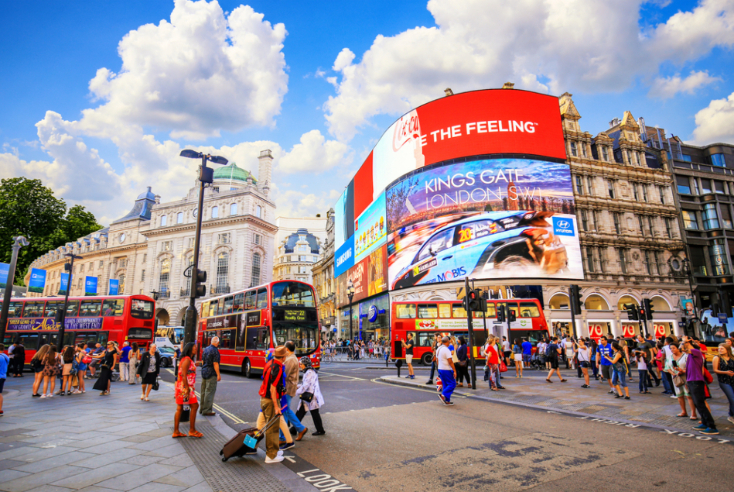
At Piccadilly Lights, Ocean Outdoor collaborated with Sky Creative to deliver a 3D “moving patchwork” on a deep screen, delivering a spectacle pedestrians could not miss. Another example of innovative interactive formats is Ocean and Universal Pictures’ M3gan 2.0 pop-up at Westfield featuring AI-powered animations triggered by passers-by.
In October, it was announced that Nick Shaw, currently the chief commercial officer UK at Ocean, would take over from Phil Hall as CEO, from 1 January 2026.
In an exclusive interview with The Media Leader, the pair made clear that Ocean will continue to assert its dominance in large-format, full-motion, deep-screen technology to drive growth in 2026.
JCDecaux hit 1bn programmatic impressions in H1, with brands in particular realising the value of OOH in delivering timely activations around big events such as the England Women’s Euro campaign.
The key here is PrOOH’s ability to match message to moment, and will undoubtedly flock brands to the medium during next summer’s FIFA World Cup.
On the topic of sporting events, in July, Ocean Outdoor launched a large format DOOH campaign showcasing 31 big match moments from the UEFA Women’s Euros 2025.
Shanil Chande, Talon’s chief programmatic officer, said: “Brands want to react quickly, keep up and embed themselves in cultural moments.”
Sporting events are becoming increasingly embedded as cultural moments in society — brands want to be involved and are increasingly waking up to OOH’s capacity to deliver.
The unskippable, attention grabbing ad
As misinformation and disinformation has risen along with distrust and ad avoidance, OOH’s position as an unskippable and trusted medium has further cemented.
As programmatic digital out-of-home (pDOOH) develops, OOH will become more central to omnichannel media planning.
This was reinforced by the finding that premium large-format DOOH gains five times more attention on average than online digital formats.
A key result from The Attention Dividend, produced by Ocean Outdoor in partnership with attention measurement company Lumen, presented in June.
Notably, this format holds attention for 8.2 times longer than online display, 5.5 times longer than social media content and 1.6 times longer than online video.
In terms of brand recall, the research found that premium large-format DOOH delivers 2.5 times the brand recall of online video.
Video creative on this format also drives 2.5 times more brand choice than static content.
According to Route, OOH reached 98% of the UK population weekly, and as highlighted by Ian Whittaker in a report for Talon, Branding in the Age of Inflation: Thinking Outside the Playbook, what is really the differentiator with OOH and attention is that adverts are actually being viewed at a much higher rate than online adverts.
As the wider industry continues to absorb the shockwaves of continuous change, OOH is on an upward trajectory.
Its brand-building abilities, cultural relevance and its capacity to drive short-term sales through the new targeting powers of programmatic, its safe to say OOH hasn’t yet reached its peak.