



How the advertising industry can navigate The World Ahead
Partner Content
The Economist‘s global head of advertising reflects on Tom Standage’s keynote at The Year Ahead.
At the start of June each year, The Economist’s Tom Standage (deputy editor, The Economist and editor, The World Ahead) turns his attention to the following year, slavishly researching and gathering intel on the broader macro-trends that he and his army of experts think will shape the world agenda.
This is not a new initiative; in fact, this process has taken place in a similar form for the last four decades. The World Ahead 2026 is the 40th iteration.
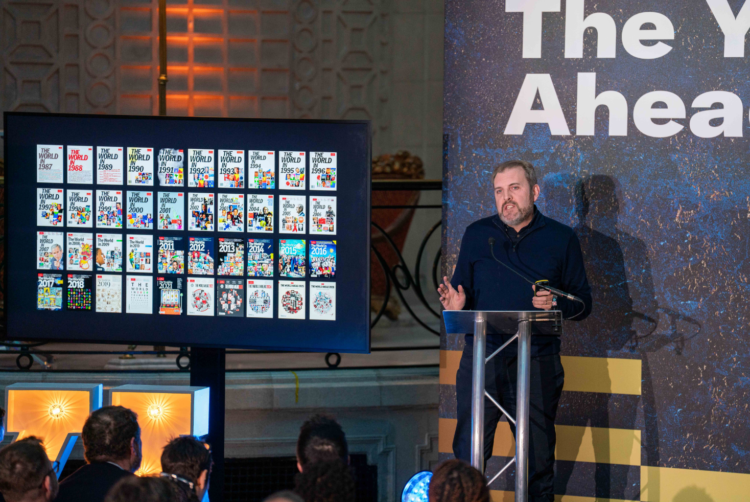
For those enlightened souls who attended AdWanted’s similarly titled ‘The Year Ahead’ event at The Waldorf recently, you will have heard Standage deliver his top 10 predictions in typically effervescent and engaging fashion.
They are broad in scope, bold in conception and cover topics as diverse as geopolitical drift, war or peace, America’s 250th birthday, concerns over AI, a big year for sport, China’s opportunity and everything in between. Unsurprisingly, many of the featured topics specifically referenced Mr Trump, his unpredictability the only truly predictable prediction.
But what does all this mean for advertising, and can we, as an industry, take the relevant lessons from such invaluable economic and political insights and make them work for our clients?
Well, the answer, as is so often the case these days, is probably yes…..and no.
There’s not an advertiser or media owner out there who’s not excited by the opportunities that the FIFA World Cup presents, albeit opportunities more complicated because the three host countries, the US, Mexico and Canada, are barely on speaking terms.
Our industry’s obsession with AI is legitimate and necessary. Hyper-personalisation at scale, smarter audience targeting, enhanced automation of manual workflows are all potential upsides, but what if that AI bubble bursts – even the best laid plans will struggle to survive a cataclysmic collapse of .com bubble proportions.
How about China’s opportunity?
If Mr Trump’s “America First” policy does end up offering China a chance to extend its global sphere of influence, does this help or hinder the advertising industry?
You can look at this in two ways. A resurgent China at home, and a return to the aggressive consumerism of years gone by, can only be additive.
Take the luxury sector, which has suffered more than most from recent volatility, but signs are already there that consumer spending is on the rise again, and with that rise comes clear potential for advertisers and advertising in general.
Similarly, the proliferation and expansion of homegrown Chinese products and services will only help drive advertising spend across the markets they prioritise.
But what of Europe, touted by Standage as likely to experience a problematic year?
Defence spending might lift growth, but only slightly. Deficits loom, but austerity risks boosting the far right. And all the while, it has to find a way to continue its delicate dance with the US – keep your friends close and your enemies closer.
It’s hard to see how advertising can possibly benefit from such economic and political uncertainty, but in difficult circumstances, it is the cream that rises to the top.
Intelligent, data-informed strategies are key, but just as important are context and environment. Trust between consumers and content is critical, so ensuring appropriate, relevant, and timely messaging is more important now than ever.
Which brings me neatly to controlling the controllables…
Trying to anticipate what will happen to Greenland, hedge against China’s military intervention in Taiwan, or attempting to identify Venezuela’s future path is a fool’s errand.
Better to focus on what you know you can influence, the key indicators that will help grow your business and underpin foundational success.
Ruthless prioritisation is paramount – spend time on the creative, the media placement and the overarching strategy – data-informed, not data-led – and you’ll be controlling the controllables.
That’s got to be better than second-guessing which mineral-rich island Trump sets his sights on next. Leave that sort of prediction to Standage and his team.
Nothing we’ve seen so far this year hints at a less chaotic 2026 – it’s a question of navigating your way through it.
Which is where I return to The Economist, a brand I have long admired but only had the privilege of working for these past seven months.
What it does better than anyone is to make sense of the madness, providing unparalleled clarity of thought and unquestionable data-led insight.
In a world gone mad, an authentic, trusted voice is vital. The World Ahead and The Economist deliver this insight, this clarity of thought, in spades, and I have no doubt that the clever folk in our advertising industry will turn this insight into action and this clarity into opportunity.
And as for those really enlightened souls I referenced earlier, surely they’ll now be working out how to get The Economist on their media plans as a matter of urgency.
 Jamie Jouning is the global head of advertising at The Economist