



Scrutiny or silence? The media’s choice could determine the next General Election
Opinion
What does the Whitehall editor of The Sunday Times have in common with Jeremy Clarkson? They appear to be the only two writers willing to scrutinise Reform UK, says Ray Snoddy.
The Sunday Times had a very interesting story on the financing of Reform UK by the paper’s Whitehall editor, Gabriel Pogrund.
At first glance, it could have been missed with its modest headline at the bottom of a front page dominated by the latest Epstein-linked revelations about Andrew Mountbatten-Windsor.
Pogrund revealed, with further details inside, an extraordinary tale of how a churchwarden from Potters Bar who works for “a highly secretive Kazakh-born billionaire” was the man behind £200,000 in donations to Reform UK.
The churchwarden John Richard Simpson, a conveyancer, is the owner of a small company, Interior Architecture Landscape Ltd, that made seven payments to Nigel Farage’s party last summer.
According to The Sunday Times, there is no evidence that Simpson has any background in interior design and that he refused to discuss the source of the funds.
Simpson has long worked for Sasan and Yasmin Ghandehari, a married couple whose family office sponsored Farage’s pass to the World Economic Forum at Davos and paid for his hotel room there last month.
The billionaire family claimed to have retained the Reform leader as “an honorary and unpaid adviser”, a relationship first reported by the Financial Times.
As The Sunday Times pointed out, it is illegal for foreign nationals to donate directly to a political party in the UK, but not for a foreign investor to deposit funds in a UK company that, in turn, donates to a political party.
The piece lifted a small veil on some of Reform UK’s funds, but it is significant for a different reason – the rarity of such stories.
A lack of interest by the British media
It highlights the apparent lack of interest among the British media in investigating the affairs and policies of a party that continues to hold a firm lead in the opinion polls.
As we have been endlessly told, if there were a General Election now, Nigel Farage could indeed find himself as Prime Minister of the UK.
The latest Ipsos poll for January shows Reform at 30%, Labour at 22%, and the Conservatives at 19%.
The poll shows a narrowing of the Reform lead from 15% in November to 8% now, as Labour has gained four percentage points and the Conservatives 3%.
But the relative lack of media scrutiny is still remarkable, with some sections of the right-wing press perhaps hedging their bets in case Farage really does turn out to be a winner.
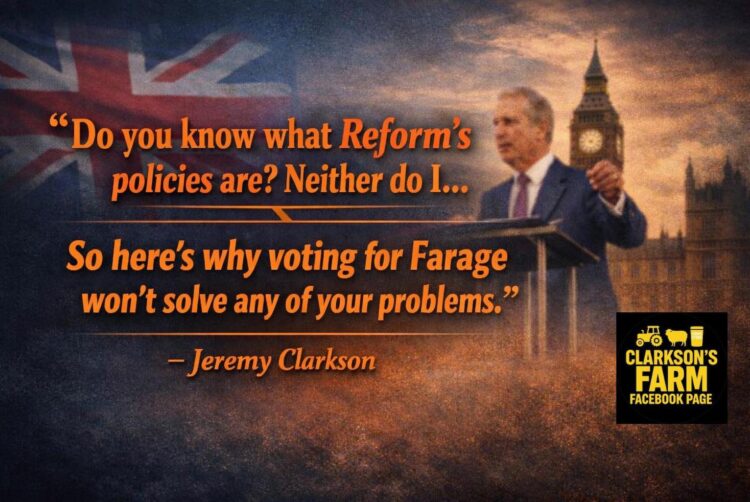
Ironically, the day before The Sunday Times article, there was a feisty column in The Sun by a columnist whose public persona would suggest a rather conservative outlook – the UK’s most famous farmer, Jeremy Clarkson.
Clarkson warned that “if and when Reform wins the next election”, the army of people who voted for them are going to end up sorely disappointed.
They would not be voting for Reform’s economic policies, Clarkson argues, because no one knows what they are.
“It’s the same story with their policies on transport, agriculture, education, potholes, health and smoking in pubs. You know what Nigel Farage thinks about China? Me neither,” says Clarkson, who believes all we have been told is that Reform will “do something” about immigration.
The “doing something” includes proposals to repeal the Human Rights Act, exit the European Convention on Human Rights, mass detention and deportation of asylum seekers without appeal rights, and the abolishing of indefinite rights to remain for hundreds of thousands of legal residents.
Reform’s big policy mirrors that of President Donald Trump’s America, and Farage has been a long-term Trump acolyte.
As Clarkson points out, Trump’s anti-immigrant policies and his ICE agents have been going down well in Minnesota.
Despite the efforts of the unlikely duo – Pogrund and Clarkson – there is a danger that in their coverage of Farage and Reform, the UK media will mirror the failure of much of the American media, which normalised Trump with disastrous results.
A self-fulfilling prophecy
As many have argued, the BBC has played a central role in transforming an obscure former member of the European Parliament into a household name through repeated appearances on BBC One’s Question Time.
Television news channels cover Reform UK press conferences live at the drop of a hat and offer little by way of scepticism.
That was just the sort of mistake made by the US networks.
In a self-fulfilling prophecy, Farage is news because Farage is famous and therefore news, although now there is the justification that the party is ahead in the polls.
Pogrund apart, has there been adequate scrutiny of the finances of both Farage, his financial backers, and his party, which is actually a limited company?
Why has no one really got to the bottom of who actually came up with the £800,000 used to buy the house in Farage’s Clacton constituency and whether any rules were broken along the way?
Has there really been enough clarity on the issue of possible Russian influence on Reform following the 10-and-a-half year jail sentence imposed on Nathan Gill, the former leader of Reform UK in Wales?
Gill admitted to accepting bribes in exchange for pro-Russian interviews and speeches.
Farage is happy to tour the country, claiming that Britain is “broken” and that nothing works here anymore, without the media reminding him that, if his claim is true at all, it is largely because of his all-too-successful campaign to take the UK out of the European Union.
Has there been enough coordinated coverage of the largely abysmal performance of the local authorities where Reform UK is in charge? Although they have tried to deny it, the party campaigned on cutting waste and council taxes and has done neither.
There is a slice of the electorate so disaffected with conventional politics that they will probably vote for Farage and Reform come what may.
But the duty of the UK media is at the very least to subject the claims of Reform, the party aiming to govern the UK, to intense scrutiny.
That is the only way to ensure that Jeremy Clarkson’s warning does not come true – that after the next General Election, the army of people who voted for Reform do not end up sorely disappointed.
 Raymond Snoddy is a media consultant, national newspaper columnist and former presenter of NewsWatch on BBC News. He writes for The Media Leader on Wednesdays — bookmark his column here.