



Brands, AI, consumers: How to navigate this love triangle without a backlash
Opinion
Consumers love AI, just not when brands use it to replace ‘soul’. So how do you navigate this complex ménage à trois?
Consumers use ChatGPT daily, then revolt against AI-generated ads. Brands need AI to survive, but audiences flee toward anything “human-made.” Welcome to marketing’s most dysfunctional three-way relationship.
Here’s how the affair plays out. Brands and AI are getting cosy behind closed doors – media planning, consumer insights, asset production, what used to take weeks now takes hours. Consumers feel left out and are reacting erratically. But here’s the twist: those same consumers are having their own AI affair. They love AI, just not when you use it on them.
So what do you do when the threesome turns into a fight?
The secret affair
Brands and AI are in their honeymoon phase. Amazon’s Creative Agent generates streaming TV ads from product pages. Meta’s Advantage+ automates campaigns. Google’s AI Max handles performance workflows. The tools actually work, which is half the problem.
When production costs approach zero, things become possible that weren’t before. The output has that distinctive AI look, though – over-warmed colours, smooth textures. Would you use it for your flagship campaign? Probably not. For testing product variations at scale? Sure. Maybe that’s exactly the point.
The betrayal
Consumers watch brands embrace AI, and something feels fundamentally off. The word that keeps surfacing: soul.
Guess ran AI models in Vogue‘s August 2025 issue. Two synthetic women named “Vivienne” and “Anastasia,” flawlessly beautiful in that too-perfect way. TikTok erupted about the fake beauty standards being set. Real models are being displaced by synthetic perfection that costs nothing to generate. That’s soul leaving the room in real time.
Google’s Dear Sydney ad should have been safe. A Dad uses Gemini to help his daughter write a fan letter to an athlete. But showing it publicly broke something – it completely negated why someone would write a letter. The struggle, the personal effort, the intention, all replaced by prompt efficiency.
The pattern: when AI replaces invisible infrastructure – media planning, A/B testing – nobody cares. When AI replaces perceived soul – models, a child’s effort – revolt.
The hypocrite’s confession
Those furious consumers? You can be sure they’re using ChatGPT for cover letters, birthday cards, and reaching out to their idols. The backlash isn’t about the tech itself, but about control. When I use AI, I feel empowered. When you use AI on me, it feels like cost-cutting without soul.
The unlikely alliance
Sometimes the betrayed unite against the third. Anti-AI positioning became the luxury flex of 2025.
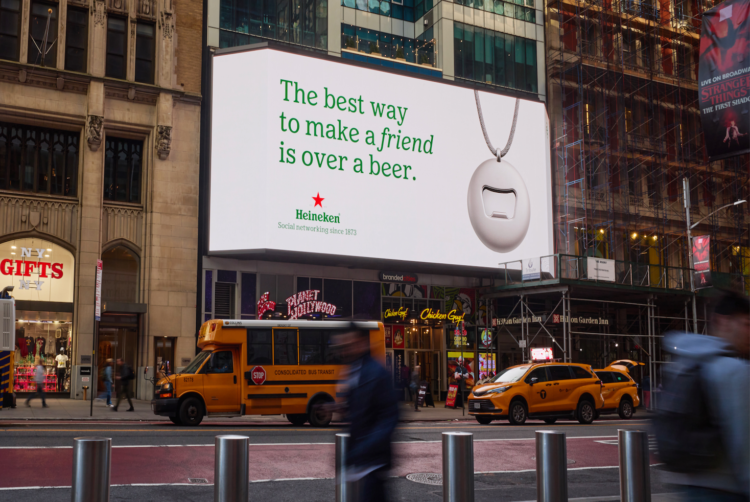
Heineken vs. Friend AI. The latter had plastered NYC subways with ads for algorithmic companionship. Those ads got vandalised fast – “AI doesn’t care if you live or die” spray-painted across the posters. Heineken launched a campaign with the tagline “You can’t create real friends with AI.” Zero subtlety, completely on-brand for a company selling social lubrication.
Polaroid placed bus stop ads near Apple and Google headquarters: “AI can’t generate sand between your toes.” It works because Polaroid’s entire brand is built on imperfection as a feature. Everything AI promises to fix, Polaroid celebrates as the point.
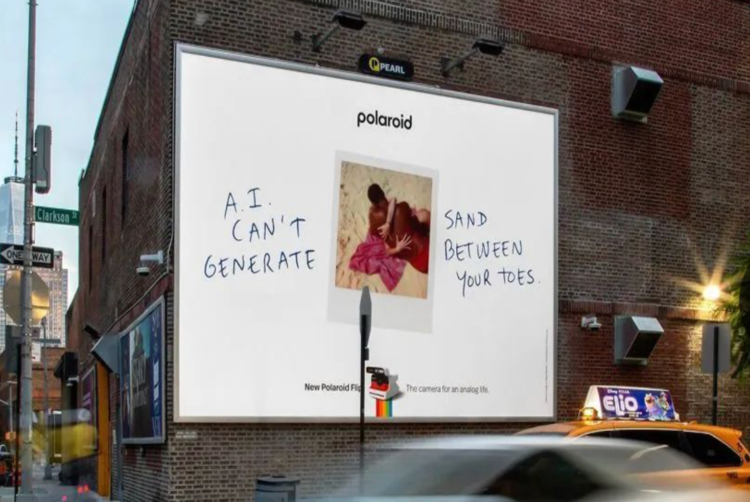
These campaigns work because they’re expensive signals only certain brands can afford. Notice who can’t pull this off: small and medium-sized businesses on compressed margins, or anyone for whom platform tools are becoming mandatory.
Managing the complicationship: Three rules
1. Know what your consumers think has soul
Soul is one of those infuriating concepts that makes analytics uncomfortable, which is exactly why it matters. You can’t A/B test for it or optimise for it. But consumers know when it’s missing.
The question isn’t “does this require human skill” but rather “will consumers feel betrayed when they find out a machine did this?” Fashion models have a soul for consumers. Stock photo backgrounds don’t. A child’s letter has soul. Media planning doesn’t.
Here’s the annoying part – it’s different for every category, and you have to guess. Think of it like relationship boundaries. Some things feel like betrayal, others don’t. You won’t know all of them until you cross one.
2. Let AI be your affair, use the gains to romance your actual relationship
If the platforms deliver what they promise – time and budget savings – don’t just let finance reclaim those gains. Use them to fund the weird, signature stuff that makes your brand yours.
Let Amazon handle product testing. Spend the savings on that experimental hero campaign. When everyone uses the same AI tools to generate the same aesthetic, your only moat is distinctiveness.
This is relationship advice applied to brand management – AI handles mundane logistics, but you still show up for moments that matter.
3. Don’t reject your AI partner unless you can afford to be single
The anti-AI stance only works if you’re rich enough to mean it. Heineken and Polaroid can afford it because their brand DNA already points toward “real” anyway.
For most brands on compressed margins, where platform tools are becoming mandatory, this positioning is an expensive fantasy. Better to stay quiet, use tools where they solve problems, and maintain distinctiveness through what you do with efficiency gains.
The failure mode isn’t using AI – everyone is. The failure mode is letting it make you forgettable while chasing optimisation metrics that hollow out brand equity. You’re staying in a complicated relationship because leaving would be economically devastating. Just don’t pretend you’re there by choice, and don’t let the relationship consume everything that made you interesting.
Set your own boundaries
The relationship isn’t resolving itself. Brands need AI economically, consumers reject it emotionally while using it constantly, and platforms profit from every angle.
The brands that survive won’t solve this paradox because it’s not solvable. They’ll stay conscious while navigating it. They’ll know what they’re displacing and whether the backlash is worth efficiency gains. They’ll use AI where soul isn’t perceived and keep humans where it is.
In any complicated relationship, someone sets the boundaries eventually. Either you do it deliberately with open eyes, or the platforms do it for you by default.
 Alex Turtschan is innovation director at Mediaplus Group (part of Serviceplan Group)