



Has Keir Starmer just done a ‘reverse ferret’?
Opinion
These days, 24-hours is a very long time in politics. How the British Prime Minister went from being ‘toast’ to pulling it back from the brink, as charted by the press.
Among many much more serious issues, the notorious former Sun editor Kelvin MacKenzie will be forever remembered as the creator of the “reverse ferret” concept.
For those not born at that time, when MacKenzie wanted to turn over a politician, he would order his team of journalists to “stick a ferret up his trousers.”
Then overnight, perhaps on the command of Rupert Murdoch, the politician was suddenly a good guy after all, and the cry went out, “reverse ferret.”
In the past few days, we have seen a modern variant of the theme in the shape of Sir Keir Starmer.
The Prime Minister faced multiple attacks by ferrets for his serious misjudgements in believing the blandishments of Lord Mandelson and pushing ahead with appointing “the Prince of Darkness” as Washington ambassador, ignoring many warnings along the way.
And then, of course, there was the litany of policy U-turns.
Sir Keir was “toast” and the political equivalent of a dead man walking.
A BBC political journalist described the Prime Minister’s position as “very, very, very, very perilous.”
Princes of Darkness
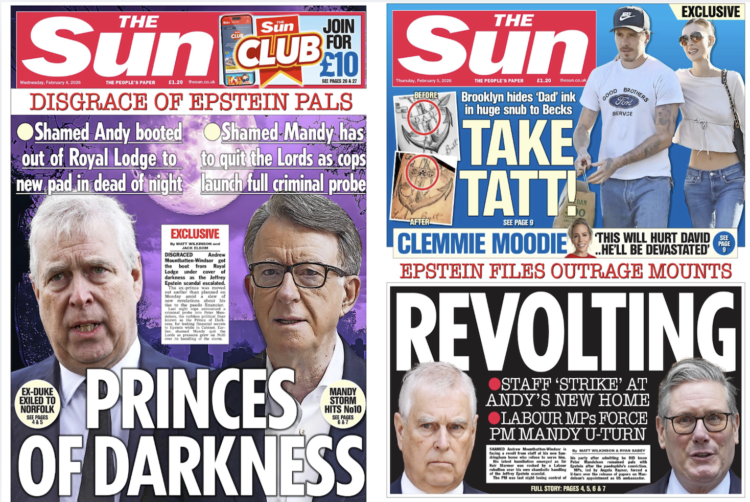
The Sun took heart from being able to link two scandals on the same front page by combining Sir Keir’s problems not just with the finally, terminally disgraced Mandelson but with the travails of Andrew Mountbatten-Windsor.
Last week, the paper’s subs came up with the winning headline: Princes of Darkness over pictures of Andy and Mandy.
Even better from The Sun‘s point of view was to picture both the former Prince and what many believed would soon be the former Prime Minister under the headline Revolting.
It was a bit of an artificial squeeze – some of Andrew’s servants were “revolting” by allegedly refusing to serve him, while Sir Keir was getting the “revolting” treatment by apparently losing control of his MPs after admitting that he did know Mandelson had kept in touch with Epstein after his conviction.
By Thursday, the Daily Mail was describing Sir Keir as being in “grave peril”, and its sketch writer Quentin Letts had clearly enjoyed Prime Minister’s questions.
“Punctured perhaps beyond repair, Sir Keir deflated before our eyes. Kemi kept bayonetting him. From Labour MPs, a cold, sinister silence,” Letts wrote.
Who would put much money on Sir Keir surviving the night, never mind all the way to the May local elections?
By Monday, the paper was sounding impatient, almost petulant, asking: “So How Long Can Starmer Cling On?”
At the same time, it commented that the Prime Minister had lost his last line of defence with the departure of his chief of staff, Morgan McSweeney.
It was “like a loyal officer on a stricken ship” walking the plank to save his captain from a mutinous and bloodthirsty crew, the paper commented
On Sunday, in the unlikely event that Sir Keir had time to read the Sunday papers, he could have the pleasure of reading his political obituary and a comprehensive catalogue of his political misjudgements and political failings – most of which are undoubtedly true.
Out for the count?
The Sunday Times did a particularly thorough job with Jason Cowley accusing Sir Keir of habitually outsourcing politics, strategy and policy to others.
“The result is a government that has no mission, command or sense of direction,” argued Cowley, who believes that Sir Keir sees himself as a King Lear figure – more sinned against than sinning.
The paper’s political editor, Caroline Wheeler, described in detail how the Prime Minister had tried to win over some of his MPs at Chequers with chilli, red wine and a pep talk. But many of them, she argued, had already counted him out.
The Sunday Times was a little more generous in terms of timing than most and concluded that Sir Keir, if he wanted to hold onto the office he enjoys, “now has a matter of weeks” to chart a new course and communicate to a jaundiced public “precisely what the point of this government is”.
Very few in the media were giving Sir Keir anything like that much time and were now counting his time in hours or days at the most.
Once upon a time, one of Sir Keir’s Labour predecessors, Harold Wilson, caused controversy and accusations of cynicism when the comment that “a week was a long time in politics” was attributed to him.
Things have changed significantly since 1964, and everything has accelerated relentlessly. Nowadays, a day is a very long time in politics.
For Sir Keir Starmer, Monday was that day – a day in which communications director Tim Allan followed McSweeney out the door, with Cabinet Secretary Sir Chris Wormald likely to follow.
Next up, the Scottish Labour leader Anas Sarwar calls on Starmer, his former ally, to resign for the good of the country after “too many mistakes” in Downing Street.
Reverse ferret time
Was it a cue for a widespread rebellion? Unlikely because Sarwar told Downing Street what he was about to do in advance, allowing Starmer, according to The Times, time to co-ordinate a series of supportive messages from the entire Cabinet.
According to the Daily Mail, they were all bounced into it.
Then, after less than 12 hours of action and drama, the Prime Minister was able to persuade a meeting of his MPs to continue to support him.
Serious reverse ferret time. Sir Keir is not going to resign after all, nor is he going to be defenestrated by his MPs – at least for now.
Helpfully, The Times yesterday provided a detailed guide to the new political reality by setting out four ways Sir Keir could leave Downing Street.
The first is that he resigns. Unlikely because he is planning a fightback.
The second, according to The Times, is that the Cabinet moves against him. Possible, but haven’t they just universally endorsed him, however reluctantly?
The third “real moment of jeopardy” is the Gorton and Denton by-election on 26 February, particularly if Labour comes third behind Reform UK and the Greens. Only heavy tactical voting will give Labour any chance, and the will might be missing.
The biggest threat would be a wipeout in the May local elections, and in the meantime, there would be plenty of time for the plotters to plot.
But remember, the odds against Leicester winning the Premier League were once 5000-1 and much further back- all the way to 1897, Mark Twain returned to America from a trip to London to find that in his absence, the papers had published his obituary.
As he replied: “The record of my death was an exaggeration”- not as widely misquoted “greatly exaggerated.”
Will Sir Keir Starmer be so lucky?
 Raymond Snoddy is a media consultant, national newspaper columnist and former presenter of NewsWatch on BBC News. He writes for The Media Leader on Wednesdays — bookmark his column here.