



How to solve the crisis in advertising: Start at the beginning
Opinion
Nick Manning explains the proposed changes to the advertiser business model in the first of a series following the ‘Advertising: Who Cares?’ conference.
The ‘Advertising: Who Cares?’ summit last Thursday was a gargantuan effort by generous people who were working for free.
It took eight months, 70 volunteers, 35 presenters, eight hours and 200 attendees.
It was made possible by benefactors such as Digital Cinema Media, ITV, and Ocean Outdoor.
It proposed ideas and solutions for the crisis in advertising. Believe me, it’s not too soon to be using the ‘c’ word.
Contrary to popular belief, this doesn’t refer to a crisis in the advertising industry. That’s a bi-product. The problem is advertising itself.
Advertising should play a key role in commerce, causes and society, informing, educating and entertaining the public, while funding the content we all get for free.
It is declining in every respect. It is no longer as effective as it was, it engages the public less and the media eco-system is being undermined by the stampede of money to user-generated content platforms.
There is plenty of data to support these assertions in case anyone is in denial, and the summit aimed to move on from a reiteration of the problems. However, the reasons for all of this need to be restated, as the penny still doesn’t seem to have dropped.
The advertising doom loop
We are stuck in a doom loop of excessive supply and an over-emphasis on short-term results, as if the purpose of advertising were only to sell something today. For many advertisers, especially SMEs, that is true and relevant but for many brands, it is only one potential benefit of advertising.
The other factor in the advertising doom loop is the massive trend towards addressing audiences one person at a time. I’ve written about this a lot, but it still seems to be an intractable issue in a world where the big platforms hold all the cards and receive the majority of ad revenue.
Many advertisers are not achieving the full effect of their advertising by focussing on the wrong targets, often in isolation of other upper-order objectives, and force-feeding the public like foie gras geese., one goose at a time.
Advertisers are under enormous daily pressure to deliver results today because there may not be a tomorrow, but in chasing daily results in one-to-one media they are wasting enormous sums of both advertising and ad tech money.
Proposed solutions
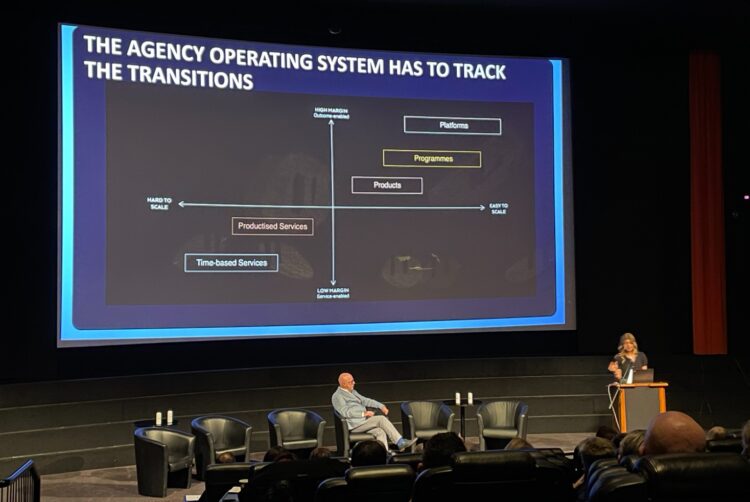
The solution that was proposed last Thursday is to change the advertiser business model. Not necessarily their economics, but their organisation, operations, culture and ways of working.
Without this, many of the improvements sought by our eight other workstreams are either not possible or are nullified.
Marketing and advertising should involve an integrated approach to team structures where each of the disciplines that contributes to success is part of a ‘whole body’ process that takes into account the various elements, including price, product, promotions and so on, with a single objective: net incremental profit (in the case of branded goods or services).
With this single objective and a unified way of measurement that guides decision-making, everyone is focussed on one goal , and this can be linked to the value of the business. This is the way to the CEO/CFO heart.
This can all be achieved with the help of agencies and outside parties who are strategically and creatively brilliant in how communication works today, and have the talent and technology to execute against the task of net profit uplift, measured against the unified data framework (which we designed in the build-up process).
Agencies can reinvent themselves if they change their own business models, organisation, operations, culture and language, while developing new products and services on a split-risk basis.
They also have to act with ‘full fat’ transparency, not just in media, and be prepared to share in the results generated, measured through the unified framework.
The other element in the equation that came through loud and clear last Thursday was the bifurcation of the advertising industry between the established advertisers who believe in high creative, production and media standards and the fat long tail of advertisers, many of whom are doing it for themselves.
The advertising industry can’t solve the problems of excessive poor advertising coming from advertisers who don’t use agencies, but their clients are all competing in the same market, so standing out from the dross is critically important.
In part two next week, I will address the dominance of the platforms and the effect this has had on the advertising industry. It created quite a lot of heat last Thursday, and let’s hope it carries on doing so.
‘We are in a crisis’: Advertising: Who Cares? suggests media business models must change
 Nick Manning is the co-founder of Manning Gottlieb Media (now MG OMD) and was chief strategy officer at Ebiquity for over a decade. He now owns a mentoring business, Encyclomedia, offering strategic advice to companies in the media and advertising industry, and is non-executive chair of Media Marketing Compliance. He writes for The Media Leader each month.