



Lisa Nandy, are you sure you’ve thought this through?
Opinion
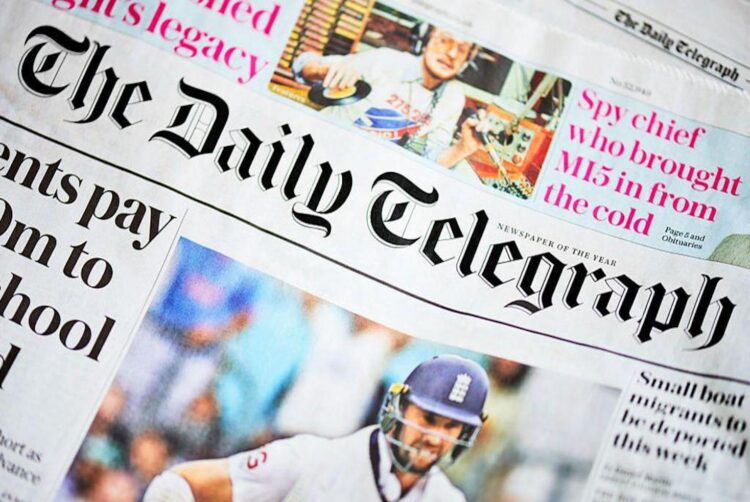
According to the Daily Mail, culture secretary Lisa Nandy is paving the way for a ‘timely’ sale of The Daily Telegraph to DMGT. Not so fast, says Ray Snoddy. Is this really a good idea?
By any standards, the £500m bid by Daily Mail owner DMGT for The Telegraph is a bold and unexpected manoeuvre.
It is bold in financial terms because £500m is the asking price, and other potential bidders kicked the tyres and walked away, with some analysts suggesting the current value is closer to £300m-£350m.
It could be worth more to DMGT than to a non-newspaper owner because of potential savings that might be squeezed out of the combined operation.
Yet, it is still surprising, given that last year DMGT seemed wary of a bid as part of a consortium because of the regulatory hurdles it may face due to industry consolidation.
Despite the Daily Mail, The Daily Telegraph, and their Sunday equivalents being the most rabid and relentless tormentors of the Labour Government of Sir Keir Starmer, have they been given the nod by culture secretary Lisa Nandy?
It might appear so given yesterday’s coverage of a statement by Nandy in the Daily Mail.
The headline read: “Culture Secretary looks to end Telegraph ‘limbo’ with ‘timely’ sale to DMGT,” making it look like a slam dunk.
However, the headline writers may have erred a tad on the optimistic side in their employers’ favour.
Nandy did not say quite that, though she did suggest the present situation was “unsustainable”ed for nearly two years of uncertainty and that the ne be brought to an end.
The culture secretary asked that a request for permission to buy be submitted to her within the next three weeks.
Then, of course, there are processes to follow in what would be a major consolidation of the national newspaper industry.
The bid could also yet be formally investigated by the Competition and Markets Authority, a process that could easily take up to a year.
DMGT can make a strong case for approval. Despite its distinctive politics, the Daily Mail has been in the Harmsworth family since 1896, 41 years after The Daily Telegraph began publication.
In that sense, we are talking about qualified owners and newspaper respectability here.
If The Daily Telegraph were loss-making and needed saving from immediate extinction, then there would be no regulatory argument. DMGT would be encouraged to buy to save a historic title and those who work for the business.
But it’s a little more complex than that. The Daily and Sunday Telegraph made operating profits of around £65m last year and could stand alone, but for the fact that the business was loaded with debt by previous owners.
DMGT, whose newspaper stable includes Metro, The i newspaper, and New Scientist magazine, has promised that the paper will maintain its editorial independence under the current editor, Chris Evans.
The promised plan to invest in The Daily Telegraph to fund an accelerating expansion into the US is strong and has been highlighted by other potential bidders in the past.
DMGT also has a strong argument when it points out how much the newspaper market has changed in recent years.
“Today’s media landscape is unrecognisable from a decade ago. Newspaper publishers have to compete against both vast global online platforms and myriad digital and social media news sources, some of them highly unreliable,” DMGT argues.
Lord Rothermere, DMGT chairman, added: “The role of trusted news media has never been more important and requires news publishers with scale and experience to compete.”
Yes indeed – up to a point.
The slight problem is that established newspapers sometimes try to have it both ways. When it suits them to cry poverty, they emphasise how far their paper sales have fallen, which is, of course, absolutely true.
On other occasions, they emphasise their international digital reach and claim, with equal veracity, that the overall reach of newspapers through print, digital and mobile has never been greater.
Interestingly, the main DMGT arguments for the need for scale and expertise to compete globally could apply almost equally to Rupert Murdoch’s News Corp.
If there were any hint that DMGT was going to get an easy regulatory passage, it is not inconceivable that the Murdoch family, never knowingly underbid, might pitch up, even at this late stage, to try to disrupt the exclusive negotiations agreement.
Difficult to prove in any absolute sense, but it looks as if in recent years, The Daily Telegraph, once a stickler for accuracy and impartiality in its news columns, has become more and more like a broadsheet version of the Daily Mail.
They both supported Brexit with unbridled faith – a process that independent experts believe has not just diminished the UK on the world stage, but also cost the country between six and eight per cent of overall production, not to mention putting additional pressure on today’s budget from Chancellor Rachael Reeves.
And both supported, uncritically, one Conservative Prime Minister after another, some of them among the worst the country has ever had.
All sense of balance and fairness seems missing when reporting the admittedly chaotic affairs of the Labour Government. However, The Daily Telegraph may be marginally less toxic in this regard than the Daily Mail.
Moreover, neither holds back in their enthusiasm for routine attacks on the BBC and its licence fee, the funding mechanism which preserves its role as a national public service broadcaster.
What, you might ask, does it matter if one paper hostile to the principles of social democracy can buy up another with very similar views?
Except that there has long been a political imbalance in the outlook of national newspapers in favour of multi-billionaire, usually offshore, press barons whose main interests seem to involve holding onto as much of their traditional power as they can while paying as little tax as legally possible.
We should be wary of anything that consolidates or even increases that power and influence, as a merger of the Daily Mail and The Daily Telegraph inevitably would.
For that reason, the culture secretary should not allow herself to be pushed into an overnight decision, and any deal should be carefully examined by the CMA to see whether it is really in the wider public interest.
 Raymond Snoddy is a media consultant, national newspaper columnist and former presenter of NewsWatch on BBC News. He writes for The Media Leader on Wednesdays — bookmark his column here.