



‘OOH is enjoying a real moment’: Check out 2025’s impactful new formats
From high-impact 3D builds and immersive transit environments to hyper-local digital screens and programmatic activations, OOH advertising is innovating exponentially.
OOH is becoming more dynamic through digitisation, making formats more diverse and reactive, offering more opportunity for advertisers to reach different kinds of audiences.
The Media Leader rounds up of some of the standout new formats and executions this year, showcasing how the industry is redefining the medium.
Roadside: A digital revolution
Media owners have been making waves in roadside OOH, from smart street furniture to full-network roadblocks, as the format becomes increasingly digital-focused and high-impact.
JCDecaux is doubling the number of digital panels in its London Digital Network, installing 1,000 digital roadside bus shelter screens across the city, with 500 of these having already gone live in 2025.
These screens are 30% larger than the market average, consume 20% less power and feature new creative and motion capabilities alongside a new Video Advertising Motion Measurement scale.
It reflects JCDecaux’s commitment to making OOH the “big-reach medium”.
The Oxford Street site and Holland Park Tower have both received upgrades, with the latter reportrdly delivering over 403,000 weekly viewed impressions.
Additionally, JCDecaux boosted its Drive network of large-format digital screens by launching in Glasgow in January — a first for the media owner in Scotland.
JCDecaux has also signed a 15-year contract for bus shelters and free-standing digital advertising in Nottingham. This will see “smart city” technology added to bus shelters, including free public Wi-Fi and air-monitoring technology.
Notably, in a sustainability-led move, JCDecaux is refurbishing these shelters as opposed to replacing them.
Global is also scaling up its roadside offering through its partnership with BT. They are rolling out digital street hubs in more than 200 towns and cities in a bid to provide better connectivity and hyper-local advertising.
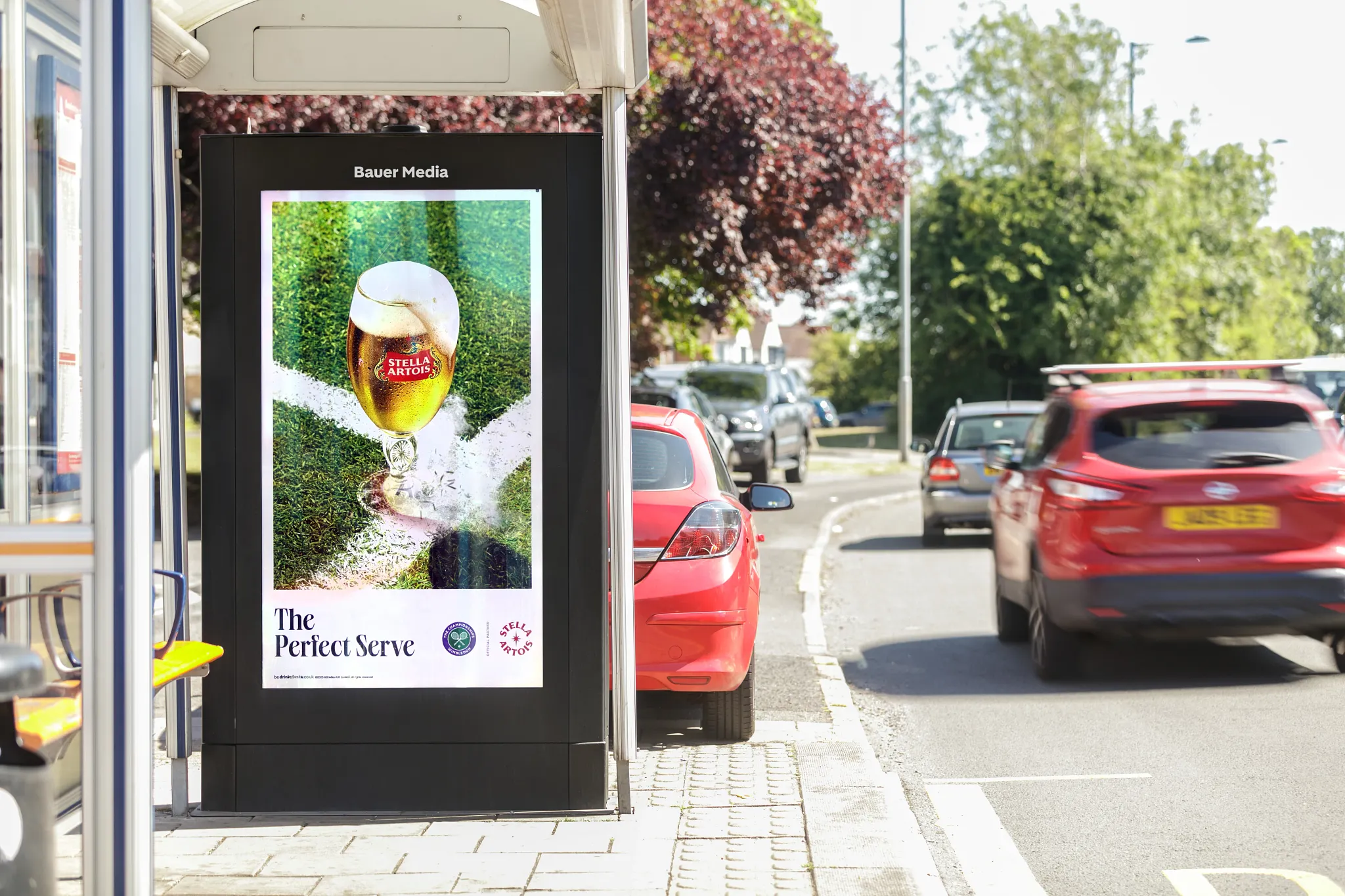
Meanwhile, Bauer Media Outdoor introduced its digital roadside offering, Roadblock, in July. It is a national-scale digital takeover that enables brands to dominate thousands of Adshel Live D6 screens simultaneously for an hour.
“This is about national representation of audiences,” said client partnership director Aimee McKay. “You’ve got no interruption of other brands within your loop, so you can really tell a story and in a more emotive way.”
UK sales director Mark Smith added: “We urge planners to think beyond the London bubble — there’s 85% of the UK population who live beyond the M25.”
Travel: OOH as an experience
Transport environments have become a playground for immersive OOH advertising, with various formats seeking to transform the daily commute.
As part of its eight-year contract with Transport for London (TfL) announced in September 2024, Global is carrying out a major digital overhaul of the London Underground.
This includes installing 1,000 new D6s and 150 3D-enabled D12s across all nine zones of the capital, as well as nine new digital gateways and five new sets of digital escalator panels.
Notably, Global is also introducing brand new digital tunnel wraps for the Elizabeth line — a format that has been described as a “world-first”. Four 10-metre LED screens matching the curve of a tunnel will immerse commuters in full-motion campaigns.
At Waterloo station, Global is developing a 160-metre multisensory travelator experience, featuring four pairs of connected digital screens to create a 4D canvas, combining sound, 3D visuals, scent and motion.
Global’s entire upgrade seeks to be underpinned by sustainability, utilising solar-powered screen assembly and carbon-neutral materials, along with modular screens that can be easily repaired.
Chris Forrester, managing director of commercial outdoor at Global, noted: “Using data in clever ways to make campaigns relevant in real time is becoming more advanced and growing in popularity.”
Global’s Naked smoothies campaign, which was triggered by passing trains on the Elizabeth line, reflects this.
JCDecaux has also enhanced its rail offering through branded immersion zones, which feature full corridor takeovers at St Pancras International.
These full-corridor takeovers have been used by brands such as Marriott, Bonvoy, E.ON and Nuii.
JCDecaux is also expanding its digital screen inventory as part of a contract with Northern Trains, bringing more digital opportunity to stations outside the capital.
3D and interactive: OOH you can’t miss
This year has seen some of OOH’s most creative moments, with interactive formats showcasing the medium’s strengths.
At Piccadilly Lights, Ocean Outdoor collaborated with Sky Creative to deliver a 3D “moving patchwork” on a deep screen, delivering a spectacle pedestrians could not miss. Another example of innovative interactive formats is Ocean and Universal Pictures’ M3gan 2.0 pop-up at Westfield featuring AI-powered animations triggered by passers-by.
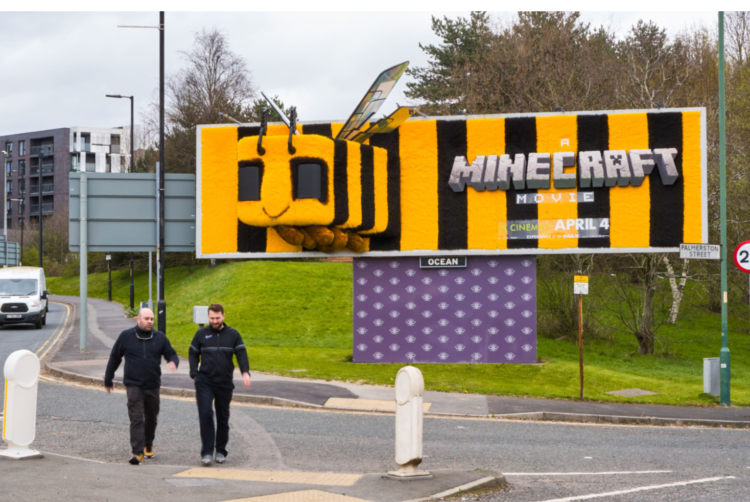
In Manchester, Ocean’s Minecraft special build used a giant pixelated bee to tap into local identity — an example of how context and location can elevate an activation.
Nick Shaw, Ocean’s chief commercial officer UK, added: “You can’t beat a special build and clever planning always delivers the goods.”
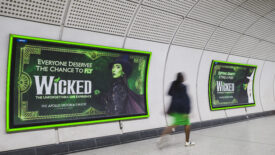
Global also launched a custom-lit poster, for a Wicked campaign on the Elizabeth line, it utilised a creative solution with green-halos around the posters.
Programmatic takes centre stage
Programmatic digital OOH (PrOOH) is leading the charge in bringing flexibility, relevance and speed to the medium.
JCDecaux hit 1bn programmatic impressions in H1, with brands realising OOH’s value in timely activations around big events such as the England Women’s Euro campaign and how it can align with wider campaigns.
Agencies also seem to have noted the value PrOOH can offer in enabling brands to match message to moment.
As Shanil Chande, Talon’s chief programmatic officer, noted: “Brands want to react quickly, keep up and embed themselves in cultural moments.”
Chande cited Specsavers’ real-time Euro win messaging, Allevia’s pollen-triggered creative and Kenco’s commuter-targeted messaging in highlighting PrOOH’s ability to allow brands to take advantage of the moment.
“It offers the ability to react, not just to culture but to things like changes in weather,” he added. “It’s like having the responsiveness of digital advertising and the reach of TV, but out in the real world, on the streets, in stations, near stores — where people are living their lives.”
Separately, Chande also expected the incoming less healthy food advertising restrictions to make OOH more vital to advertisers.
The legislation officially comes into effect in January but, as previously reported by The Media Leader, the industry has committed to comply with the restrictions from 1 October.
LHF ad ban delayed to 2026 as government commits to explicitly exempt brand activity
OOH’s lasting impact
For brands, OOH poses an opportunity to create a lasting impression and build emotional connection.
“OOH is enjoying a real moment right now,” according to Remar Nelson-Wilson, creative media manager at Radical + Disruptive Lab at Mediahub.
He described the medium as “a collective experience received individually”, highlighting formats such as drone shows and large-scale projections, as well as community activations including Pinterest’s Women’s Euro watch party.
“More than ever, clients are asking for campaigns that go beyond a quick flash of attention,” Nelson-Wilson added. “They see OOH as a medium that can carry real stories, build connections and leave an impression that lasts long after the moment itself.”
Looking ahead
Media owners are investing heavily in both infrastructure and creativity in OOH, with more tools at their disposal than ever.
Tim Lumb, director of OOH trade body Outsmart, underlined the unmatched reach the medium can offer: “Media consumption is fragmented across devices and platforms, and OOH is the only way to reach everyone at once.”
He stressed: “97% of the UK population see OOH every week and that scale is important when combined with great creativity.”