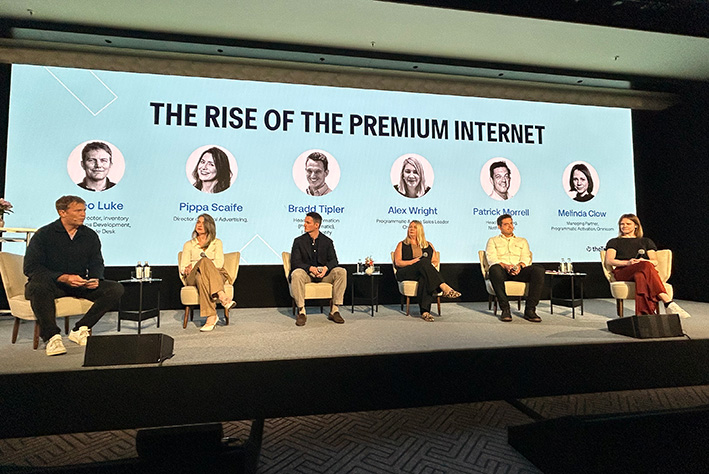
Premium media must do a “better job” to highlight how it shares many of social platforms’ benefits while offering a superior environment for advertisers.
That was the key talking point during a panel discussion at The Trade Desk’s Rise of the Premium Internet event last week.
Earlier in the event, The Trade Desk had presented research showing the advantages of advertising in premium environments.
Ads in premium media drive higher purchase intent and positive association
During the session, TV was repeatedly highlighted as a premium environment.
Responding to the inevitable comparison with YouTube, which continues to gain popularity, Pippa Scaife, Sky’s director of digital advertising, pointed to YouTube’s different guidelines to TV, with “no editorial vigour or regulatory oversight”.
“It’s not a TV channel,” she stated. “It’s a tech platform that allows us to view content across 110m channels.
“YouTube doesn’t differentiate what you’re watching — whether it’s the Premier League or someone literally watching paint dry.”
Channel 4 takes a different approach, making full episodes available on the Google platform. Alex Wright, its programmatic and data sales leader, conceded that “younger audiences do gravitate towards YouTube”.
However, she stressed that if brands want to advertise against only premium Channel 4 content on the platform, they have to work directly with the broadcaster instead of via YouTube.
ITV and C4 happy to let viewers watch long-form content on YouTube
Simplifying the sell
As Scaife observed: “Marketers want to know how to spend less with Google and Meta, but continue to spend lots with them.”
The key is for premium media to do a “better job” of promoting its scale and performance, much like social platforms, but also highlight that it’s a premium environment.
For TV, that means both simplifying the proposition (by not confusing advertisers with SVOD, AVOD and so on but just “TV”) and making it easier to buy, according to Patrick Morrell, UK head of trading at Netflix.
“We ask why money is going into social. TV is complicated to buy,” he admitted.
This argument applies to premium media more generally.
Highlighting the “brain rot” and “doomscrolling” of social media, Bradd Tipler, head of automation (programmatic), EMEA, at Spotify, urged advertisers to think about the environment they appear in.
Indeed, Melinda Clow, managing partner, programmatic activation, at Omnicom, called on brands to look at IPA effectiveness papers to better understand this relationship.
She added: “It’s about where brands are showing up. That affects how consumers think about your brand.”
The panel was moderated by Theo Luke, senior director, inventory partnerships development, at The Trade Desk.
No-one knows whether YouTube is TV or social — not even YouTube