



Advertisers keen to equip themselves as AI continues to evolve search
The Future of Media London 2025
“Eventually everything will become an ad network, but we’re not there yet.”
This was the key message from Will Akhurst, chief digital strategy officer from Brainlabs, speaking at today’s The Future of Media London, held at Kings Place in King’s Cross.
Along with his colleague, Andy Goodwin, managing director of paid search, the pair highlighted how the introduction of new platforms, such as social search, has created more touchpoints, reshaping search and the ways advertisers connect with consumers.
They underlined that, despite only a small number of AI platforms currently including advertising as part of their business model, Google’s interest in introducing ads within its AI mode and in AI Overview, is set to redefine search. This is likely to happen before the end of the year in the UK and is already being explored in the US.
What does search look like today?
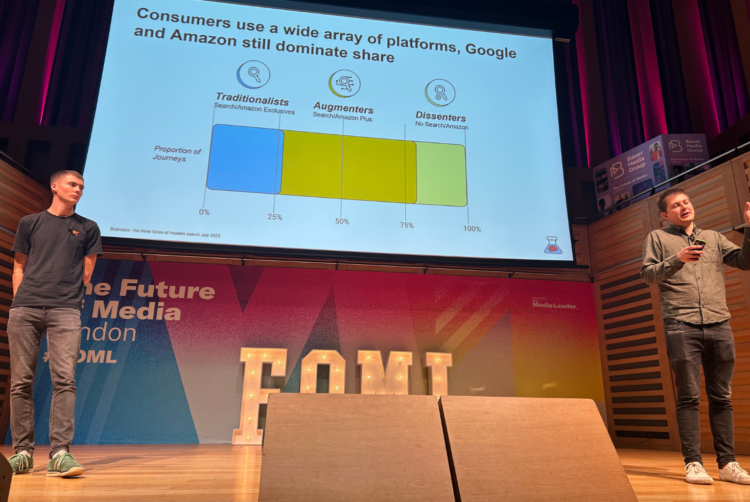
During the session, Brainlabs introduced the results of a survey of 2,000 people in the US and 1,000 in the UK, which found that three types of people do searches.
Akhurst said: “The research is not based on the technology that they’re using but on habit, because it’s the habit that will win in the end.”
There are the traditionalists, who use search and Amazon exclusively. This group hold a 25% platform share.
Then there is the augmented group, which sees consumers adding in “new age” platforms such as social search on YouTube and even platforms like ChatGPT.
Finally, there are the dissenters, who are solely interested in searching on social and AI platforms and no longer use traditional search engines.
Notably, 80% of purchase journeys still include traditional search. In the UK, the use of platforms like ChatGPT, remains small, with a 1.8% platform share, showcasing low but fast growth.
Akhurst echoed this, stating: “Search is changing but not as quickly as the narrative is suggesting.”
The session made clear that consumers are not using many different platforms in their purchasing decisions, but instead are choosing a few platforms for different purchases.
However, the trend does seem to be toward AI platforms, and at the centre of this is the discussion around how advertisers can be involved.
What does advertising and AI look like?
Currently, only Microsoft’s Copilot offers a space for advertisers to buy ads on an AI answer engine.
Several players have publicly said they do not have any desire to introduce advertising into their business models, these include ChatGPT, Gemini and Claude.
However, in the pipeline for ads are Perplexity, Grok and Google.
Goodwin underlined the significance of this move from Google, which would see ads coming to AI overviews and AI mode.
“Google has suggested this could happen before the end of the year,” added Goodwin.
This would have an impact on Google’s revenue and bring new opportunities for brands wanting to advertise on their platform.
Akhurst speculated that buying ads would be the same process as purchasing search inventory and that ads would be served on “shorter dual type queries.”
Akhurst said: “When ads do come to the AI overview space, Google will be able to trigger an ad not just based on creative search but also if the content generated within the AI response is relevant to what an advertiser might offer then they will be able to bring them in.”
How to appear in AI search
The session highlighted certain steps to ensure a brand appears in AI search.
These included content optimisation and formatting in a way so that key takeaways and snippets are clear for the AI to pick up on.
Multi-modal content and building authority through third-party sites were also underlined.
The future of search
Slowly AI is becoming the precedent, and Akhurst pointed to the commercial driver behind its adoption.
“Google is being pushed into doing it right now, and they have to show leadership in this space; otherwise, the stock market price drops,” he added.
Greater personalisation was also highlighted as an advantage of AI, and Brainlab underlined how, in five years’ time, queries will become tasks and an AI agent will undertake this research and even make purchases.
Answers will become more personalised and websites may become grounded AI agents, where consumers’ personalised agents will interact with the brand’s website agents to gather the information it needs.
Google has been approached for comment.