



The two faces of The Daily Telegraph
Opinion
The Daily Telegraph may have broken the story that has plunged the BBC into crisis, but the newspaper group is facing a crisis of its own, as Ray Snoddy explains.
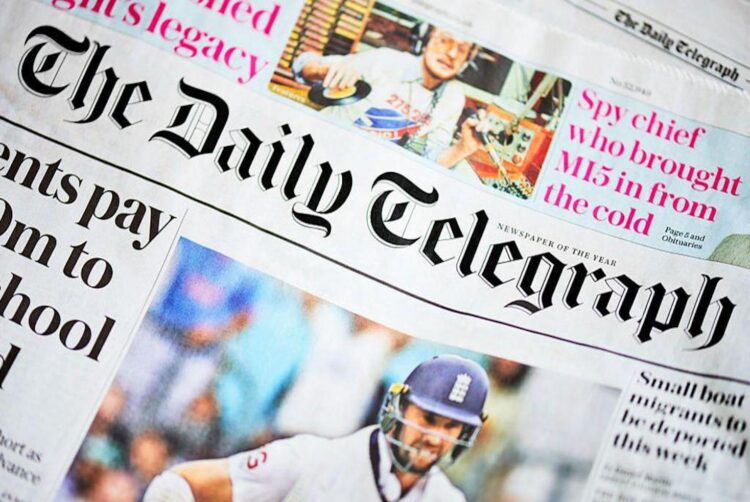
There are two quite distinct The Daily Telegraphs at the moment.
One is in full cry, leading the charge against one of its traditional targets – the woke, allegedly left-leaning BBC and its dreadful licence fee.
As you would expect, neither the Daily Mail nor the Mail on Sunday are exactly holding back on the glorious opportunities to put the boot in to the Corporation.
But it is The Daily Telegraph that has been the trailblazer with contentious leaked memos from inside the BBC setting out, not just details about the splicing of Trump quotes in an edition of Panorama, but also claims of bias in the Corporation’s Arab service and attitudes towards LGBTQ coverage.
The impact of The Daily Telegraph’s coverage, accompanied by bucketloads of anti-BBC stories, led directly to the resignation of director-general Tim Davies and news chief executive Deborah Turness.
Then there is President Donald Trump looking for up to $5bn in compensation, even though he would, at the very least, find such a legal action challenging.
With the matter still unresolved, it is impossible to say for sure that the Trump lawsuit will not bring down an iconic 103-year-old British institution.
The depth of the row has released all the old forces that want to defund the BBC by removing its licence fee.
End the licence fee and you essentially kill the BBC in its present form – as a universal broadcaster serving the entire population and paid for by the entire population.
In such an eventuality, only impoverished remnants would survive. It is indeed an existential crisis for the BBC.
As news stories go, it isn’t easy to think of another which has had such a massive and continuing impact.
The only one that has come close – but not that close- came also from The Daily Telegraph in the form of the MPs’ expenses scandal.
Even those who do not want the destruction of either the BBC or its licence fee, and despite a degree of imbalance in the Michael Prescott memo that sparked proceedings, The Daily Telegraph deserves recognition for its great scoop.
The other Daily Telegraph
Telegraph journalists should not, however, spend too much time on the Champagne. This is not a time for hubris.
Because there is another Daily Telegraph, a business that is on its knees and facing an existential crisis of its own because of poor ownership, and several questionable would-be owners.
The hammer blow for The Daily Telegraph came last Friday when Redbird Capital Partners pulled out of its £500m bid for The Daily and Sunday Telegraph.
Most outsiders thought the deal was about to go through after the national newspapers had effectively been without owners for more than two years.
It seems that the private equity group may have been put off by opposition from senior Telegraph journalists, regulatory fears and, perhaps, a growing feeling that the £500m asking price is simply too high.
Respected independent media analyst Alex DeGroote says the Telegraph, despite making an operating profit of £56.4m last year, “is clearly not worth £500m.”
Most rival bids were believed to have been in the £300m to £350m range.
Further delay and uncertainty are the last things The Daily Telegraph needs because it is suffering from a peculiarly cruel form of financial death.
The definition of a declining asset
As is well known, most of the revenues of national newspapers, particularly broadsheet ones, come from their paper sales and in most cases, digital revenues barely get close.
The circulation of The Daily and Sunday Telegraph is unknown because it does not release sales figures.
In December 2019, the official Daily Telegraph circulation was 317,817, while the Sunday circulation was 288,288.
Press Gazette has estimated that if the Telegraph titles had fallen in line with the rest of the industry since then, by last month, The Daily Telegraph would be selling around 150,000, with the Sunday on 100,000.
Anybody bidding now for The Daily Telegraph should use the help of an actuary to work out the age and morbidity rates of remaining readers of the actual newspaper.
If ever there was a definition of a declining asset, it is The Daily and Sunday Telegraph, and that downward trajectory cannot be reversed until there are well-heeled owners who can put in place a new international digital strategy.
Such a strategy is possible. Before he left to become publisher and chief executive of the Washington Post, Sir Will Lewis was putting a consortium together with a plan for The Daily Telegraph to specialise increasingly on business, together with expansion into the US market.
It is difficult to imagine what will happen next, particularly since there have been suggestions that there is, in effect, “a poison pill” requiring new owners to make up the £500m price tag by taking on debt to compensate for a lower bid.
Somewhere along the line – and the clock really is ticking- there may have to be more realistic expectations.
There may now have to be a rather crude auction, with one sophistication, that accepted bidders may have to be “clean skins” with no obvious potential problems with regulators or governments.
That, unfortunately, could rule out many who have the desire and the money to proceed.
It would rule out anyone with links to China, Russia and probably also Middle Eastern money.
It would also rule out other large newspaper groups such as News Corp and the Daily Mail and General Trust.
There will now follow a period when remaining interested parties play a game of chicken, finding out how long they can risk sitting on their hands while an asset continues to waste.
There are at least three parties who have previously expressed interest and will be watching the developing situation closely for a fire sale to begin.
One will be GB News investor and owner of the Spectator, Sir Paul Marshall, and another could be Lord Saatchi and Lyn Forester de Rothschild, who previously made a £350m bid.
David Montgomery, who has time on his hands after the sale of National World, could be a dark horse, alongside Todd Boehly, who leads the consortium that owns Chelsea Football Club.
The irony now is that if Trump fails in his bid to make the BBC pay billions in compensation, it could be the BBC that emerges from its existential crisis first – well ahead of the distressed newspaper group whose reporting led to that crisis in the first place.
 Raymond Snoddy is a media consultant, national newspaper columnist and former presenter of NewsWatch on BBC News. He writes for The Media Leader on Wednesdays — bookmark his column here.