



What will the regulators rule in the tale of two newspapers?
Opinion
The deal to take over The Telegraph has been referred to the regulators to ensure sufficient plurality of views in news media and plurality of persons at the helm. Both interesting ideals, explains Ray Snoddy.
Culture secretary Lisa Nandy was right to refer the Daily Mail and General Trust’s £500m deal to take over The Daily Telegraph to the regulators – but possibly for the wrong reasons.
The Competition and Markets Authority will examine competition issues, while Ofcom will investigate the public interest implications.
In the public interest, Nandy emphasised the “need for a sufficient plurality of views in each UK market for news media” and, moreover, the need for a plurality of persons “controlling media enterprises serving every different UK audience.”
Plurality of views is an interesting concept when applied to the Daily Mail and The Telegraph.
Obviously, the Mail is a mid-market tabloid compared to the broadsheet, in every sense.
Although the Mail scores much more highly on the shrill and unashamedly biased index than The Telegraph, on major issues, it is difficult to tell them apart.
Both were for Brexit, a policy now almost universally judged to have greatly damaged both the UK economy and the country’s international reputation.
This is reflected in the latest poll showing 63% of Britons want to rejoin, a percentage that will only increase over time as old Brexiters, who are mainly already old, fade away and are replaced by cohorts of younger voters, much more in favour of rejoining than the average.
Both papers resolutely supported a succession of Conservative Prime Ministers, ranging from the decent but dull to the outrageously incompetent and the downright outrageous.
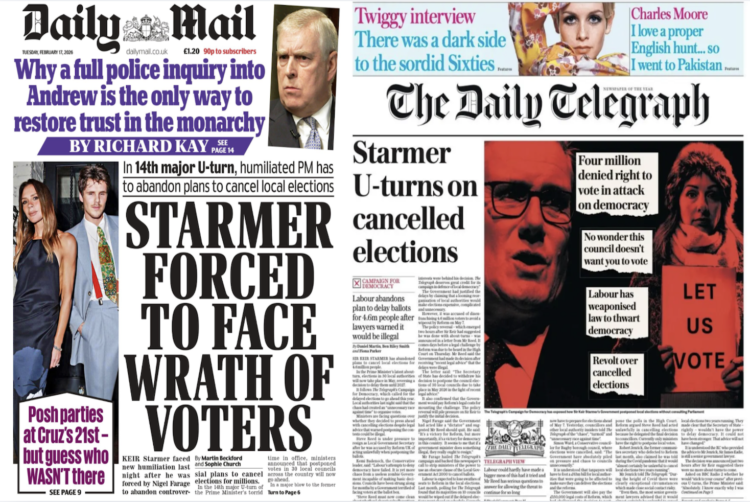
Mostly, the papers are separated by tone of voice rather than substance, a notion borne out by yesterday’s respective front pages on the story of the day, Prime Minister Sir Keir Starmer and the on-again May local elections.
For the Daily Mail, it was a case of: “Starmer Forced To Face Wrath of Voters” with the sub-plot of a “humiliated” PM forced into his 14th U-turn.
There was little sense in the coverage that local councils facing a major reorganisation had asked for the delay, or space for the fact that new elections within two years will cost an additional £63m.
The Telegraph, which campaigned against the delay even though Conservative governments had ordered similar delays in the past, was more factual and more restrained.
The paper’s line was simply that the Labour Government had abandoned its plan to delay ballots for 4.6m people after lawyers warned it could be illegal. Inside the paper, there was more triumphalism about how it “led the charge in the fight for democracy.”
Plurality of persons
As for a “plurality of persons”, it is difficult to see much difference between ownership by a single billionaire non-dom who does not pay UK taxes or two non-dom, tax-avoiding billionaires, which could in theory have been the case.
Perhaps the culture secretary was interested in pushing a politically hot potato down the road a bit, so she could be guided by the views of the CMA and Ofcom if tricky decisions arise in the summer.
While the likelihood is that, against the background of intense competition in the digital world, even though The Daily Telegraph is profitable on an operating basis, a deal will go through, with conditions.
There may, however, be a few potholes along the road.
Rivals will likely complain about increased market concentration and the additional commercial power it will confer.
And what if Prince Harry and his motley band were to win in the High Court in their bitter case alleging that DMGT used illegal methods to get stories?
The allegations are vigorously denied, but you never know with judges, and DMGT would suffer significant reputational damage if Prince Harry were to prevail.
Is there a chance that someone else would come forward if, for any reason, the Daily Mail deal were to unravel?
The price is high, and it is difficult to see how a stand-alone purchaser could make the numbers add up.
However, David Montgomery has in the past shown interest and has not the slightest interest in retiring. He just likes running and, if possible, owning newspapers.
Long-shot Lewis
There is another log shot because of recent events at the Washington Post.
Sir William Lewis had been trying to put together a consortium to buy The Daily Telegraph when he unexpectedly popped up as publisher and chief executive of the Jeff Bezos-owned Washington Post.
Lewis presided over, presumably, the Bezos-inspired plan to sack 300 journalists at the Post, including most of the paper’s foreign correspondents.
Observers noted that the evisceration of one of America’s great newspapers contrasted with his willingness to pay $70m to make and market the film Melania, by most accounts one of the worst movies ever made.
Sir Lewis rapidly followed the 300 out the door. He said he had decided it was time to move on, but the Post‘s journalists’ guild saw no such intention days earlier and stated bluntly that he had been sacked.
Whatever – Sir Lewis could now be looking for new adventures, but after the events at the Washington Post, journalists at The Telegraph might not be keen on him getting anywhere near the paper.
In an ideal world, non-dom billionaires should not be able to own national newspapers in the UK at all, let alone increase their power and wealth through acquisitions.
In the real world, we are almost certainly talking about conditional approval.
In a statement marking last week’s referral, DMGT said it remains committed “to investing in The Telegraph and its journalists, preserving its distinctive voice and team, and accelerating its global expansion with a focus on the US.”
Each element of such a statement is praiseworthy, and with American billionaire media owners more interested in appeasing President Trump than running independent newspapers, there could indeed be an opportunity for The Telegraph.
A mechanism must, however, be found to ensure that DMGT not just carries out such promises but does so over time.
Such undertakings could include appointing an independent chairman and a majority of independent non-executive directors to a DMGT-owned business, with regular oversight by Ofcom.
This is the only way to ensure that the public interest continues to be served.
As Bezos has demonstrated all too clearly, billionaires should not be given free rein to do what they want with national institutions.
 Raymond Snoddy is a media consultant, national newspaper columnist and former presenter of NewsWatch on BBC News. He writes for The Media Leader on Wednesdays — bookmark his column here.