



Will one and one equal ‘more than two’? Omnicom to complete purchase of IPG imminently
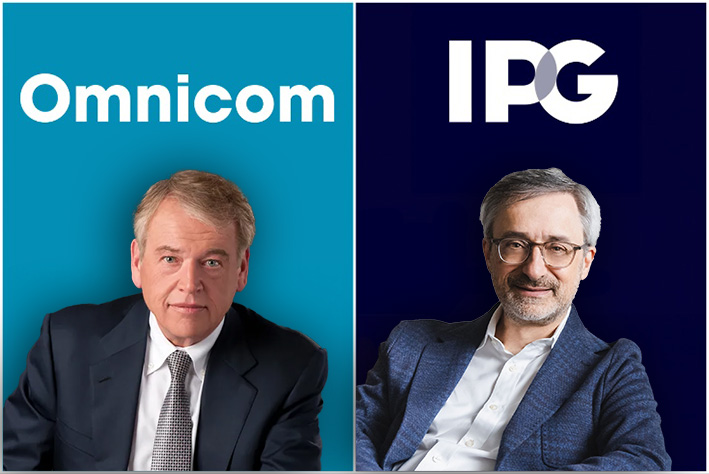
Omnicom Group is set to complete its acquisition of Interpublic Group (IPG) by the close of business today.
On Monday, the deal cleared its final regulatory hurdle. The European Commission unconditionally approved the $13.25bn deal, clearing the way for the two companies to combine to form the largest media holding group in the world.
With combined net revenues exceeding $20bn, the completion of this merger, which was first announced last December, will undoubtedly shake up the current agency landscape. It is on a scale akin to current industry top performer Publicis Groupe and could leave WPP further behind.
The deal aims to challenge global tech giants, which have been taking greater market share through their ad offerings and more advanced use of AI and other technologies.
Once completed, Omnicom shareholders will own 60.6% of the new company, and Interpublic shareholders will own 39.4%. The deal is expected to generate annual cost synergies of $750m, according to the companies.
The new Omnicom will have 100,000 employees
Interpublic is the smaller of the two companies and has underperformed its counterpart recently. In its Q3 financial results, it reported revenues of $2.5bn, compared with more than $2.6bn in Q3 2024, an organic decline before expenses of 2.9%.
Meanwhile, Omnicom reported Q3 revenue of $4.04bn (the company does not disclose net revenue), with organic growth of 2.6%.
In June, the US Federal Trade Commission (FTC) approved the merger on the condition of a proposed consent order which imposes restrictions to prevent Omnicom from colluding or coordinating “to direct advertising away from media publishers based on the publishers’ political or ideological viewpoints.”
The acquisition has already had substantial impacts on staff. This month, a filing with the US Securities and Exchange Commission (SEC) revealed that IPG has let go of 3,200 employees this year, including 800 in September alone, and has also reduced its global real estate footprint by 730,000 square feet.
Cindy Rose announced as WPP CEO following revenue forecast downgrade
Analysis: A band-aid for the cracks
Reflecting on the agency model, consolidation is not surprising, with Gerry D’Angelo, senior advisor at McKinsey & Company, stating: “One could argue the agency model is somewhat past its sell-by date with some cracks appearing.”
D’Angelo highlights that there are, however, several exceptions, naming Publicis as one. The holding company’s Q3 results posted net revenue of $3.5bn and organic growth of 5.7%.
Publicis’ success has hinged on two things: Consolidation (the group got rid of internal silos and streamlined internal structures) and leaning into proprietary media.
Meanwhile, for Omnicom and IPG, the merger, D’Angelo explains, is “ticking the box of the first one,” which will reduce cost, streamline internal organisational structures; however, the question remains whether it will lean into proprietary media.
D’Angelo also stresses the importance of making strategic decisions and keeping clients happy, citing the reduction in choice for global advertisers seeking a holding company’s services.
This reduction in competition in the holding co space needs to be met with innovation, and as Omar Oakes, independent journalist and consultant, and ex-editor-in-chief of The Media Leader, wrote when the deal was first announced: “Innovation is what this industry needs as media consumers have more choice than ever before to avoid ads.”
Oakes further points out how “fewer competitors means less innovation,” and the success of agencies will be pitted on their ability to “change incentives to marry with what their clients need: growth and relevance.”
The ability to provide this for clients, and AI’s role in this, has been heavily debated.
Striking the AI balance
Both IPG and Omnicom have invested in their data and AI offerings; however, arguably, there is a balance to be struck.
Nick Manning, the founder of Manning Gottlieb (now a part of Omnicom as MG OMD) and a former Media Leader columnist, believes that much of the success of the combined entity will depend on its ability to “retain strategic focus and not become excessively focused on an AI-led automated trading future where media cost and potential arbitrage predominate.”
Manning is hopeful the acquisition reinforces their agencies’ creative capabilities, “even if prior experience elsewhere doesn’t encourage optimism.”
Despite this, D’Angelo highlights that the need to show “immediate and tangible business outcomes” is the industry’s direction and the “only way to do that is through data and technology,” making the case that AI is at the “cornerstone” of what Omnicom and IPG are trying to do.
Time will tell
The months ahead of integration will be a crucial period for the new holding group.
Manning tells The Media Leader: “As with all mergers, the key is successful integration and transforming to horizontal structures. This will take time and be hard, but we have to hope that one and one equals more than two.”
Manning adds that the success of the merged Omnicom and IPG entity is important for the industry as a whole — not only because it will become the world’s largest agency holding group — but also because of the increasingly important role agencies can play in protecting the quality of media and advertising.
“We need agencies and agency groups to be as potent as possible to preserve advertising that is well made and distributed, especially when the majority of advertising seen and heard by the public isn’t,” he says.