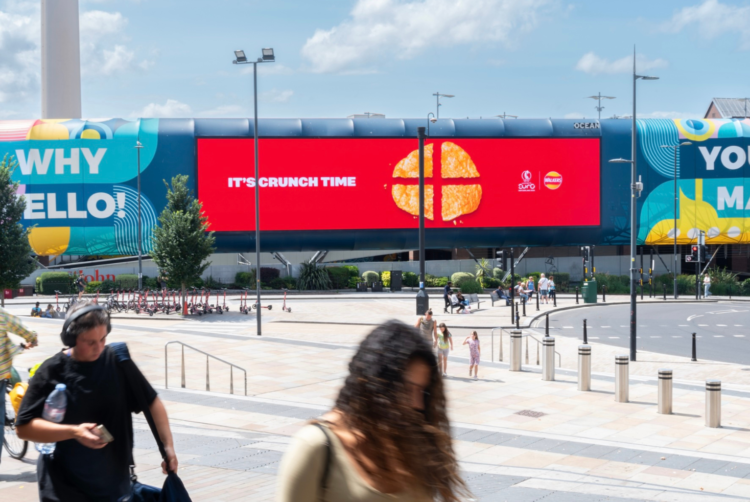
During its Year Ahead webinar yesterday (28 January), WPP Media highlighted four important trends in OOH this year: Creativity, brand building, personalisation and the real-world algorithm.
After a year of careful navigation and a slight slowdown in growth trajectory in Q2, the media giant is optimistic about growth in 2026.
In Q3 OOH advertising in the UK reported growth of 4.4%, totalling £376.6m, according to industry trade body, Outsmart.
Interestingly, in Q3, classic OOH overtook Digital out-of-home (DOOH), reporting 6.5% growth compared to digital’s 3.3%. However, according to AA/Warc, digital is set to continue driving growth in 2026, with ad spend forecast to increase 5.3% and OOH growth at 4.1%.
This growth, however, according to WPP, will hinge on four pivotal pillars.
It’s all in the creative
A crucial message from the webinar was the importance of the creative in driving growth in 2026.
Sam O’Connell, head of active OOH at WPP, underscored the importance of “being brave,” noting that now is the time to push boundaries and create “special builds which transcend traditional ad formats.”
According to WPP, special builds increase consumer action by 17% and purchase consideration by 35%, indicating that screens that capture audiences are not just “nice to haves” but drivers of commercial outcomes.
Meanwhile, screens that incorporate immersive and interactive technology, such as 3D effects, see a 15% uplift in attention vs. 2D and a 17% uplift in creative appeal, with 70% of consumers saying they would want to see the creative again.
Notably, creatives which push the boat out hold a higher chance of driving social media and PR attention, which ultimately builds fame and drives sales for the brand.
The renaissance of brand building
Lucy Cutter, head of planning OOH at WPP Media, highlighted that the “pendulum” is swinging back toward brand building and away from an overfocus on short-term sales.
Here is where OOH shines: Cutter describes its ultimate strength as “ensuring a brand comes to mind easily” in a brand-buying situation.
This is essential for resilience in a disruptive geopolitical landscape, as Cutter explains that it is a “critical tool for survival and protects margins when costs are rising.”
The brand-priming element of OOH cannot be ignored: 84% of purchases are pre-decided by brand priming, and 58% of people trust OOH.
Additionally, OOH has the ability to reach 98% of all audiences, depicting the brand exposure offered through the medium.
The strength of OOH as a trusted, attention-grabbing, brand-building medium was compounded by the release of Rapport’s Standing on the Shoulders of Giants report, released in November at its annual DPAA Town Hall event.
Notably, the report found that brands that allocated 15% or more of their budget to OOH saw a 17% increase in sales value, a 25% increase in profit, and a 100% increase in market share compared with brands that didn’t invest in OOH.
Importantly, the research acknowledged the amplifier effect OOH can have on other channels, such as social, display, TV, video-on-demand (VOD) and search.
The OOH power-users saw a 3% boost in display, a 17% boost in social effectiveness, a 21% boost in TV and VOD, a 27% boost in online video advertising (OLV), and a notable 129% boost in search.
Cutter added: “OOH owns the subconscious.”
Personalisation
A crucial point of progress will be around personalisation in 2026.
Steven Dennison, managing partner, commercial, DOOH.com how the use of data and technology will be essential in targeting specific moments and audiences.
Dennison also highlights how this kind of targeting in OOH gets around the demise of third-party cookies online, and in many ways is more relevant and optimisable to greater numbers, as well as being privacy compliant.
Dynamic creative optimisation (DCO) also creates opportunities and utilises a master template with calls to action, which can be assembled using the most relevant ad version before serving specific screens at the right time.
The main message was a “shifting of focus onto moments.”
The real world algorithm
Jennie Roper, head of intelligence OOH, WPP Media, highlighted: “OOH is the last true broadcast channel — public and unskippable, with a gut feeling of familiarity.”
Roper drew on data showing that 25% of all commerce occurs on the move, 60% in store and just 14% at home.
She underlined how, within the industry, there is an “over focus on at home.”
“Media planning is stuck in the past, overwhelmingly geared towards reaching people where they live,” she added.
It was outlined that a fourth place of commerce is coming — AI agents.
As shopping decisions are delegated to AI agents, the real question will be how marketers influence those choices.
Roper outlined how OOH campaigns signal public confidence by building trust, creating a “digital echo.”
Notably, it was argued that OOH generates data that trains an AI agent to make suggestions.
Roper said: “The battlefield isn’t the sofa — it’s the street.”
Adwanted UK is the trusted delivery partner for three essential services which deliver accountability, standardisation, and audience data for the out-of-home industry.
Playout is Outsmart’s new system to centralise and standardise playout reporting data across all outdoor media owners in the UK.
SPACE is the industry’s comprehensive inventory database delivered through a collaboration between IPAO and Outsmart.
The RouteAPI is a SaaS solution which delivers the ooh industry’s audience data quickly and simply into clients’ systems.
Contact us for more information on SPACE, J-ET, Audiotrack or our data engines.