



Snap is betting on smart glasses. Should brands?
Feature
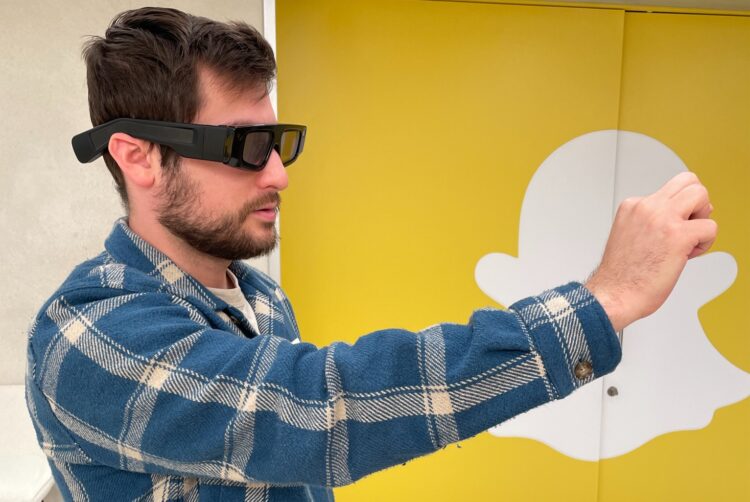
Next year, Snap will unveil its sixth-generation Spectacles, the social media company’s line of smart glasses that it claims represent the future of consumer technology.
The augmented reality (AR) glasses feature a display in the lens, cameras and sensors to allow hand-based interaction with Snap OS, the glasses’ spatial operating system.
Snap claims the Specs will be a “fraction of the size” of previous iterations and the current developer kit, as well as being lighter weight, more comfortable and more fashionable.
The company is at a “crucible moment”, according to CEO Evan Spiegel. In a letter to staff last week, Spiegel admitted that Snap “stumbled” in Q2 amid sliding ad revenue growth and shared his view that Specs represent a substantial opportunity.
“One pair of Specs can substitute for many screens,” he wrote. “Our operating system, personalised with context and memory, compounds in value over time.”
Snap has been working on consumer AR glasses for more than a decade. Spiegel claims the project is driven by a desire to “make computing more human” by merging “the digital and physical world” in the same way Snapchat’s AR lenses do.
“Imagine pulling up last week’s document just by asking, streaming a movie on a giant, see-through and private display that only you can see, or reviewing a 3D prototype at scale with your teammate standing next to you,” Spiegel posited. “Imagine your kids learning biology from a virtual cadaver or your friends playing chess around a real table with a virtual board.
“Specs make computing social by providing shared experiences in the real world.”
‘Phones had their time’: Meta UK chief Matras pushes smart glasses future
Meta competition
Snap is not alone in betting on smart glasses — it’s also a core project for Meta. Its EMEA vice-president, Derya Matras, touted smart glasses as “the next form factor” at last year’s Advertising Week Europe, remarking: “Phones had their time.”
More recently, CEO Mark Zuckerberg claimed on Meta’s Q2 earnings call, without evidence, that people without smart glasses may be at “a significant cognitive disadvantage” in the future.
This week, at Meta Connect 2025, the company is expected to debut its own line of new smart glasses. According to Engadget, the glasses are expected to go on sale later this year. That said, they aren’t expected to include immersive AR experiences demoed with its Orion glasses last year.
Snap believes it will beat Meta to that punch. The company has released its Specs in various forms since 2016, with the fifth generation launching in 2024. That version was praised for its advances in AR computing, while also criticised for being bulky and unseemly to wear.
The Media Leader was invited to try on the next-generation developer kit to see how the technology works, its potential consumer use cases and how brands might consider leaning in to the device as competition heats up between Snap, Meta and, potentially, Apple.
First impressions
The development kit made available to The Media Leader includes, like the fifth-generation Specs, an AR lens with a 46-degree field of view in the centre of each pane.
It is designed to produce “minimal information when you need it”, while also allowing users to partake in more serious computing tasks such as browsing the open web or watching YouTube videos.
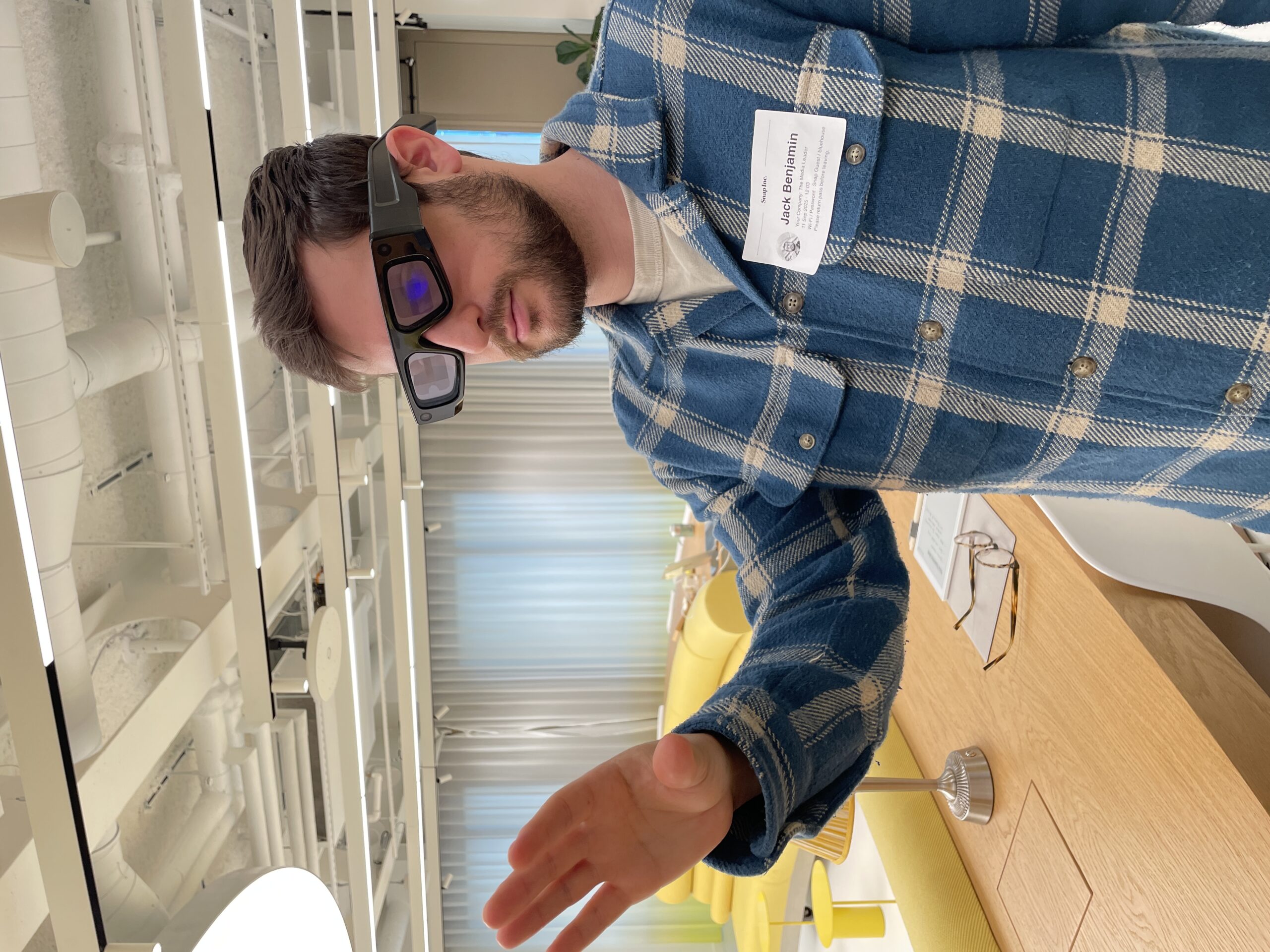 Operating the OS is intuitive but requires a period of learning. The menu can be accessed by looking down at one’s palm and tapping AR icons. Opened applications are placed “in the world” and can be moved around with a pinching motion.
Viewing items in AR is limited to a relatively narrow slice at a given time given the narrow field of vision. However, Snap hinted that future releases could feature a wider field of view.
The glasses make use of OpenAI and Google’s Gemini for AI and can be interacted with by asking questions about what you’re looking at.
For example, The Media Leader was instructed to look at a skateboard and ask the glasses to “tell me how to do an ollie”. After asking the question several times to ensure the Specs heard correctly, they were able to do so with visual instructions.
Other consumer use cases could include creating a flexible workstation, training medical students and consuming entertainment on the go.
The Media Leader sampled a handful of current applications, including scrolling Reddit on a web browser, watching a YouTube video placed within the visual environment (audio quality is passable), translating a menu in Mandarin and “painting” in the air.
Developers are currently working on a slew of applications for the device ahead of the next-generation launch.
Brand opportunity?
For brands, the immediate use cases are less obvious and remain experimental.
The Media Leader opened one app developed for fashion giant Dior. It asked the user to pick a card out of a deck based on Zodiac signs. Among a starry backdrop, the card was split in half across the field of vision, requiring the user to walk up to and interact with them to “stitch” the pieces back together.
Speaking to The Media Leader from New York following the the demo, Resh Sidhu, Snap’s global director of AR marketing, argued that Specs give brands “a whole new way to connect with people” by enabling them to do so “in the flow of real life”.
As with any “platform shift”, innovative brands like Dior have already begun leaning in to the glasses by experimenting early — a move Sidhu suggests is wise as it provides first-mover advantage, assuming AR glasses take off as a major consumer product.

Sidhu pointed out Lego’s early adoption as an ideal fit given the playfulness of the brand and suggested that travel brands can take advantage of in-flight entertainment use cases.
“I just travelled from London to New York and was using Spectacles on the flight,” Sidhu said. “I felt like I was living the future. I was looking at gallery photos from my trip in London, playing games. For entertainment partners, you can think about how games and music are brought into your [physical] space.”
On Monday, Snap announced a range of updates to Snap OS, including an overhauled browser, a gallery, a “travel mode” and new lenses. Specs wearers can now access Snapchat’s Spotlight mode via a dedicated lens, allowing them to “do the dishes while your favourite creator’s video plays seamlessly in front of your eyes”.
Without providing specifics, Sidhu advised interested brands to consider developing “utility experiences” that are additive to people’s lives.
“When the iPhone launched, every brand said: we need an app. The question was: do you? And, if you do, what should it be? That’s what brands need to question when we think about the future of computing.”
While the Specs appear to offer brands only upper-funnel opportunities for the time being and could require a substantial budget to work with new AR development tools, Sidhu insisted that Specs could appeal to brands whether they are “juggernaut[s]” or “small startups”.
“It’s not necessarily about big budgets,” she claimed. “You don’t need huge budgets; you need to have the right strategy and the right technology. We’re bringing the right technology.”

The right strategy, according to Sidhu, is for brands to not simply replicate what works in 2D spaces.
That said, she acknowledged that, for many brands, the conversation around AR opportunities is likely to start in a simpler place. For instance, showing them how a display ad might look in the AR browser or how users could shop online could serve as an initial spark.
Sidhu did, however, rule out any initial focus on incorporating direct advertising into the glasses.
“Absolutely not,” she said of the suggestion that ads might enter a person’s AR field of view.
New rules of engagement
Who would brands’ initial target audience be?
Sidhu declined to reveal a starting price for the sixth-generation Specs, but implied that their initial consumer base will comprise “early adopters” and “individuals that see technology and a device like this really helping their everyday life”.
While that might appeal to some digital-first brands, a limited user base could stifle the desire to commit to the smart glasses hype. And doubly so if strong data and effectiveness measurement aren’t incorporated into the platform.
Sidhu suggested that advertisers will need to be comfortable with a different standard of measurement than what they have become used to with display and social media advertising. That could result in risk-averse brands shying away.
“[Measurement] changes when there’s a paradigm shift,” she argued, warning that brands and agencies make mistakes when “trying to apply the old rules to new technology”.
“You’re trying to measure views and clicks, and that’s not what we’re measuring,” Sidhu insisted. “In the new era of spatial computing, there’s a new era of measurement.”
With Specs, there won’t be initial benchmarks for brand performance. “What we have to do is create new rules of engagement and new ways to measure what success looks like,” Sidhu explained.
New rules of engagement will also doubtlessly need to be applied to user safety and privacy. While Snap claims privacy “is always at the core of what we do”, wearable tech, equipped with cameras and microphones, inherently carries the risk of being used to spy on people or collect sensitive personal data.
Last year, a pair of Harvard University students managed to put facial recognition software into Meta’s less technologically capable Ray-Ban smart glasses. Not only were they able to identify people in public, they were also able to pull other information about their subjects from around the web, including home addresses, phone numbers and family members.
Snap claims that its camera has a blinking light when it’s on to inform others that a recording is taking place. But it’s unclear whether this feature, or other similar privacy considerations, could be disabled.
Who is this for?
Snap’s push into smart glasses occurs as consumers are increasingly “pushing away from screens and devices”, Sidhu acknowledged, amid toxic online environments that have negatively impacted mental health for many users.
The brand launched an ad campaign last year aimed at repositioning Snapchat as superior to “social media”, even as parents and researchers have found the app rife with drug dealing.
As Spiegel and Sidhu alluded to, Snap is now making the case that Specs represent a “more human” approach to technology by removing screens, allowing users to “stay present” but also “connected” at the same time.
But, in doing so, that puts the content one interacts with on screens into potentially every environment a person may interact with.
A Specs wearer could, if they were so inclined, covertly watch a YouTube video while in a social setting. Could the same be true of viewing pornography? Of online gambling?
What about children — what if they brought them to school? They could be great for learning or possibly be the ultimate distraction — a secret portal to the internet where no-one else can see what you’re doing.
Big Tech has a penchant for promoting positive use cases for new devices without considering potential negative externalities. For Sidhu, Specs “aren’t meant to be worn every day” but are “there when you need them: if you see something and want to know more, if you’re traveling and need help with translation”.
Utopian ideals with unclear implications. Perhaps a better prescription is needed.