



The special media relationship
Opinion
One side of the Atlantic is hollowing out what makes its media culture special. The other is fighting to preserve it.
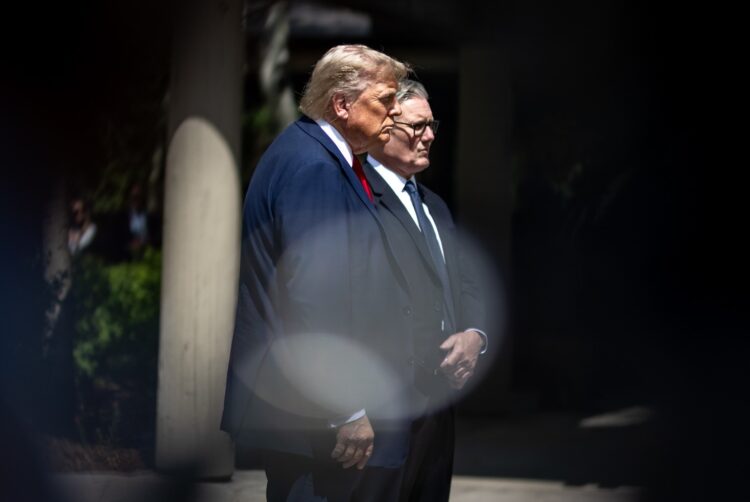
Last week’s nauseating UK state visit by convicted sex offender Jeffrey Epstein’s “closest friend” Donald Trump coincided with two hugely consequential moments for the media industry on both sides of the Atlantic.
I don’t need to dwell on why President Trump relentlessly puts pressure on media companies to influence their editorial behaviour. It may have something to do with the fact it’s quite newsworthy that the US president was such a close friend of a convicted sex offender.
The point is how we as an industry not only respond to threats from politicians to make our business weaker and poorer, but how we continue to ensure we are a business at the heart of culture rather than regressing into a soulless, valueless, personality-less collection of “platforms”.
While US media giants throw their culture under the bus for short-term gain, UK broadcasters are at least trying to defend media’s role in a modern, free society.
The cowardice of corporate America
Jimmy Kimmel’s ousting from Disney-owned ABC could reportedly helped Nexstar — a major affiliate group — clear a $6bn merger through regulators.
Kimmel wasn’t even making a joke about Trump being sex offender Jeffrey Epstein’s “closest friend”! It was a comment about who’s to blame for a famous political activist being shot dead.
But that was enough for Nexstar, who was put on notice by Federal Communications Commission (FCC) chairman Brendan Carr on Wednesday. The next day Kimmel was gone.
US TikTok sale brings uncertainty for creators amid free speech chill
Nexstar isn’t some anomaly. It’s the poster child of legacy US media: a conglomerate stitched together by acquisitions, with no vision except “don’t rock the boat.”
This model is exactly what the great economist John Kenneth Galbraith predicted in his 1967 masterpiece The New Industrial State. Galbraith warned that capitalism was no longer driven by entrepreneurs or free markets, but by the technostructure: a class of managers, planners and risk-averse operators more concerned with internal stability than creativity, competition, or cultural value.
These are not media leaders. They’re bureaucrats in nice suits. And their job is to make sure nothing unexpected happens.
Stability is Paramount
The same logic took down The Late Show with Stephen Colbert — even though it was the most-watched late-night show in America.
The former Paramount chair/heir Shari Redstone explained why the show was axed during litigation with CBS: “The suit was really a distraction… and you never know what’s going to happen in discovery.”
Then she added, more chillingly: “I just think we all — not because of Trump or because of any other reasons — need to be thoughtful of the content we’re putting on air given the division that exists in this country.”
Thoughtful? About what, exactly?
Free speech? Journalistic integrity? Or just not upsetting powerful people who can delay your next M&A deal?
And when even the highest-rated shows aren’t safe from political chill, what hope is there for the rest of the system?
What a Paramount takeover of Warner Bros Discovery would mean
Meanwhile, in a hotel ballroom in Cambridge…
The Kimmel fiasco erupted on the same day as the UK’s leading TV executives got together in a room and made a stand of their own.
At the RTS Cambridge Convention, the BBC, ITV, Channel 4 and Channel 5 united to call for government action to protect British broadcasting. They demanded platform regulation, tax incentives, digital prominence, and real support for news. And they have support from Culture Secretary Lisa Nandy.
Essentially their target is YouTube, a video-sharing platform which has been telling advertisers at Cannes and elsewhere that “YouTube is the new TV”. While I’ve tried to point out repeatedly how this claim is dubious outside of the very particular (and, as we’re witnessing, increasingly peculiar) US market, it’s undeniable that YouTube is now a big commercial concern for any UK broadcaster.
The prominence issue extends far beyond YouTube as a platform. On a modern TV, the home screen is everything. If you’re not there, you’re invisible. No one cares how great your drama slate is if it’s buried five menus deep behind autoplaying trailers.
Marshall McLuhan was only telling part of the story when he famously wrote decades ago that “the medium is the message”.
The medium is, and always will be, the distribution, too. The interface is the message: the way digital media owners curate and enable viewers to interact with content.
If you believe in public-service broadcasting, then prominence is fundamental. As a society, we are signalling that some media operators are special because they are upholding our values as a community.
Ofcom calls for more public-service media prominence on YouTube
That’s what makes media special. A shared culture matters and we all have something to tap into in order to tell meaningful stories to consumers, whether we’re in it to express art or market baked beans.
Some of us even have the opportunity to shape culture through media.
Why would you give all that up?
Values come first (and last)
Kimmel, Colbert and other exiled American comedians will be just fine.
But will anyone replace them? We used to think of America as having unshakeable free-speech protections against despotic government. If that becomes nothing more than a platitude, where is the legal footing for any comedian to say anything remotely satirical, let alone downright offensive?
I’d argue for more free-speech protection in the UK, but at least we still have leaders willing to back public broadcasters. That matters because media, even at its most flawed, is one of the most powerful ways we project values at home and abroad.
Some media owners simply matter more because they serve the public, not just shareholders.
Whatever the point of last week’s state visit was, at least one side of the pond reasserted what makes its media sector special.
 Omar Oakes was founding editor of The Media Leader and continues to write a column as a freelance journalist and communications consultant for advertising and media companies. He has reported on advertising and media for 10 years and was previously media and tech editor of Campaign. His column on The Media Leader was nominated for the BSME’s B2B Column of the Year in 2024.