



High-attention media is more profitable, finds Peter Field, Lumen and Newsworks

The Future of Media Manchester
High-attention media campaigns deliver significantly better business outcomes compared with low-attention ones, according to a study from news publishing marketing body Newsworks, attention measurement company Lumen and effectiveness expert Peter Field.
It found that media campaigns in high-attention formats boost market share by 12%, thanks in part to a 17% uplift in brand effects.
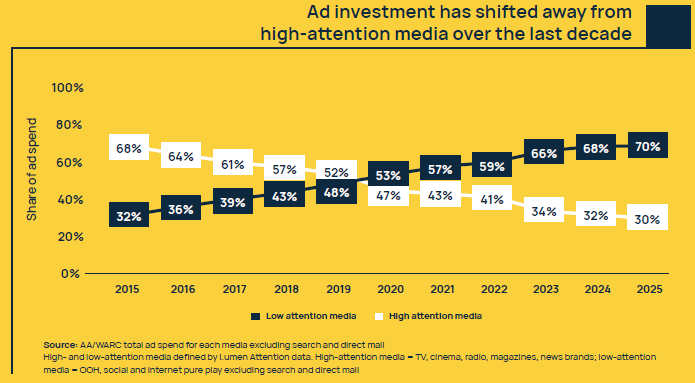
Ad investment have been shifting away from high-attention channels over the past decade. In 2015, more than two-thirds (68%) of media investment went to high-attention channels, compared with 32% going to low-attention channels. Today, that ratio has flipped.
“This research uncovers an astonishing absurdity: that advertisers are shifting spend from high- to low-attention media,” Field stated. “This doesn’t make commercial sense and it needs to be fixed — fast.”
The study combined data from the IPA Effectiveness Databank, Brand Metrics and Lumen to examine how attention impacted media effectiveness. It was presented by Field and Newsworks insight director Heather Dansie at The Media Leader‘s Future of Media Manchester event on Thursday morning.
Lumen’s data provided the definition for high- or low-attention media. High-attention media includes TV, cinema, radio, magazines and news brands. Low-attention media includes OOH, social media and pure-play internet, excluding search and direct mail.
Ads in high-attention environments were found to be more visible, memorable and better at delivering on key business effects. High-attention media campaigns achieve 58% more attentive seconds for every advertising pound spent, the research concluded.
Not all display ads are equal
Notably, not all display ads have the same impact. The study examined the levels of attention generated by ads on 12 news brand sites compared with the top 500 non-news sites by volume of impressions in Lumen’s dataset across 2023 and 2024.
Ads on news brand sites were found to dramatically outperform ads on non-news sites, receiving 40% more attention. Video ads on news sites also received 24% more attention than on non-news sites.
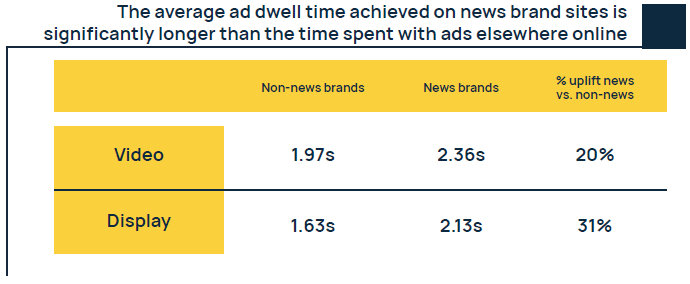
Such ads are viewed for longer, with average dwell time up 31% for display and 20% for video on news sites. This was attributed to slower scroll time and more active engagement among news readers.
The greater attention to ads on news sites translated to brand uplifts for awareness (+11%), consideration (+23%) and action intent (+32%).
It’s further worth noting that the top 500 non-news sites represent “only the tip of the iceberg” of the long tail in the programmatic mix, many of which receive “often very low (and non-human) attention”, the research pointed out. This means the 40% uplift in news brand display is a “hugely conservative figure”.
Lumen CEO Mike Follett commented: “News brands have been hugely powerful in achieving attention for advertisers for decades.
“We know that attention to advertising is a by-product of attention to the surrounding content. In this case, it boils down to the quality of news brand journalism and the time people spend with it.”
Additional benefits
The study further found that news brand sites deliver benefits in all media-mix scenarios. Advertisers investing in social or non-news digital inventory would see substantial effectiveness benefits by simply including news sites in their media plan. As Field described, news brands offer an “antidote” to advertisers that are currently over-investing in low-attention media channels like social platforms.
“This analysis proves that digital news brands are high-attention media and shouldn’t be grouped with the long tail of display advertising,” the study stressed. “News brand sites work harder for advertisers in delivering key business outcomes.”
The IPA Databank analysis showed that campaigns that included news brands reported stronger results across all key business metrics, including sales, market share and profit.
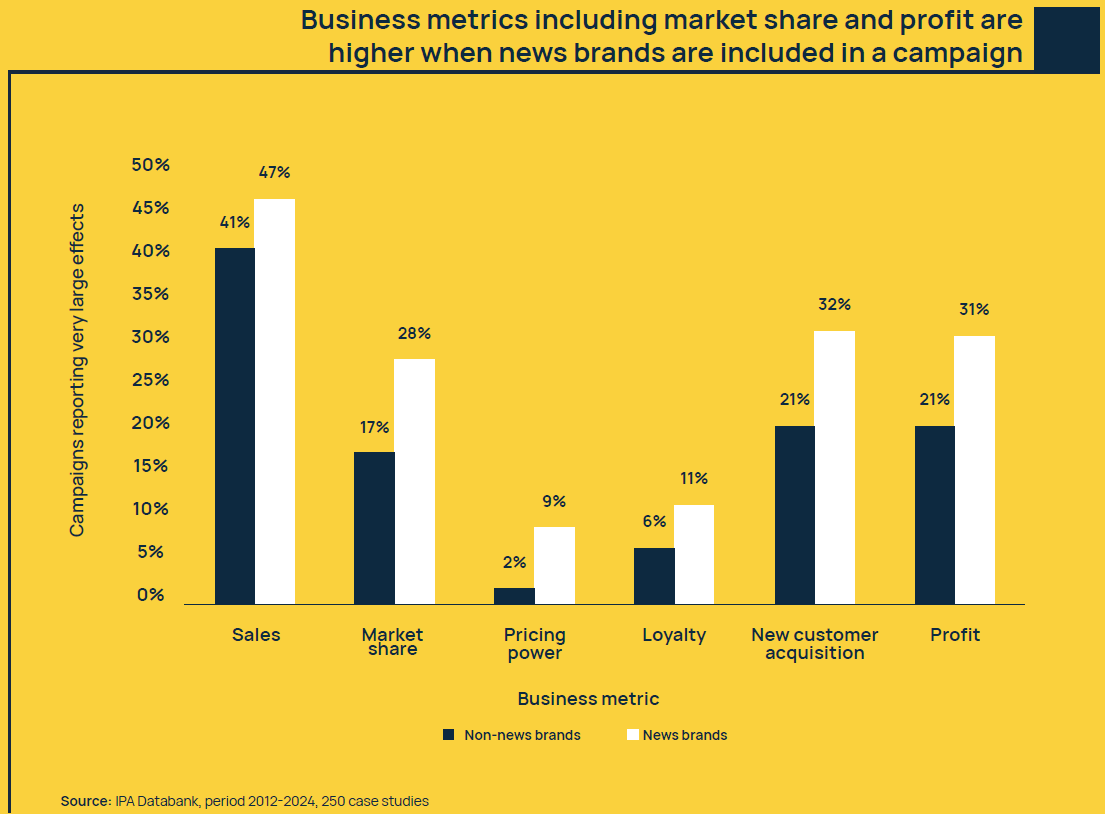
According to the study, news brands’ impact on effectiveness has nearly doubled since 2018.
Field noted that news brands have become a more effective medium for brand advertising over time, attributing this not only to the increased attention consumers give to news brands, but also the “shittification” of the rest of the media ecosystem.
While the report’s authors noted that quality inventory costs more, they argued that it is worth it from a business perspective.
“When considering that not all inventory bought by advertisers is actually seen (by humans), and that some digital inventory works harder than others, it is important to consider the value that high-attention media, like digital news brands, delivers,” the research highlighted.
Acknowledging variation in campaign costs, Lumen’s data estimated that the cost of news brand display ads is 24% higher than general display. However, when the value is “focused on the cost of media that gets seen”, as defined by Lumen’s “attentive cost per 1,000” metric, digital news brands were still found to offer 11% better value for advertisers.
Overall, the study concluded that ensuring at least 20% of digital impressions are in news brands is the optimal mix for most brands from a reach and frequency perspective.
Dansie added that, beyond the business benefits of investing in news brands, advertisers receive an “additional benefit” of supporting high-quality, independent journalism.
She summarised: “If you have attention, you can translate that into profit and into power.”
The study will be discussed in further detail on a podcast with Field, Dansie and Follett, recorded live at The Future of Media Manchester.