



The Guardian promotes its creative canvas amid US investment drive
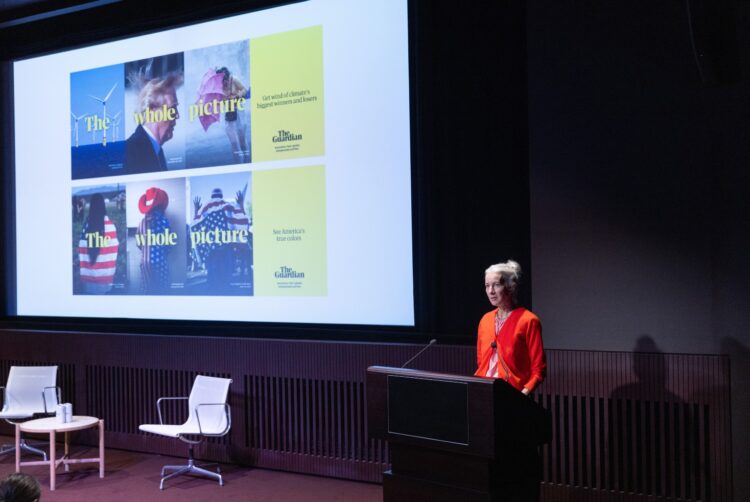
“When advertising really works, it reimagines the rules.”
At The Guardian‘s Upfronts on Thursday, CEO Anna Bateson promoted the news brand as not only an integral journalistic voice amid “relentless pressure” from attacks on free speech, but also an opportunity for brands to drive effectiveness.
Hosted at the Tate Modern in London, the publisher sought to draw comparisons between the visual artistry on display at the museum and the creativity on display each day on The Guardian‘s “canvas”.
“Just like the Tate, we’ve got style and substance,” Bateson said with a smile.
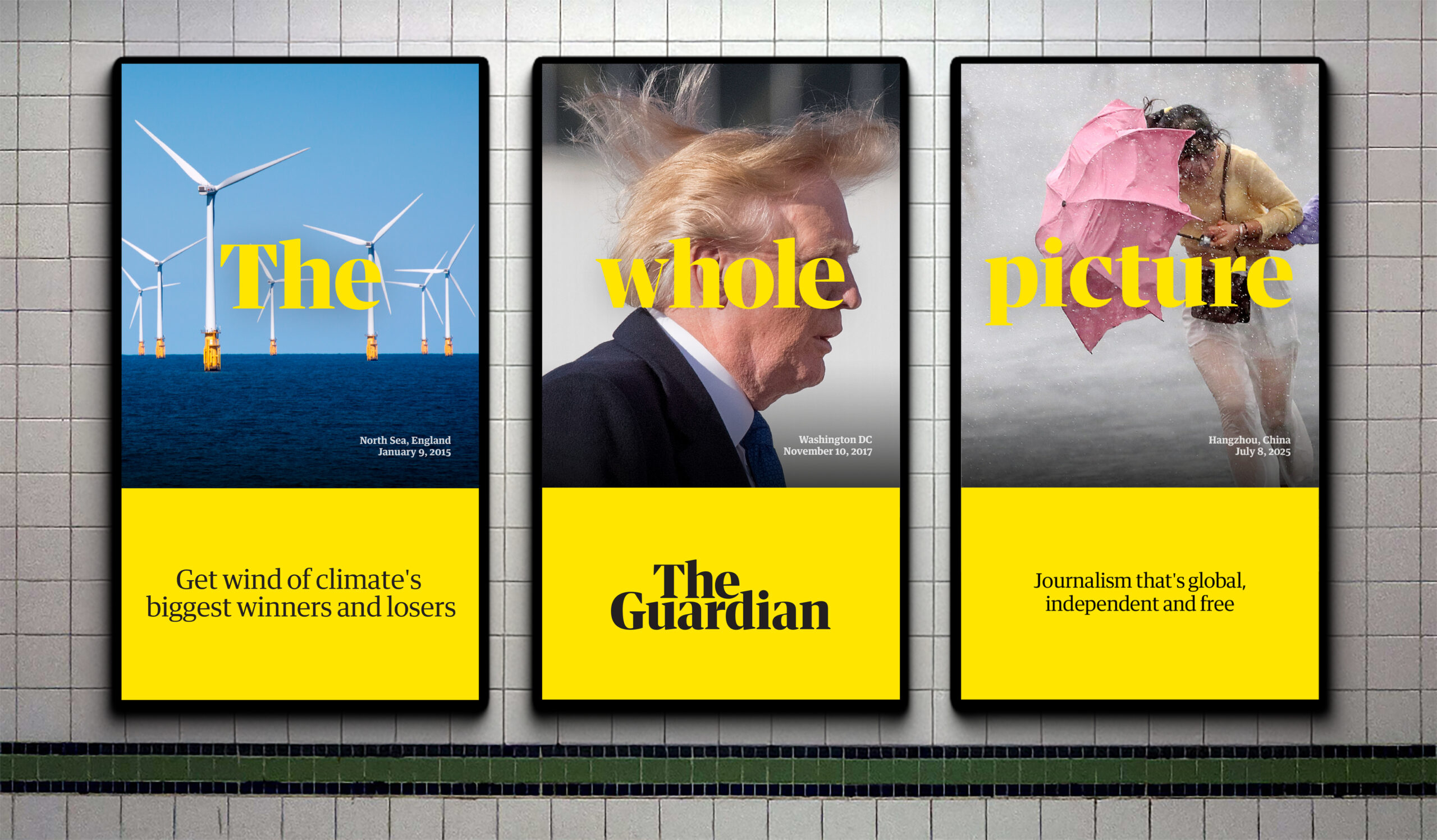
Presenting The Guardian‘s famous 1986 “Points of View” ad as emblematic of what the news brand still stands for today, Bateson said the title’s latest brand campaign, its first in the US, was likewise inspired by the same ethos of offering consumers “The Whole Picture”.
The campaign, launched last month in partnership with creative agency Lucky Generals, is concentrated in New York City, with numerous OOH activations, alongside paid audio ads on Vox Media Podcast Network programmes like Pivot and Today, Explained.
It comes as the outlet looks to introduce more products, including its product recommendation vertical, Filter and new podcasts, to the US market.
Discovering Guardian US
Speaking to The Media Leader from New York in advance of the London Upfronts, Steve Sachs, The Guardian‘s US managing director, explained the brand campaign was long in the making, as the publisher aims to grow readership and attract greater ad investment from a market that is still learning about The Guardian, its journalism, and its brand values.
“We decided to ‘heavy up’ in New York because there is a dual audience target here,” said Sachs, referring to both potential readers and potential advertisers.
In advance of the campaign, The Guardian conducted market research on Americans’ perceptions of the brand, alongside other top US news brands.
“Where we landed was on the combination of the unique value proposition of having a global perspective, being independent, and being free to access,” Sachs described. “There’s no other brand in the US that has that combination.”
Citing Comscore data, Sachs indicated The Guardian typically reaches between 40m and 50m unique users monthly, which would make the title larger than The Wall Street Journal and nearly as big as The Washington Post in the US market.
“In spite of that, many people in the news market here — on the audience side and on the advertiser side — are really still discovering The Guardian in the US,” he added.
The outlet has long had an editorial bureau in the US, but only in the past decade has it significantly ramped up efforts to grow its business in the market. Sachs joined in October 2022 and has been tasked with leading the entire US business, including supporter revenue, ad revenue, and philanthropic revenue.
US revenues in each of those categories grew last year. Total revenues jumped 25% year-on-year to $71m, driven by a 33% increase in reader revenue, likely bolstered by a well-timed endorsement of US presidential candidate Kamala Harris after other competitors, notably The Washington Post, declined to do so.
In comparison, US ad revenues grew 11% to $20m.
Despite The Guardian‘s solid US audience figures, there is still considerable room for growth. Whereas the title achieves 88% prompted awareness in the UK market, the same is true of just 57% of Americans.
“We’ve already grown to be a significant news brand in the US, but we still have so much room to grow because 43% of people in the market here have never even heard of us on a prompted basis,” Sachs said.
The same is true to some extent of the ad market. “Advertisers here know of us and many people work with us, but there are still many potential advertisers,” Sachs continued. “They think of us quite narrowly as a UK news organisation with a big UK audience, not realising that we actually have a larger audience than many of the legacy news brands here.”
Inaccurate brand perception could be a disadvantage to a growing publisher like The Guardian. Still, Sachs sees it in a more positive light. Since the title’s name is not derived from a specific city (The Guardian dropped Manchester from the title in 1959, when it relocated its headquarters to London), many Americans are more receptive to its journalism due to its lack of local brand association.
Equally, US advertisers aren’t necessarily put off by The Guardian‘s left-of-centre UK reputation — though Sachs admitted they may skirt around the Opinion section if they’re feeling uneasy.
“When we cover the US, we cover it with an outside perspective, which is valuable,” he continued. “We don’t have a billionaire owner, we aren’t reporting to Wall Street every quarter. We can cover a wide range of news with the audience in mind. We are one of the few remaining news organisations in the US that puts everything up for free.”
Imogen Fox, The Guardian‘s chief advertising officer, added that key areas of focus for The Guardian US over the next year, both editorially and commercially, include politics, climate, and the 2026 World Cup, which will be hosted across North America.
She characterised the US market as “not so very different — but I would say we’re more known in the UK, so we’ve got more work to introduce ourselves.”
How The Guardian is expanding its commercial footprint — with Imogen Fox
‘Fewer ads, more effective’
Back at the Tate Modern, Fox touted The Guardian‘s redesigned app, which launched in May. She said the publisher is looking to sell a 100% share of voice on the app to one advertising partner, akin to the strategy it has taken with its food app, Feast, and client Tesco Finest.
“We want to crack in-app advertising, because we don’t think most publishers have yet,” she added.
Separately, The Guardian‘s senior commercial leaders presented findings from research conducted in partnership with Differentology that aimed to evidence how high-quality ad environments drive better brand metrics.
“We believe creative is the single-biggest driver of effectiveness — if you give it the space to breathe,” said director of advertising James Fleetham.
Warning that profit-seeking behaviour has “made online advertising worse”, Fleetham and head of strategy Lara Enoch unveiled a new approach: FAME, or “Fewer ads, more effective”.
The FAME research sought to measure behavioural response to ads in different ad environments. High-ad digital environments, with formats like pop-ups and stickies, were found to cause subjects to literally contort their faces to show confusion and fear. On the contrary, low-ad environments were much better received.
The study found that low-ad environments overwhelmingly scored higher than high-ad environments when measuring both brand recall and favourability.
In response, The Guardian and Differentology developed an index to score different digital media owners based on the quality of their ad environment.
As Fleetham concluded: “What is good for the audience is also good for the advertisers.”