



Meta: Media planning can’t be replaced in AI era
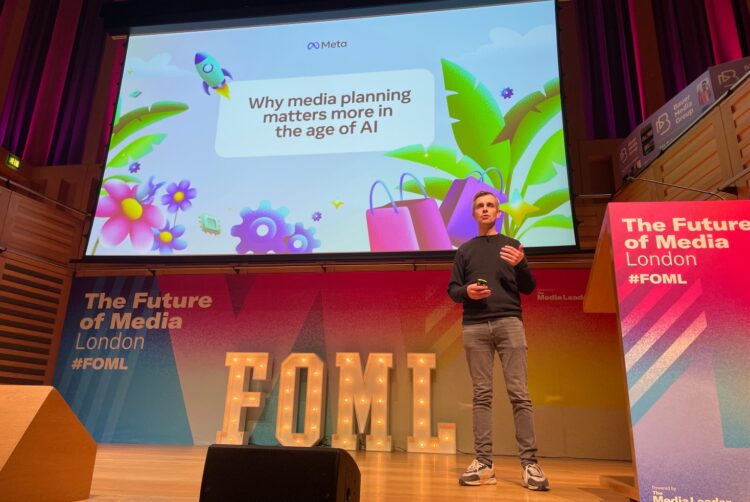
The Future of Media London 2025
“I believe that planning will matter more in the age of AI than ever before.”
Would you believe a Meta employee said that quote?
This summer, the tech giant announced it aims to provide tools to fully automate ad creation and targeting by next year.
CEO Mark Zuckerberg said: “In the not-too-distant future, we want to get to a world where any business will be able to just tell us what objective they’re trying to achieve, like selling something or getting a new customer, how much they’re willing to pay for each result, and connect their bank account and then we just do the rest for them.”
You could feel the shivers sent down the spine of many a media planner. Could it be possible, based on the mass treasure trove of ad campaign data held by major tech companies, that human media planning could go the way of the horse-drawn carriage?
At the Future of Media London, planners reckoned with the risk to their livelihood.
Venya Wijegoonewardene, chief strategy officer at Publicis Groupe agency Spark Foundry, admitted there are “certainly elements of our job that might become a bit easier” with AI, but shared optimism that the tools allow “more freedom to think more strategically, apply more critical thinking.”
Caroline Manning, chief design officer at Initiative, likened AI to the Iron Man suit: “The planner still needs to wear the suit to make it fly and do all these amazing things,” she said.
Later in the conference, Pete Buckley, Meta’s connection planning director, appeared to agree.
He reassured the audience of planners that it is not his or Meta’s view that media planning will become obsolete. To the contrary, he argued, for big brands and their agencies, AI will make good planners even more valuable as the technology “levels the playing field” for smaller brands.
Big brands’ moat will disappear
Meta has 10m active advertisers on its platform, Buckley shared, with the vast majority being small, local businesses without marketing teams — let alone agencies. For those businesses, “having end-to-end automation is a real game-changer.”
But for bigger brands and agencies, Buckley argued that not everything can—or should — be automated. In fact, the human element might be what sets big brands apart.
Citing a variety of studies from Analytic Partners, Kantar and System1, Buckley noted that the most effective media plans use eight or more channels, four different (and often contradictory) measurement solutions, and five different market research tools.
Media channels are also constantly adapting their inventory. As Buckley noted, Meta has released or “evolved” 60 ad products this year alone.
“Planning is essential [to] simplifying that complexity and making the most of that change today,” he said.
Why planners are investing so heavily in Meta, despite attention metrics
Planning is also essential to getting a more consistent return on investment. Citing Profit Ability 2 data, Buckley acknowledged that social media sees the widest variation of any media channel in terms of ROI.
“Mostly, the reason they get big variation is the quality of the planning and the quality of the creative,” Buckley said.
He continued: “Platforms like ours are democratising, allowing smaller advertisers to do things that in the past only large advertisers could do. So we’re going to see a lot more competition.
“As AI generation reduces the production costs of high-quality video, you’re going to see a lot more video advertising. That moat that big brands used to have is going to quickly disappear.”
According to a study by Medialink, advertisers have seen a 27% reduction in production costs for ads this year.
But while smaller businesses are now more capable of creating quality ads and serving them to audiences automatically, human planning, as Buckley argued, provides “empathy for the audience” — a greater understanding on how to create emotional resonance.
Where planning matters more
Given most brands today use ad products from the same small number of tech platforms (Meta, Google, Amazon), in Buckley’s view, planning will become essential to differentiation. As the “guardian of effectiveness”, it can help provide incremental returns that “go beyond the average” of what is recommended by AI planning tools.
“If we’re all using these same platforms and we’re all optimising the same thing, how do we actually stand out?” he asked rhetorically. “What matters with AI, like many things, is garbage in, garbage out. You have to fuel these platforms with a high level of insight and signals.”
Buckley believes planning is moving from an audience-centred effort to a signal-centred one. As AI becomes capable of optimising to a variety of different outcomes, planners will need to decide whether and how much to optimise for, say, volume of sales versus value of sales.
IAB Upfronts 2025: Meta makes the case for business messaging through WhatsApp
Context also matters. While critics of social media platforms have repeatedly argued that platforms pose inherent brand risks due to the lack of control advertisers have over the context in which their ad shows up on different users’ feeds, Buckley noted that Meta and its competitors have begun offering slightly more control to advertisers, such as by allowing brands to place ads next to top trending content or, in the case of TikTok, adjacent to videos from premium publishers.
It’s thus on planners to consider whether higher CPMs are worth paying to improve control over context, Buckley implied.
Likewise, planners will increasingly be tasked with scrutinising ROI and designing experiments to understand what drives outcomes beyond last-click attribution.
And perhaps most significantly, Buckley believes planners will need to take a key role in “making creative a media decision”.
As production costs decline and given the success of organic social rests on creative quality, Buckley added that media planners must take on greater involvement in creative decisioning to succeed.
He concluded: “At the moment, where we are today, this cannot be automated.”