



2025 in review: Publishing upended by AI search and creators as social platforms lower moderation standards
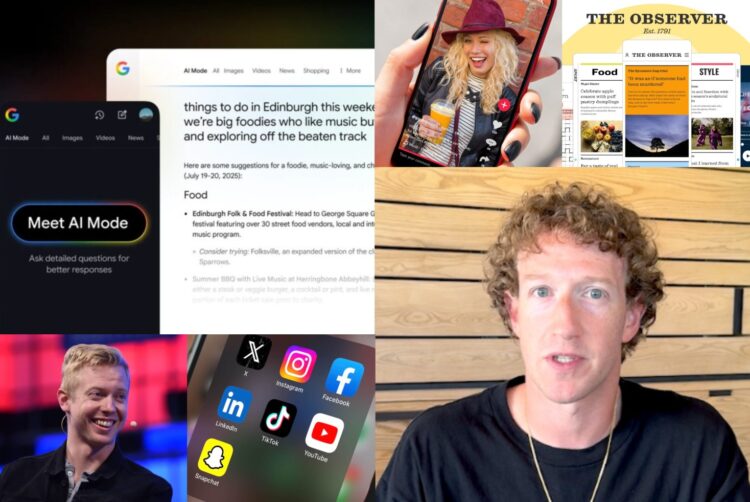
2025 in Review
For the online web and social media platforms, 2025 was a year in which disruption became maturation.
Two to three years after the launch of ChatGPT, AI search finally rolled out, sending shockwaves across the open web and to the publishers whose business it relies on.
Meanwhile, the creator economy took off this year and established media owners finally capitulated, leaning into third-party platforms for distribution.
Those tech platforms are only getting bigger. According to the latest AA/Warc global adspend forecast, ad revenue growth is being “concentrated” in Big Tech. Outside of China, Alphabet, Amazon and Meta are now expected to account for 58% of the entire global ad market next year.
The rest of the market is undergoing a period of consolidation, including in publishing. The Observer changed hands from The Guardian to Tortoise Media this year. The Telegraph may finally have its long-awaited buyer, Daily Mail and General Trust.
If you aren’t a platform, you’re getting squeezed. None more than the web’s long tail of media owners, who struggled this year as they were caught between shrinking referral traffic in an AI search era and growing demand for short-form video.
Here are five key themes from the past year in the increasingly blending worlds of social media and publishing.
Publishers stake out a piece of the creator economy
For news publishers, 2025 was the year in which long-planned investments in AV production started to come to fruition. Yes, “pivot to video” is back in full-swing.
The Independent launched its new development, production and distribution Studio in April, aimed at driving a convergence between the news brand and the creator economy. The publisher has sought to work with established creators to launch new multimedia brands that fit within its core coverage areas, like football.
The Daily Mail likewise launched two new social publishers at its upfront event in October. DMG Newmedia and Creator Media are being led by Gen Z and Millennial talent with a mix of focus between news, entertainment, fashion and lifestyle across different channels.
The New York Times has also embraced short-form video and directed its journalists to be more personable, interacting in the comment section of their articles and doing more work on camera.
Meanwhile, The Guardian is in the midst of a AV-led investment drive of its own ahead of next year’s World Cup.
For journalists, the result is those with multimedia skills are likely to be elevated into new roles (including potentially partaking in commercial content), while those historically focused purely on the written word are being forced to adapt. For publishers’ commercial leaders, the hope is that by tapping into the creator economy, publishers can access new revenue via branded content and AV budgets. The same is true, it’s worth noting, for broadcasters as well.
TikTok, in other words, may well have truly changed the publishing industry for good. As Good Housekeeping MD Liz Moseley told The Media Leader in July: “The language of the internet is video”.
‘Social as a destination itself’: Inside Mail Metro Media’s two new social publishers
Low content moderation is the new standard on social
Part of publishers’ strategy in embracing social this year is to carve out a niche of trusted, quality content within platforms that are widely associated with concerns over brand safety, user safety, AI slop, misinformation and other harmful content.
After all, the year kicked off with Meta CEO Mark Zuckerberg announcing changes to Facebook, Instagram and Threads’ content moderation policies that, he explained, mean the company “is going to catch less bad stuff”.
The tech giant halted its third-party fact-checking programme, replacing it with an X-like Community Notes feature. In addition, Meta quietly updated its hateful conduct policy to allow users to, for example, call women “household objects” or refer to transgender or non-binary individuals as “it”.
TikTok has also reportedly disinvested from its trust and safety efforts, laying off more than 400 members of its trust and safety team this autumn.
On the aforementioned X, meanwhile, owner Elon Musk has repeatedly pushed a nativist and white supremacist agenda on his own account while tinkering with the algorithm behind the scenes to promote far-right content he personally finds favourable. Musk also called for the overthrow of the UK government and the dissolution of the European Union.
While advertisers have been wary of spending on X, many key public figures and journalists, including the UK government’s official accounts, remain posting on the platform.
Meanwhile, despite outcry from marginalised communities, advertisers have continued to reward Meta and its competitors with significant ad revenue growth this year.
We need to talk about Meta — with Outvertising’s Sonnie Spenser
Big tech gets bigger — but how much is fraud?
Indeed, in Big Tech’s latest earnings results, Meta, Snap, Pinterest and Reddit all reported revenue growth in double-figures.
In Q3, Meta reported 26% year-on-year growth in revenue to £51.2bn; Snap grew revenue 10% year on year to $1.5m; Pinterest reported 17% year-on-year revenue growth to $1.05bn; Reddit grew total revenue 68% year on year to $585m.
While TikTok does not report earnings as a private company, its growth in commerce through TikTok Shop has been similarly impossible to ignore.
Blowout earnings from the tech giants come as other media channels are struggling amid macroeconomic headwinds. According to the latest AA/Warc adspend figures, digital ad channels, including search, online display, retail media and social media, now account for more than four-fifths (81%) of UK adspend.
The platforms have benefitted from a mix of growth from small- and medium-sized enterprises (SMEs) as well as enlarged social media and online display budgets from many larger brands. In March, Unilever became one of the largest companies to undertake a social-first marketing strategy, with CEO Fernando Fernandez announcing it would dedicate half of its adspend to social media.
While platforms appear to thus have strong momentum, it may be built on an unsteady foundation. In November, Reuters reported Meta projected about 10% of its 2024 revenue came via ads from scam or banned goods.
Meanwhile, overinvestment in platforms has repeatedly been questioned by media effectiveness experts, who have repeatedly warned that low-attention media is inefficient and has harmed brands’ long-term prospects.
Challenger agencies have backed an informal effort to return ad investment back to high-quality media owners, including and especially news publishers. Stagwell’s Future of News Initiative saw it commit to increase its adspend with news media by 22% this year and host a news publishing upfront in New York this autumn. Bountiful Cow, meanwhile, helped prove that advertising against web articles deemed “brand unsafe” by keyword blocklists in fact led to improved campaign performance.
AI search changes the game…
With Big Tech companies raking in revenue, they’ve had long leashes to spend billions developing new generative AI models that they have pitched as transformational for businesses and the web as we know it.
Just three years after the launch of ChatGPT, AI is everywhere, including in our search bars. Google this year rolled out its controversial AI Overviews and AI Mode features, resulting in “existential” harm to publishers whose content has been illegally scraped and surfaced in AI search results.
While Google has repeatedly claimed its AI features have not had a negative impact on referral traffic to publishers, publishers have almost universally reported stark, sudden declines in traffic from Google Search.
Over the summer, Authoritas, an SEO analytics company, found publishers experience an average 47.5% decline in click-through rates on desktop and 37.7% on mobile when Google’s AI Overviews are served to users. The Daily Mail has publicly shared that, when an AI Overview is triggered in response to a keyword, the average clickthrough rate is 80% to 90% lower on Mail articles compared to when no AI Overview is present.
AI search is also changing user behaviour beyond clickthroughs. According to a new behavioural study conducted by ViewersLogic and released this week, “heavy” users of OpenAI’s ChatGPT spent 39% less time on news and newspaper websites during the first half of the year.
As James Rosewell, co-founder of Movement for an Open Web, commented: “Google’s AI Overviews are nothing more than double daylight robbery, stealing content from publishers to inform their models and then using these outputs to steal traffic from them.”
As The Media Leader reported in September, one-third of publishers in the Independent Publishers Alliance could be out of business by the end of next year if no regulatory intervention is made to protect publisher business models affected by AI search.
A complaint filed in July by the Independent Publisher Alliance and Movement for an Open Web, in tandem with Foxglove, resulted in the European Commission opening an investigation this month into whether Google’s AI products amount to anticompetitive conduct.
“What we need to see now is immediate action to stop the pain for publishers,” said Rosewell, indicating hope for an emergency injunction that could staunch the bleeding. He added: “This case isn’t about opposition to innovation, it’s about stopping a business model that’s built on theft and monopolistic dominance.”
Even if an injunction comes, enough damage has already been done to the web ecosystem that publishers need to consider new strategies. As Enders Analysis’ former CEO and director of publishing and tech Douglas McCabe warned at the the Professional Publishers Association (PPA) Festival in May, the “death of the website” is nigh.
Publishing brands are competing in an “asymmetric battle with the creator economy”, while consumers are turning to AI search for spoon-fed information, he posited.
The result? More paywalls and subscription fatigue, yes, but also an opportunity for premium publishers to stand out by being “top-tier consumer and world life experience[s]” by ceding “time-passing” behaviour to platforms.
One-third of indie publishers could shut down by next year as AI search hits traffic
… And blows the search market wide open
As publishers struggle to reorient themselves in a changing web, AI search has created new opportunities for competitors to challenge Google for search dominance for the first time in decades.
Google, sitting on an incomparable raft of user data and hastened AI development, may yet win that battle against the likes of ChatGPT, Perplexity and Meta AI. But changing user behaviours this year have benefitted two platforms in particular: TikTok and Reddit.
TikTok has emerged as a growing destination for search. As UK general manager of global business solution Kris Boger explained to The Media Leader this week, one in four TikTok users conducts a search within 30 seconds of opening app. Video-based search can be informative, but equally can work in tandem with other search behaviours. A user searching for a travel destination on Google or with a large-language model (LLM) can turn to the platform to quickly visualise the trip, for example.
Reddit, meanwhile, has been a breakout star among advertisers this year, with multiple heads of social at holding group agencies telling The Media Leader in recent months that the platform has been a standout both for paid advertising and organic efforts to have their clients surfaced in AI search.
According to Reddit CEO Steve Huffman, as of this summer Reddit was making up a plurality of the data Perplexity and ChatGPT use in response to queries. Influence the conversation on Reddit, it follows, and brands can influence AI search results.
“If you’re using the internet, you’re probably using Google. If you’re using Google, you’re probably using Reddit,” Huffman said at the Cannes Lions Festival of Creativity this summer. “We spent the last 20 years learning how to talk to Google and ask questions to get the right answer out of it. But now there’s whole new class of question — this kind of open-ended, subjective question — that we as internet consumers can now ask and expect to get an answer out of.
“Now, that might come from Google; it might come from ChatGPT. But I actually think it will increasingly come from Reddit.”
Reddit CEO Steve Huffman: ‘People hate ads, but they love brands’