



Sounds of the future
The Future of Audio: In Focus

To understand the disconnect between digital radio’s ROI and its adspend, J-ET’s Oliver Plume examines how the landscape has changed.
With the start of the new year, the industry press (this parish included) is awash with predictions, trying to answer the question: what will be the main focus of 2026? AI has, understandably, had hundreds of column inches dedicated to it over the last few weeks, and we will surely be feeling its impact well beyond this year.
Outside of this monumental leap forward/existential threat (take your pick), I’d like instead to draw your focus to a more ‘down to earth’ section of the media landscape, which, in recent years, has been quietly undergoing a revolution of its own.
You heard it here first: 2026 will (finally) be the year of digital audio.
To clarify, that’s not to say its linear counterpart is necessarily in a bad place. Far from it.
According to Radiocentre’s High Gain Audio research, full-term profit ROI from broadcast radio is £4.80 for each invested pound – exceeding online video, PPC, paid social and online display. However, the long-term ROI for digital audio is even greater, at £5.80.
While impressive, the ad spend hasn’t followed. Between 2023 and 2024, the total audio audience grew by 5.2%, while revenue growth lagged at 1.8%.
There is clearly a disconnect between the potential of this growth market and industry investment. To understand why, it is worth examining the components of the new audio landscape and how they have changed over the last five years.
Meet the new boss…
Much has been made of the ‘podcast boom’ of the pandemic. While people were locked away and the performing classes’ options were limited, it seemed every Z-list celebrity and their mother-in-law were scrambling around for recording equipment.
Fortunately, this period also produced some outstanding content amongst the dross, and the public agreed: podcasts’ weekly reach increased from 23.2% in Summer 2019 to 32.5% in 2022 (RAJAR MIDAS Summer data will be used for the remainder of this section for ease of comparisons).
The ‘podcast bubble’ never burst and has established itself as a core part of the audio landscape.
Podcasts also boast some of the highest rates of ad recall in advertising, full stop. However, while their audience continues to grow, the market has since begun to saturate, with that reach currently at 34.2%. Good, but not game-changing.
Similarly, music on-demand services, though a far more established section of the digital market – having the greatest weekly reach amongst digital audio peers of 42.2% in 2019 – are also growing.
New players have arisen to compete with the likes of Spotify in recent years, meaning the collective weekly reach of the music streaming giants is now 57.1% of the population (and an incredible 88.6% for 15–24-year-olds). Of course, as many as half of listeners will have ad-free subscriptions, but regardless, those are still numbers no one can easily overlook.
The new king of digital audio may surprise you, however…
Live online radio now reaches 72.0% of the UK population weekly, and 31.6% of MIDAS respondents listen ‘every day’.
That’s up from 40.3% weekly reach in 2019 – a staggering amount of growth in just five years. Despite the world of commercial audio being more diverse than ever, radio still holds the key to the public’s heart.
So, if what we’re listening to hasn’t changed as dramatically as first thought, it’s how we listen that has.
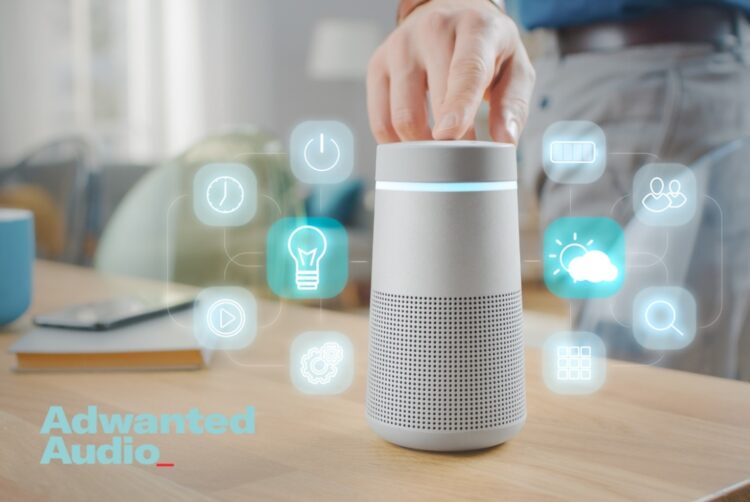
The real game-changer has been the uptake of smart speakers. Over half the population now has regular access to a voice-activated speaker and, with little discrepancy between social classes (ABC1 – 53.8%, C2DE – 52.3%), they are on their way to becoming a staple of the British household.
Our own AudioLab data (which reports on both online radio and podcasts) supports this.
Just over 40% of all impressions registered by the system have been heard through a smart speaker, and they have the highest listen-through rate (97.8%) of any device type.
Brave new world
This new era of listening provides massive opportunities.
As well as all the advantages in targeting and measurement associated with digital media, smart speakers in particular may hold the key to the most elusive of audio metrics: attribution.
Amazon has made great strides with interactive ads on Prime Video recently. Why can’t the same be replicated on its Alexa devices?
We’ve already seen some creative agencies experiment with copy delivered through Audiotrack that encourages listeners to ask Alexa to add products to their basket.
While they are so far uncommon, with existing VAST delivery methods and AI reducing the creative load, it doesn’t seem like much of a leap to serve ads to smart speakers and attribute resulting purchases via IP or account details.
Of course, any experienced planner will be the first to tell you that, when it comes to audio’s performance, there is a lag between ear to purchase. But does it always have to?
Audio no longer needs to be a solely brand-building medium. The above is just one example where new technology could be utilised by advertisers to drive immediate purchases. The question is, why haven’t they?
Each type of digital audio has its own challenges. With podcasts comes unreliability of downloads as a metric and debates about whether they are purely audio or not.
Music streaming services face the entropic threat of ad-free subscription models. All digital audio faces challenges with booking and reporting that come with such a disparate market.
Despite not exactly being a new form of media, digital audio is still experiencing growing pains.
The market is more diverse than ever, and while tempting to buyers, it will never reach its full potential without a more integrated ecosystem and processes that provide the same levels of trust as linear broadcasting. The market has exploded, now it needs to be reigned back in again.
We’ve made strides of our own at Adwanted UK, launching digital trading through J-ET towards the end of last year to integrate both the linear and digital buying process.
So far, this serves audioXI and DAX (Bauer and Global’s respective systems), but the more cohesive the audio environment is, the more attractive it becomes as a sales prospect.
But trading is just one part of the equation. The aforementioned targeting and creative possibilities remain largely untapped. We can help facilitate it with VAST delivery, but it is up to advertisers to come up with imaginative ways to meet that potential.
Still, I remain optimistic that 2026 will be the year that happens. The structural foundation has been set and will continue to expand – both in scope and functionality. Now it’s just up to the industry to take advantage.
 Oliver Plume is Adwanted UK’s audio communications specialist. You can sign-up to his monthly, audio focused newsletter ‘ReSoundUp’, here.