



AI, press freedom and platform power: The 77th World News Media Congress
WAN-IFRA Congress preview
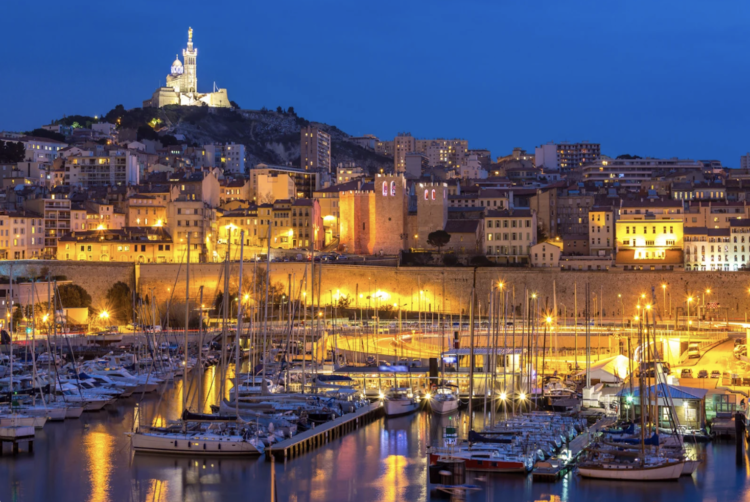
More than three decades after it was last held in Marseille, France, the World News Media Congress will return in June 2026, amid profound structural change in the global news industry.
Organised by WAN-IFRA in partnership with CMA Media, the gathering takes place during what many leaders believe is a defining inflexion point across economic, technological, and political fronts.
Jean-Christophe Tortora, CEO of CMA Media Press, frames the moment as a “turning point” shaped by three simultaneous pressures”
* The economic challenge: building sustainable business models in an environment where advertising remains volatile, and audience acquisition has become more expensive and less predictable.
* The technological disruption, driven by how artificial intelligence is reshaping content production, distribution, and monetisation.
* A growing political challenge: media organisations across multiple regions face increasing hostility, regulatory uncertainty, and direct attacks on press freedom.
A sector that is cautious, but not defeated
Despite a narrative of crisis that often dominates public debate, WAN-IFRA’s latest World Press Trends Outlook 2025-2026 suggests a more nuanced reality.
Based on responses from more than 170 senior media executives across 66 countries, 65% say they are optimistic about their prospects over the next three years.
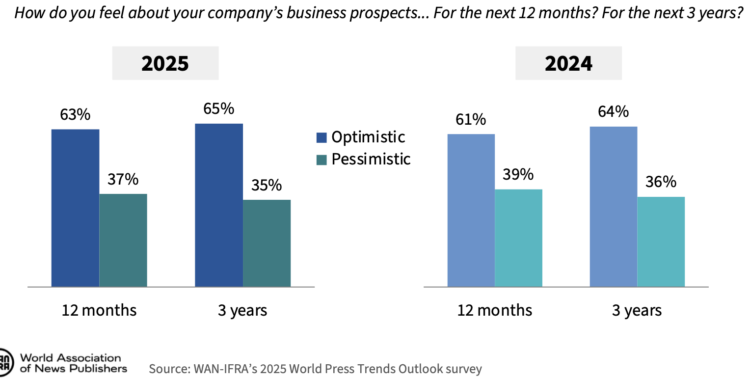
Revenue transformation is well underway. Digital income and diversified revenue streams now account for 56.4% of total revenues in the surveyed markets, compared with 43.6% from print. Seven in 10 companies report maintaining or increasing headcount, challenging assumptions of uniform contraction across the industry.
However, optimism coexists with clear structural risks. Data referenced in the report indicates that referral traffic from Google Search has declined by approximately 33% year-on-year, reflecting the broader shift towards AI-generated summaries and in-platform answers.
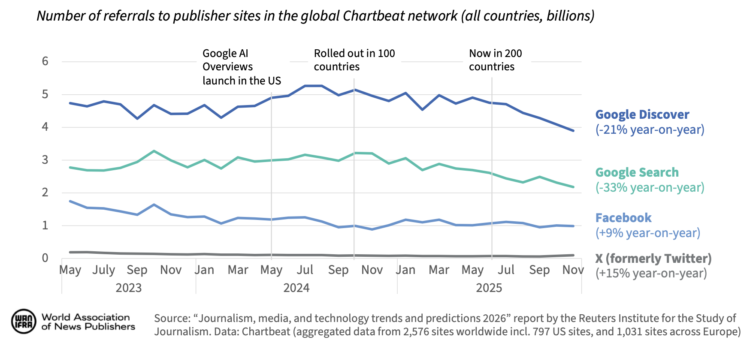
Traffic from generative AI tools such as ChatGPT remains marginal, accounting for about 0.02% of total referrals. For publishers in both the UK and the US, this reinforces a critical question: how sustainable is audience acquisition in a post-search-dominant environment?
Stig Kirk Ørskov, CEO of WAN-IFRA, puts it bluntly: “There can be no independent media without financial sustainability”. In other words, editorial independence is structurally tied to revenue resilience.
AI licensing and the risk of fragmentation
One of the most sensitive debates concerns the industry’s approach to AI partnerships. Some publishers have signed individual licensing agreements with AI companies, while others remain sceptical.
Tortora argues that fragmented negotiations risk weakening the sector’s collective leverage. He calls for a broader AI licensing framework to prevent publishers from negotiating in isolation with major technology players.
WAN-IFRA has articulated five guiding principles for the AI era: transparency, attribution, recognition of sources, pluralism and dialogue.
Ladina Heimgartner, president of WAN-IFRA and CEO of Ringier Media Switzerland, emphasises that the organisation does not position itself as a traditional lobbying body. Instead, it aims to create a global platform for structured dialogue among publishers, platforms, and policymakers, while remaining unequivocal in its support for press freedom.
For UK and US publishers, where platform relationships have evolved differently — from Australia’s bargaining code model to the patchwork of US licensing deals — the question of collective versus individual negotiation remains highly relevant.
Press freedom under pressure
Beyond economics and technology, the political dimension is increasingly central.
According to the WAN-IFRA data, 45.5% of surveyed executives believe press freedom has deteriorated in their country over the past year. In addition, 57.8% report increased online harassment targeting journalists and newsrooms.
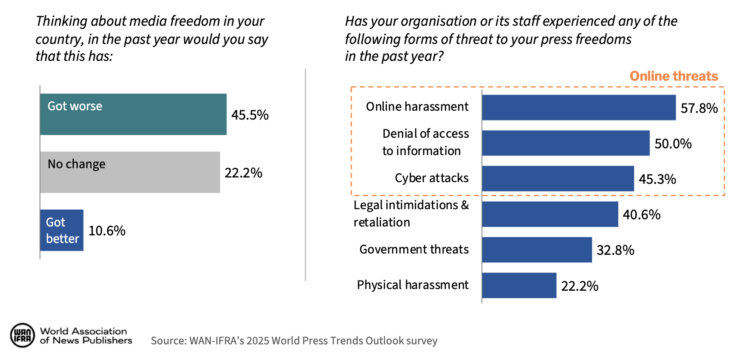
These figures resonate strongly in both US and European contexts, where trust in media remains fragile and political polarisation continues to shape public discourse.
The Golden Pen of Freedom award, presented annually at the Congress, underscores that the fight for press freedom is not symbolic but operational, often involving legal risk, financial pressure and personal danger.
Heimgartner argues that the explosion of synthetic and AI-generated content presents a paradox. While misinformation and deepfakes blur the line between real and fabricated content, the role of professional journalism becomes more essential, not less. In that sense, AI may simultaneously destabilise and re-legitimise the industry.
From resilience to renewal
The 2026 Congress is positioned not simply as a forum for sharing best practices but as a platform to shape collective responses.
Topics will include AI in media, future newsroom structures, and revenue innovation. International leaders from The New York Times, Dow Jones, The Guardian and AFP are among the confirmed speakers, reflecting a cross-Atlantic conversation about the next stage of industry transformation.
For UK and US media executives, the strategic question is no longer whether transformation is necessary, but how to align technology investment, revenue diversification and political engagement within a coherent model.
The broader message emerging from WAN-IFRA is one of guarded confidence. The industry has adapted before — through the rise of the web and the smartphone era — and many leaders believe it is better prepared for this AI-driven shift than other sectors.
Yet success will depend on collaboration among publishers, platforms, and policymakers, particularly as the balance of power in digital distribution continues to evolve.
As the global news industry prepares for the future, the core challenge is clear: financial sustainability, technological adaptation and press freedom are no longer separate conversations. They are interconnected variables in a single equation.
The question is whether the sector can convert resilience into a renewed collective strategy before structural pressures outpace reform.
The Media Leader is the official media partner of the WAN-IFRA Congress in Marseille: https://wan-ifra-congress.com/2026/