



Ads are coming to ChatGPT. Do brands want in?
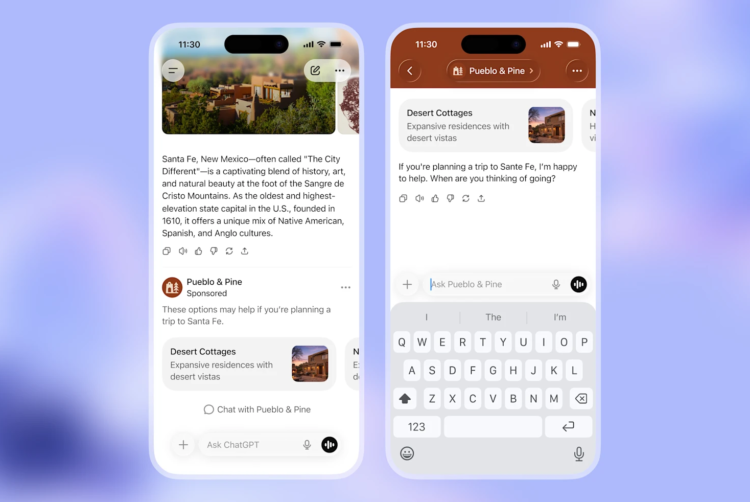
More than three years after the launch of ChatGPT, OpenAI has committed to bringing ads to the chatbot.
In a blog post last Friday, a spokesperson for OpenAI outlined its intention to begin testing ads in the US, both for free and ChatGPT Go (its new “low-cost”, $8 per month subscription tier) users. Subscribers to ChatGPT’s Plus, Pro, Business, and Enterprise tiers will not receive ads.
For its initial test, ads will be placed at the bottom of answers in ChatGPT “when there’s a relevant sponsored product or service based on your current conversation”.
Ads will be “clearly labelled” and “separated from the organic answer”. Users will be given access to prompts to learn more about why they are seeing a given ad, dismiss any ad, and provide feedback.
Both registered and “predicted” under-18 users will also not see ads during the testing period. OpenAI also claims ads are “not eligible” to appear next to “sensitive or regulated topics”, including health, mental health and politics. It’s not yet clear whether or how OpenAI will be able to guarantee such brand safety measures.
In the blog post, the spokesperson reiterated that OpenAI’s “mission” is to ensure AGI (artificial general intelligence — a still-hypothetical AI that can match or surpass human capabilities across all cognitive tasks) “benefits all of humanity”. Its pursuit of advertising, thus, “is always in support of that mission and making AI more accessible”.
To preserve user trust, the spokesperson also claimed that ads “do not influence the answers ChatGPT gives you” and that they will remain separate and clearly labelled.
In addition, conversations users have with ChatGPT will be kept private from advertisers, with the company committing to “never sell your data to advertisers”.
Users will also be given some control over their ad experience, with the ability to turn off personalisation and clear the data used to serve ads.
“We prioritise user trust and user experience over revenue”, the blog post reads. “People trust ChatGPT for many important and personal tasks, so as we introduce ads, it’s crucial we preserve what makes ChatGPT valuable in the first place. That means you need to trust that ChatGPT’s responses are driven by what’s objectively useful, never by advertising.”
Analysis: Ads as a necessary lifeline?
On Sunday, OpenAI’s chief financial officer, Sarah Friar, said in a blog post that the company’s annualised revenue surpassed $20bn in 2025, more than tripling from $6bn in 2024. Growth, she indicated, “directly tracks available compute” — as capacity to serve users has grown, so has demand.
“Infrastructure expands what we can deliver,” she added, indicating that OpenAI’s strategic focus in 2026 will be on “practical adoption”.
But $20bn in annual revenue is still just a fraction of the total OpenAI will need to gross to remain in business. The tech giant’s partners have reportedly amassed $100bn in debt to help fund its growth, and CEO Sam Altman has further made $1.4tn in commitments to build out energy and computing infrastructure.
An analysis by investment bank HSBC last autumn predicted OpenAI still won’t be profitable by 2030, even if its userbase grows to comprise 44% of the global population.
HSBC also estimated that OpenAI will need to raise at least another $207bn in “compute” to fund its growth plans.
In an op-ed published by The New York Times this month, Council on Foreign Relations senior fellow Sebastian Mallaby warns that “companies such as OpenAI are likely to run out of cash before their tantalising new technology produces big profits”. He points to the lack of “stickiness” in consumers’ use of large-language models, with a high degree of competition in the market making it easy for users to switch from one AI service to another.
“The problem for AI developers is that most users aren’t paying for their services,” argued Mallby. “People can choose among multiple free and excellent models; unless they have especially complex and compute-intensive queries, they have little reason to subscribe to the premium versions. If a model maker imposes a paywall or displays irritating ads, customers will migrate elsewhere.”
While worsening ChatGPT’s user experience with ads could prompt users to switch to an ad-free product, scaling ad revenue will be a necessary part of OpenAI’s increasingly diversified business model, if for no other reason than sheer necessity to keep up with ballooning costs.
“ChatGPT adding ads isn’t about greed, it’s about gravity,” reflected Zaid Al-Zaidy, CEO of marketing agency Beyond. “AI is expensive to run, and even the biggest players in the industry are being pulled toward the ad model.
“The perpetual tightrope walk isn’t whether users accept ads, but whether OpenAI can add them without turning a breakthrough product into just another attention marketplace.”
How interested are advertisers?
Whether advertisers are sufficiently interested in ChatGPT to the point that the ad model drives significant revenue gains is also an open question.
In a statement, IAB UK CEO Jon Mew said the move towards embracing advertising for large-language models (LLMs) “has the potential to reshape parts of the digital advertising ecosystem, particularly if conversation interfaces become a more common starting point for information discovery”.
“Any meaningful shift in user behaviour away from traditional browsing or search could have knock-on effects for publishers, search and performance-led channels that currently underpin the market,” Mew continued.
Sarah Healy, deputy head of media investment at People’s Postcode Lottery, told The Media Leader that, as AI search has developed, traditional search clicks have entered a period of decline. As such, the monetisation of AI-led search is an “exciting development” for the brand’s media team.
“It presents a new opportunity to reach audiences who are becoming increasingly difficult to engage through traditional search platforms, and we will be watching its evolution closely,” she added.
Should brands invest in ads on ChatGPT once they become available outside the US market? Certain verticals, especially travel or product-based brands, could benefit from their proximity to chatbot responses if users are actively seeking information and advice on consumption options.
“It is a big yes, but under certain conditions,” Josh Preston-White, VP of paid search at Brandtech Group agency Jellyfish, told The Media Leader. “Placements must be ethical, natively integrated, and value-additive. We shouldn’t activate ads for the sake of it; they must flow with the user’s journey rather than disrupting it.”
Willis Annison, digital performance director at independent agency Bountiful Cow, added that while clients should “absolutely explore this”, not every advertiser should necessarily embrace it, at least not at this stage.
“Clients should look at their referral data and see if there is a large proportion of traffic coming from ChatGPT, and if so, it could signal an opportunity,” he said. But he offered the caveat that OpenAI’s embrace of advertising is not likely to be as “expansive” and therefore as “opportune” as Google’s own AI search offering.
“OpenAI stating it will ‘never sell your data to advertisers’ is a bold move and one that aligns with a more data-conscious user who worries about how their data is used online,” he considered. “The likelihood is that ads will be triggered by phrases and keywords, similar to Google, based on the conversation within the chat. As a result, the focus will be more on intent signals and trigger phrases, at least in the current model.
“This may change in the future, but for now it will feel closer to a keyword-led performance approach, with demographic data playing a smaller role.”
Mew and Preston-White both stressed that AI companies introducing advertising will need to align with existing ad industry standards on transparency, privacy, and measurement.
Their willingness and ability to do so will, as Mew indicated, “determine whether the LLM-based advertising becomes a complementary channel, or simply another layer within the current digital advertising landscape”.