Agency employment declines 6.8% as creative roles hollowed out

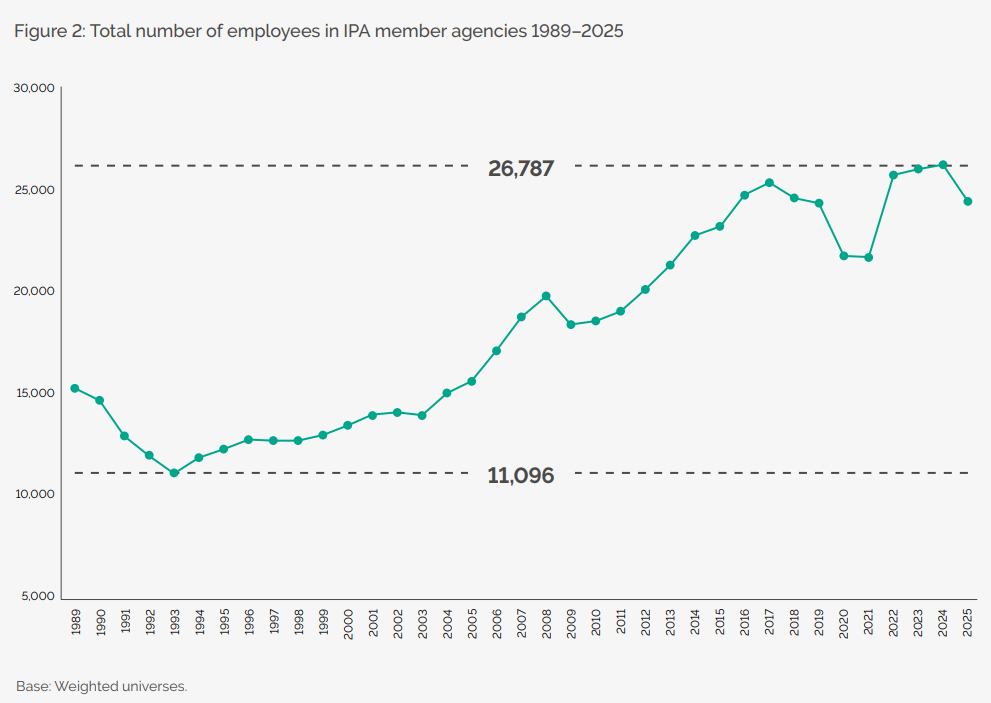
Member agencies of the Institute for Practitioners in Advertising (IPA) employed 24,963 people as of September 2025 — a 6.8% decline from the year prior.
The reduction was driven by a contraction in creative and other non-media agency employment and comes amid substantial consolidation in agency groups.
Among creative agencies, employment fell 14.3% year on year to 12,659. In contrast, media agencies increased their hiring, adding 292 roles in aggregate to reach 12,304 employees (+2.4%).
The overall decline in agency employment marks just the fourth period since the 1980s of considerable annual contraction, following the early ’90s recession, the 2008 global financial recession, and the Covid-19 pandemic.
The latest Census report comes just days after it was reported WPP would consolidate its creative advertising agencies under a single banner, dubbed WPP Creative.
Existing agencies Ogilvy, VML, and AKQA will be retained as client-facing brands, much as WPP consolidated its media agencies under WPP Media last year. WPP cut 7,000 jobs between June 2024 and June 2025 amid waning growth.
Following the December closing of its acquisition of Interpublic Group, Omnicom Group also announced it would cut 4,000 jobs and fold IPG agencies DDB and MullenLowe into Omnicom’s TBWA. Another agency network, FCB, was also folded into Omnicom’s BBDO.
“It’s important to recognise the emotional impact of job loss, as well as the logistical and financial considerations involved,” commented Sue Todd, CEO of the advertising and media industry wellbeing charity Nabs. She told The Media Leader redundancy is one of the top reasons people contact Nabs for help, and indicated that, given the latest figures from the IPA, “this trend is set to continue.”
The charity has released a guide for those facing redundancy. “These are uncertain times for the industry, but our help remains constant,” Todd added.
Substantial drop in young talent
The highest falls in staff numbers are among part-time staff (-9%, compared to -6.7% among full-time staff), men (-7.3%, compared to -6.2% among women), and those aged under 25. The latter category in particular threatens the future of an industry that has always relied upon bright young (and less expensive) talent that is well-suited to assisting marketers in reaching the highly valued 16-34 demographic.
The proportion of employees aged 25 and under fell by 19.2% year on year to 2,936 in 2025. Just 11.8% of the industry’s talent is now under 25 — a sharp decline from three years ago, when 17.4% of the industry was represented by that cohort.
Graduate recruitment fell in kind. Just over two-fifths (43.4%) of agencies reported that they currently employ graduate trainees, apprentices, employees on degree apprenticeship or school-leaver apprentices, down from 56% in 2024.
The average employee age at agencies thus ticked up to 35.6 years. A plurality (37.3%) of agency employees are ages 31-40, followed by 26-30-year-olds (25.1%) and 41-50-year-olds (17.6%). Those aged 50 and above account for only 8.3% of agency staff.
In addition to the cuts in headcount, open vacancies also dropped sharply as agencies held back on hiring.
IPA agencies reported 680 open roles across all levels of seniority at the time of the Agency Census survey, a 40.8% decline compared to 2024. This was more pronounced at creative agencies (-47.2%) than media agencies (34.7%).
AI appears to be shaping hiring and retention decisions, though it’s plausible that, given downward pressure on agency business models (share prices have been falling for months among WPP, Omnicom, Publicis and others), attributing the contraction in the agency labour market to AI efficiencies could be “AI-washing” a downturn in business performance.
According to the Agency Census, 8% of agencies said they reduced their workforce within the past 12 months as a “direct result” of AI, while a quarter (24%) expect to do so in the next year.
This expectation of workforce reduction is higher among creative and other non-media agencies (30%) than among media agencies (10%), suggesting greater pessimism among creative agencies about AI’s role and its potential to threaten employees’ livelihoods.
“Headcount is down, churn is up, and the steep fall in entry-level roles raises real questions about future capability, particularly as AI reshapes skills and ways of working”, IPA director general Paul Bainsfair summarised.
He argued that “keeping talent pipelines open” and “making far better use of apprenticeships and the Apprenticeship Levy” is “no longer optional” for agencies.
“Agencies that continue to invest in early careers, skills development and retention will be best placed to build resilient businesses and a workforce fit for the future,” Bainsfair added.
Progress on diversity, equity and inclusion
The latest Census figures were not entirely gloomy, with some progress in gender representation and ethnic diversity across agencies.
Women now hold more than 40% of C-suite roles for the first time, accounting for 40.8% of positions, up from 39.9% in 2024 and 19% in 2002. Media agencies (42%) have slightly higher representation than creative agencies (39.7%).
Meanwhile, more than a quarter of agency employees (25.5%) identified as non-white, up from 23.9% in 2024 and more than four times the level recorded in 2007. Such representation was highest at the entry level, with nearly half (45.5%) of trainees and apprentices and more than one-third (36.8%) of juniors and executives coming from non-white backgrounds.
However, the C-suite is markedly less diverse, at 12.7%, up 2.2 percentage points from 2024. Of this, women from non-white backgrounds accounted for 7% of C-suite roles, compared to 6% for men from non-white backgrounds.
Despite relative headway on diversity efforts — notable progress given the significant drop in support for diversity, equity and inclusion efforts from especially American-led business leaders following the reelection of US president Donald Trump — gender and ethnicity pay gaps have remained “substantial”, according to the Census.
Based on respondents who supplied gender and salary data, women represent 58.2% of employees but receive just 52.9% of salaries, resulting in a gender pay gap of 19.5%. This is down marginally from 19.7% in 2024.
The gender pay gap was considerably larger in creative agencies (22.6%) than in media agencies (16.6%).
Likewise, employees from non-white backgrounds receive just 18.5% of salaries, creating an ethnicity pay gap of 19.4%. This is down substantially from the 31% ethnicity pay gap registered in 2024.
Unlike the gender pay gap, the ethnicity pay gap is much greater at media agencies (26.3%) than at creative agencies (12.3%).
Geographical diversity is also still lacking, with the Census finding that 81% of all agency employees are located in London. In comparison, 16% are located in the rest of England, and just 2% are located in Scotland.
Ask Nabs Anything: Handling redundancy, rejection and mental health — with Nabs’ Annabel McCaffrey