



Authentic branding is top of mind for European CMOs, McKinsey finds
As customers tighten their spending amid global macroeconomic headwinds, brand leaders are increasingly becoming concerned with creating sustainable competitive advantages through closer relationship with their customers.
That is one key takeaway from McKinsey’s latest State of Marketing Europe 2026 report, the findings of which broadly align with Isba’s study of marketers released earlier this week. Like Isba, McKinsey found that marketers are increasingly prioritising brand-building.
According to McKinsey’s survey of 500 CMOs across Europe, “CMOs are rediscovering that branding is not a relic of the past, but rather the solid rock upon which to build resilience and long-term growth”.
McKinsey attributes the embrace of branding, in part, to generative AI undermining advertising’s emotional connection with audiences.
The report reads: “The rapid evolution of AI and digital tools is reinforcing the need for marketing fundamentals (including trust and emotional connection), which have become an anchor in turbulent times, offering clarity, consistency and emotional security to customers.”
The consultancy found that European marketers are not satisfied with the current maturation of branding, budget management, and return-on-investment (ROI) capabilities. These were ranked among the most pertinent topics requiring action, alongside a perceived urgency to figure out how best to integrate generative AI and agents into their workflows.
Embrace of ‘interactive branding’
Marketers are under constant pressure to deliver efficient growth; according to McKinsey, marketing budgets averaged 8.7% of company revenue in 2025.
To drive growth, spend is being reallocated “across the entire funnel”, with CMOs moving away from “traditional” one-off campaigns focused on narrow objectives within one stage of the funnel, and toward more multipurpose activations that integrate both marketing and sales. The goal is to balance long-term brand growth with short-term sales impact.
Among European CMOs’ top priorities for next year, branding (the top priority) and authenticity (ranked fourth) are included. Across sectors, 70% of marketing leaders emphasised that purpose-driven, authentic brand experiences are “essential” for building “distinctive emotional connections” with customers and driving brand differentiation.
This is increasingly being accomplished through the use of “interactive branding”, McKinsey notes.
Rather than relying on one-way promotion, brands are moving to formats that directly engage their consumers, often asking for feedback. These could include hosting events and other live content, “conversational marketing” with real-time customer conversations via messaging apps or social media, leaning into organic and paid user-generated content, or embracing “lo-fi” campaigns that appear less polished.
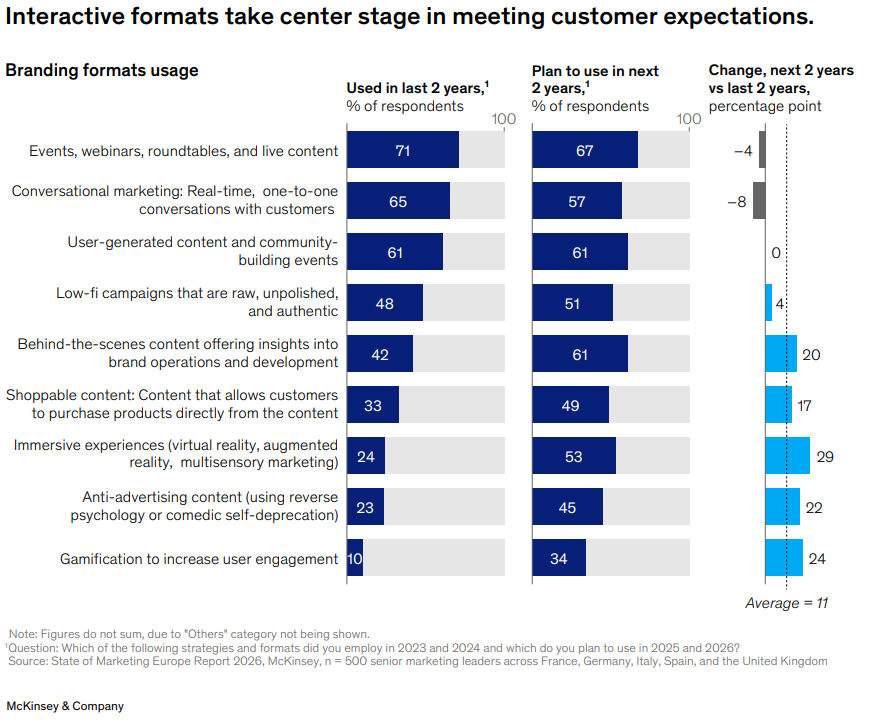
“This active involvement transforms audiences from passive observers into contributors who help shape a brand’s story and image,” the report continues. “Applied consistently across both digital and physical touchpoints, such engagement fosters stronger emotional connections and more authentic loyalty over time.”
Channel mix has thus become a highly complex issue for marketers to consider.
Channels closely associated with brand-building, such as TV, cinema and news brands, still retain value, but aren’t well-situated to offer the level of interactivity desired by many marketers. But if you make a campaign too interactive, you risk your core message going awry.
Benjamin Faveris, CMO of French telco Orange France, admitted, for example, that he is constantly grappling with “how to maintain brand coherence when speaking to new audiences”, given that hard-to-reach younger audiences pose unique creative challenges. Orange France has responded by experimenting with interactive formats, like sponsoring a YouTube creator to climb Mount Everest.
He called the effort a “careful balancing act”, adding: “I mean, TV remains a trusted medium for building brand quality and trust, but it’s not always the most flexible or interactive. On the other hand, digital and radio formats allow for more experimentation, but they can dilute the brand message if not executed carefully”.
Isba: Advertisers’ media budgets shift toward brand building