



Broadcast debate shows prioritising Labour and Tory guests despite third-party surge
Debate programmes on broadcast television are prioritising guests from parties with historical electoral support rather than reflective of total vote share or opinion polling, a new study from Cardiff University has found.
The report examined five leading political debate programmes: the BBC’s Question Time, Any Questions? and Sunday with Laura Kuenssberg, as well as ITV’s Peston and Sky’s Sunday Morning with Trevor Phillips. It revealed that those shows allocated the most airtime to Labour (39%) and the Conservatives (38.1%).
In Labour’s case, this proportion is considerably lower than its proportion of sitting MPs (63.2%) but slightly higher than its vote share in 2024 (33.7%). By comparison, Conservative representation is almost double its proportion of MPs (18.6%) and considerably higher than its vote share (23.7%).
Other parties were found to be under-represented relative to their vote share. Reform UK, for example, made up only 4.7% of politician appearances despite gaining a 14.3% vote share. The Liberal Democrats (8.6%) and Greens (3.7%) were also under-represented relative to their vote shares (12.2% and 6.7% respectively).
“This raises the question of whether broadcasters have adequately reflected the growing levels of support for third parties, such as Reform UK, the Liberal Democrats and the Greens,” the research concluded.
Scrutiny of third-party politicians needed
The report noted that the rise in support for political parties away from the traditional dominance of Labour and the Conservatives has made it “increasingly challenging for broadcasters to make impartial judgements about the selection of politicians in broadcast media”.
While it did not conclude that any broadcaster has breached due impartiality standards, the study did find that prominence based on the number of seats won at the last general election is given more weight than other factors, potentially limiting opportunities for third-party candidates despite being an accurate reflection of the UK’s first-past-the-post electoral system.
Professor Stephen Cushion, who authored the study, told The Media Leader: “Our aim was to offer an evidence-based study about how broadcasters are currently interpreting due impartiality when they allocate time for politicians to appear in their programmes.”
The study did not include GB News, where Reform leader Nigel Farage hosts a primetime show. It examined every politician who appeared on those five programmes during the 2024/25 parliamentary season to understand the proportion of coverage granted to each party.
Cushion said that, had GB News been included in the study, it “would have driven up coverage of Reform UK”.
As the study pointed out, third-party representation on the shows has not necessarily kept up with aggregate polling data. While appearances from Reform politicians have increased since it began leading in UK polls in late March, the Lib Dems and Greens are also polling higher — but this has not been especially reflected in debate and panel programming.
Cushion commented: “Some critics may argue [Reform UK] receives too much coverage from broadcasters. After all, the party only had a handful of MPs elected in the last general election.
“But given Reform UK is currently riding high in the opinion polls, there is an argument to say the party should appear more in debate and panel programming. This then allows our leading broadcast journalists to more rigorously scrutinise the party’s policies and claims.”
Among the shows on commercial broadcasters, the study found Sunday Morning with Trevor Phillips is most focused on balancing the two major parties, offering comparably limited appearances from third-party politicians.
The Lib Dems have received minimal coverage on non-BBC programmes: on Peston, they made up 5.1% of political guests; on Sunday Morning with Trevor Phillips, just 4.1%.
Meanwhile, Plaid Cymru received no representation on either programme and the Scottish National Party made up just 2% of political guests on Peston and 1.6% on Sunday Morning with Trevor Phillips.
“Despite being flagship UK political programmes, these shows primarily focused on Westminster politics, limiting the perspective of parties from the devolved nations,” the study pointed out.
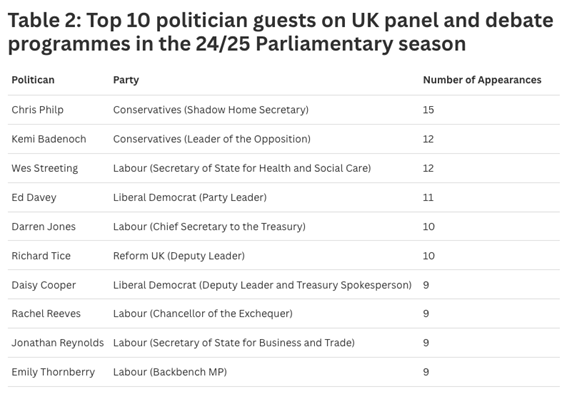
Breaking down appearances by politician, the study found that appearances by Labour politicians were split between a range of senior cabinet ministers, with prime minister Sir Keir Starmer only appearing in a handful of set-piece interviews.
Appearances by Conservative politicians were more concentrated, with shadow home secretary Chris Philp the most-featured politician, followed by opposition leader Kemi Badenoch.
Lib Dem appearances were mainly of its leader Ed Davey and deputy Daisy Cooper. Most Reform appearances were from deputy leader Richard Tice.
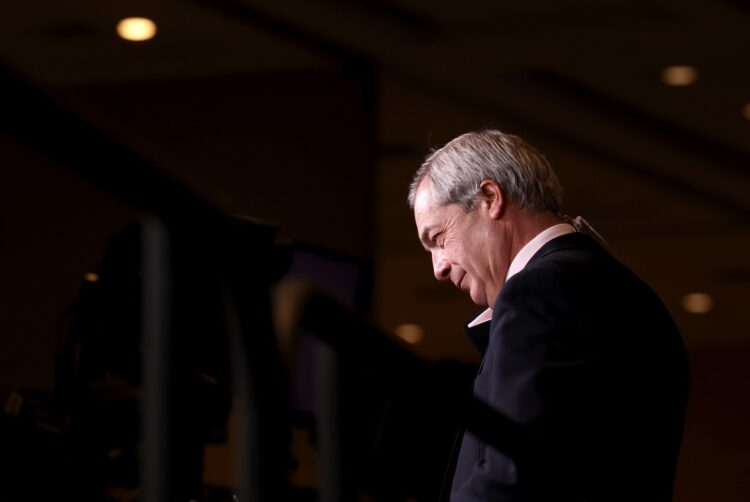
The study found Farage only appeared five times across all UK debate and panel programmes during the sample period, after years of complaints that he was given undue prominence on Question Time in particular.
Alternative modes of communication
Farage has, however, developed an alternative outlet to share his views, potentially undermining the need for him to be as active on traditional programming.
GB News, which in July and August claimed to average greater broadcast viewership than BBC News and Sky News in several key slots, is used by Farage as a mouthpiece.
Both Reform and the Tories have in recent weeks stepped up their attacks on the press — namely outlets that express critical opinions of their leadership and ideological bend.
Reform has blocked its Nottingham county councillors from speaking to Reach’s The Nottingham Post and banned The New World (formerly The New European) from attending its party conference. The Conservative party has also moved to ban Byline Times from its annual party conference.
Attending a US congressional hearing this week, Farage compared the UK to North Korea over the issue of free speech and suggested the US government should consider using “diplomacy and trade” to influence UK policy on civil liberties.
While in Washington, Farage attended the US launch party for GB News, which will officially expand its coverage across the pond this month. The event was attended by 11 members of Donald Trump’s administration. White House press secretary Karoline Leavitt said GB News shares “the values this administration holds dear: free speech, that men cannot be women, secure borders”.
Farage added: “We must believe that we can make Britain great again and that’s the mission that I’ve been on.”