



Consumers ready for broadcast switch-off in 2030s, without a nightlight
A report by the research and advisory consultancy Oliver & Ohlbaum Associates concludes that there is a strong consumer appetite in the UK for a full broadcast switch-off during the 2030s.
There is only limited support for a stepping-stone approach that relies on a reduced digital terrestrial or satellite bouquet for homes that will not be ready to shift to all-streaming TV in that decade.
This stepping-stone – or ‘nightlight’ service – is one of the options being considered by the Government. It has not been fully defined, but may include only the main public service broadcaster (PSB) services, and perhaps news channels.
The Oliver & Ohlbaum report, ‘Stream On: The Future of UK TV’, was commissioned by Sky and published in January. It implies that a nightlight service would struggle to attract viewers.
“In our survey, only 21% of broadband users who have not connected their TV set [to enable streaming TV] said that they would continue using DTT (digital terrestrial TV) or DTH (satellite) if their service was reduced to the five main public service broadcaster channels.
“This rises to 46% in the unlikely scenario that the service also included a few of their favourite commercial channels beyond this core five [of BBC 1, BBC 2, ITV 1, Channel 4 and Channel 5],” the report states.
30% of this group would turn to internet-delivered TV rather than take a nightlight service. 23% of respondents were not sure what they would do if offered a nightlight.
The report largely dismisses the possibility of operating the nightlight via satellite.
The survey questioned Freeview-reliant viewers who do not have internet TV or intend to get it over the next decade. Only 13% of this group would switch to satellite if Freeview (the free-to-air DTT service) ceased broadcasting.
Of these, 41% would use a satellite-delivered nightlight that carries only BBC 1, BBC 2, ITV 1, Channel 4 and Channel 5.
So, 5% of these Freeview-reliant viewers without internet TV access (or an intention to upgrade) are likely to use a satellite nightlight, the authors conclude. The figure rises to 6% if a few extra free-to-air channels are included.
No satellite nightlight
“Ultimately, this shows there is almost no consumer appetite for a satellite nightlight,” the report concludes.
Ofcom has been consulting the industry and wider stakeholders on whether, when and how to transition the UK from broadcasting to all-streaming. The Future of TV Distribution market report to the government (published in May 2024) set out three broad policy approaches that could be chosen.
These are: a digital terrestrial switch-off in the 2030s; a nightlight service; or continued investment to maintain a full, more efficient DTT service (assuming consumer demand is still there for DTT).
The independent Oliver & Ohlbaum Associates report, prepared for Sky, supports the former.
Most of the consumers interviewed told the report authors that the Government should focus on getting vulnerable groups ready for a clean switchover.
“Participants in our workshops preferred investment in digital inclusion schemes,” it says.
“72% supported funding for skills and affordability programmes to help people adopt internet-delivered TV services, rather than investing in nightlight options or diverting resources elsewhere.”
The Oliver & Ohlbaum study is intended to support the Government’s decision-making, which is helped by the Future of TV Distribution Stakeholder Forum, organised by the Department for Culture, Media & Sport (DCMS).
This new report draws on quantitative and qualitative research, including a representative consumer survey of 1,000 UK TV viewers, aged 18-79.
That included questions on attitudes towards future developments. The survey was conducted by FlyResearch.
There were also three consumer workshops to explore consumer perspectives in greater depth: one for IPTV (i.e., streaming or connected TV) enthusiasts, one for IPTV agnostics, and one for consumers with limited IPTV access.
The workshops were conducted in collaboration with The Knowledge Agency.
Expert interviews have also been used for additional insights.
Consumers change their minds
The report addresses concerns that large numbers of viewers will resist a switchover, noting that homes that had been expected to hold out will change their minds when faced with a confirmed switch-off date and a looming deadline.
The consumer survey found that 60% of respondents who have broadband but choose not to connect their televisions (for internet-TV services) are likely to upgrade to connected TV.
17% said ‘yes, probably within the next 1-2 years’, to the upgrade question, while 30% said ‘yes, within the next 5 years’. 13% said ‘yes, within the next 10 years’.
The advisory firm believes that if there were a planned switchover announcement around 2027, by 2034, there will be 330,000 homes that cannot, or choose not to, have internet TV or a broadband connection, including those in vulnerable groups.
The final hold-out homes are expected to receive targeted support to get them onboard. The report says this would be necessary whether broadcast switch-off happened in the 2030s or the 2040s.
The report finds that current connected TV users are much more likely to be younger than non-users. 69% of current users are aged 18-54, compared with 25% of non-users.
However, older users gain the highest value from internet-delivered TV features, it observes.
It predicts that new product innovation will strengthen this pattern. Voice control can be transformative for older and disabled viewers who struggle with traditional TV interfaces.
The report authors believe public messaging will help get broadcast-centric homes to consume more streaming TV. Among other things, this must address the misperception – as illustrated in Oliver & Ohlbaum’s workshops – that internet TV signals the end of linear channels.
“Addressing misunderstandings will be key to a successful and inclusive transition,” it states.
These sentiments echo what the DCMS found in a May 2025 report (also called ‘Future of TV Distribution’) focusing on the barriers, motivations and preferences of TV viewers.
Some of the misperceptions outlined in the DCMS consumer research, based on 100 qualitative interviews, included the belief that internet TV required a costly pay-TV subscription, that users would lose access to live TV, or that it would be complex to set up and use.
However, that DCMS report outlines the scale of the encouragement and messaging needed for a smooth transition. It found that nearly one-quarter of participants believed they would struggle without DTT.
Lobbying groups like the Broadcast 2040+ campaign have articulated the case for a longer transition, with its name summing up their belief that the government should safeguard broadcast services “until the 2040s and beyond.”
Costs of distribution
The PSBs and Everyone TV (the operating company they own, which runs Freeview, Freesat, and now Freely) have expressed concerns that the proliferation of TV distribution methods is putting “more and more cost pressure” on them.
Broadcast infrastructure comes with high fixed costs, and audiences are declining. They have warned that, first satellite and eventually DTT will reach a tipping point at which the costs of distribution outweigh the benefits.
Many multiplex licences (necessary for DTT broadcasting) expire in 2034, which is increasing the urgency for a final decision. Ofcom has previously said it would take 8-10 years to either replan the DTT broadcast frequencies or accelerate broadband take-up.
The Oliver & Ohlbaum preference for a 2030s switchover is strongly backed by the UK public service broadcasters, as represented by Future TV Taskforce, the organisation tasked with shaping the national conversation about how people want to watch TV and how it should be distributed.
The Taskforce says it supports “a carefully planned, managed transition from digital terrestrial television to internet‑delivered TV and a potential switch‑off in the mid‑2030s, as part of a broader, UK‑wide digital inclusion and transition plan.”
A spokesperson adds: “Internet-delivered TV gives audiences simple and easy access to a suite of live TV channels as well as extensive on-demand content. It has features and functionality that enhance the overall viewing experience.
“Other options for the future of distribution will lead to an inferior TV experience for audiences, with fewer channels, less content and basic functionality.
“A transition online as part of a wider plan to get the whole of the UK online has the potential to deliver benefits for audiences.”
They add: “Any transition must ensure no one is left behind.”
The CEOs at the UK PSBs (representing BBC, ITV, Channel 4, Channel 5, S4C, STV and MG ALBA – the Welsh and Gaelic language broadcasters) made a joint statement last September noting that the opportunities for audiences with internet TV are huge.
Tim Davie, the outgoing director general at the BBC, said in May 2025 it was time for the government to confirm an IP switchover in the 2030s.
He also stated the BBC’s desire “to play a vital role in helping support audiences to transition to digital in a way that is fair and equitable, where access is guaranteed and no one is left behind.”
The role of Freely
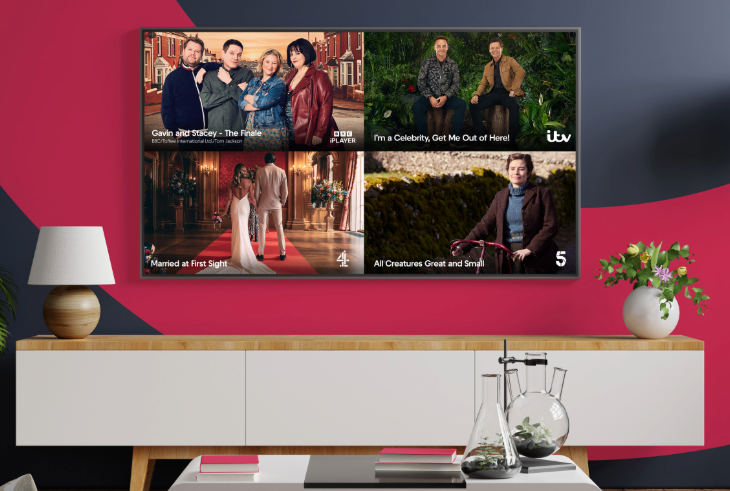
Freely (pictured) is one of the tools it will be using.
This streaming-focused, but currently hybrid broadcast/broadband platform, has pioneered a programme guide in which every channel has its own number, and that channel can be received either as a broadcast signal or an internet stream.
That makes it very easy to migrate viewers during a digital switchover: the viewer would not notice any difference the day after.
Freely is also linear-centric, though it offers easy access to PSB on-demand services. This linear focus will help to address the misperception that streaming is synonymous with on-demand.
Davie noted: “We want to double down on Freely as a universal free service to deliver live TV over broadband.”
Sky is also populating the market with streaming-only solutions (like its Sky Glass televisions and Sky Stream set-top boxes), as is Virgin Media (with its Stream service) and EE TV (including with its EE TV Box Pro).
These are the kind of solutions Oliver & Ohlbaum Associates welcomes. Its report is a worthy contribution to the switch-off debate, and its message is: Get on with it.