



How Pinterest wants to compete in ‘visual search’ amid AI reorganisation

The Media Leader Interview
UK & Ireland MD Caroline Orange-Northey discusses Pinterest’s AI development goals amid the company’s restructure, and explains why commercial goals are intertwined with improving consumer experience.
Last week, Pinterest announced it would lay off 15% of its global staff — approximately 700 people — and reduce office space amid a “reallocation of resources” to prioritise “AI-powered products and capabilities”.
The move appeared to spook investors: Pinterest shares slid more than 9% following the disclosure and remain down over 17% year-to-date. Since its initial public offering (IPO) in April 2019, shares of Pinterest are down over 9%.
But according to Caroline Orange-Northey, Pinterest’s recently-appointed managing director for the UK & Ireland, the move to reorganise comes “from a position of strength” as part of an attempt to “help us future proof”.
“These things are never easy,” she tells The Media Leader. “We’ve got a commitment to the company and to shareholders that we need to stay on the front foot. We need to stay agile. It’s a very difficult decision to say goodbye to colleagues. I think it’s necessary, though. This is a really critical turning moment.”
Orange-Northey declined to share details about how the reorganisation plan would impact the UK and Irish markets.
“We’ve dramatically changed over the past three and a half years. We’ve been really determined to make the platform more engaging and more shoppable, and leverage AI to make it feel more personal and resonant.”
AI for ‘visual search’
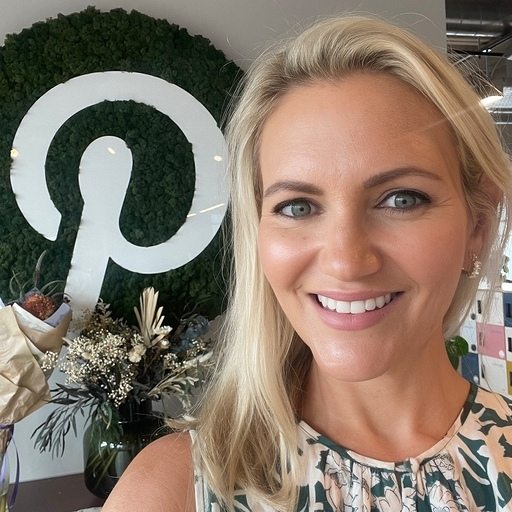 Orange-Northey (pictured, left) joined Pinterest in September 2024 as its director of retail. She had previously spent nearly a decade at Amazon Ads in various leadership roles, and earlier in her career worked at News International and the Financial Times.
In November, she was promoted to oversee the UK and Ireland following the promotion of Beth Horn, the previous MD, to VP of Southern Europe, the UK and Ireland.
Europe has been a key market for Pinterest. According to the company’s Q3 2025 earnings, the region reported 41% year-on-year revenue growth to $193m, a substantially higher growth rate than the US and Canada (+9% to $786m), albeit from a smaller base. Pinterest reports Q4 earnings next week.
“We’re at record-high users, and we’ve seen a lot of growth over the last year, particularly in Europe,” Orange-Northey describes.
Among her top priorities in her new role, which she says is backed by Pinterest’s shift to invest more in AI, is to “land the message that Pinterest is visual search”.
“We’re more than social,” she says. “And it’s a market where I think we’re really differentiated”.
She points to Pinterest Assistant, the platform’s AI-powered shopping assistant, which launched in October, as one key area of innovation the platform aims to further develop. The assistant is currently only available in the US in beta, ahead of a presumed global rollout.
“I think that’s a very good example of anticipating a customer need, but also playing in a space that’s very relevant to Pinterest,” Orange-Northey continues. “We’re already very trusted as an advisor. People come with a purpose. They’re not coming to doom scroll; they’re coming to be inspired.”
Last summer, the platform also released AI-powered auto-collages and enhancements to its Trends tool. Pinterest is also developing AI tools for additional shopping and product-discovery features. New boards and tabs the company is reportedly testing include a “Make it yours” fashion, home products and content recommendation board.
“Styled for you” and “Boards made for you” are also in development for US and Canadian users.
‘Positive’ platforms improve purchase intent, Pinterest says
The effort is part of Pinterest’s interest in moving beyond optimising for the “rational reasons” consumers might consider when shopping for an item, such as price, selection, and convenience.
Rather, AI tools, says Northey-Orange, can help analyse user psychology, anticipating “what’s going to be personal, relevant, and resonant with an individual customer” based on their tastes and aesthetic interests.
Orange-Northey claims that 96% of platform searches are unbranded, yet half of its users report coming to the platform to actively shop. That suggests a substantial opportunity for advertisers to tap into customers who are ready to spend but have not yet decided on which brand or item to purchase.
Still, Orange-Northey reiterates that Pinterest has no current interest in becoming a retailer itself, unlike TikTok’s rapidly growing TikTok Shop. Rather, Pinterest remains comfortable being “a retailer’s best friend”.
Consumer innovations drive commercial innovations
Given the platform’s relative uniqueness compared to its social competitors, Orange-Northey acknowledges that a perception gap likely persists among advertisers.
“I don’t know if it’s widely understood that over half our audience is Gen Z,” she says. “The use cases that people have for Pinterest are really different.”
As such, a core goal for 2026 is to “be out in the market” to check whether “the message around visual search has landed” with clients and their agencies.
Core to Pinterest’s go-to-market with marketers is its Pinterest Predicts trends forecast, the latest edition of which was released in December.
Over the last six years, Orange-Northey claims that 88% of Pinterest’s trend predictions have come true. The Media Leader has not independently verified the veracity of such a claim, though agency planners and buyers have referenced the report regularly as one of the few (of many) trends reports they do take into consideration when contemplating brand strategy or, in some cases, product development.
Inside TikTok’s journey to become a retailer and search competitor
She argues that what sets Pinterest Predicts apart from other trend reports is its focus on the behavioural developments that underpin fads, rather than on the passing fads themselves.
When asked to provide examples of key commercial innovations she plans to drive as MD, Orange-Northey instinctively mentions consumer innovations that are in alpha or beta testing in the US market. She describes a “Boards to Baskets” recipe solution that uses AI to provide information on which ingredients are in recipes and where to purchase them.
“Commercial innovation resonates around that space of removing friction, adding joy. That’s as true for consumers as it is for advertisers,” she says.
“If you’re not ideating on behalf of the consumer, you’re not helping your commercial partners. That’s where I always start, and work backwards.”