Isba launches guidance to inform decision-making on proprietary media

Isba has released guidance designed to help advertisers evaluate and manage proprietary media solutions.
Proprietary media, also known as principal media or inventory media, is when an agency buys media inventory and sells it to clients at a markup. In doing so, the spread is not disclosed to the advertiser. In effect, the agency acts as a media owner.
The practice is distinct from more standard media buying, which typically sees an agency buy media on behalf of a client as a facilitator, with media cost transparently passed through at cost with a commission fee or retainer on top.
As Isba notes in its guidance, agency holding companies are now selling proprietary media to advertisers via a wider range of media channels and in ways that are packaged together with other tech and data solutions.
The model became more commonplace last decade, and is typically used by the largest agencies as they are able to buy inventory in bulk and therefore negotiate preferential rates across most media channels, including linear TV, broadcaster video-on-demand (BVOD), radio, print, OOH, and with platforms such as Meta and YouTube.
Isba’s guide, Proprietary Media: Transparency, Governance and Effectiveness, straddles both sides of what has become a significant media industry debate over the ethics of the practice.
It notes that proprietary media can both offer benefits like potentially improved pricing and access to exclusive inventory, as well as obscure what and why the agency is buying and how the value of the inventory is being assessed.
The guidance outlines 10 steps to consider for proprietary media. They include agreeing on transparency requirements up front, requiring explicit approval of proprietary media in contracts with agencies, and requiring agencies to clearly identify proprietary media as a separate line on media plans.
Isba further recommends advertisers require their agencies to provide proof of performance metrics, proof of delivery, and access to placement data to help ensure transparency.
It also tells members open to proprietary media to consider specifying a maximum cap on the practice for a given campaign.
Improving transparency?
Contributors to the guidance included Isba’s Media Leaders and Procurement Groups, in addition to third-party input from consultancies.
“We’ve taken time to listen to a wide range of industry voices to understand how proprietary media is working in practice,” commented Isba director of agency services Nick Louisson. “This guidance builds on Isba’s Media Services Framework and supports our key priority of ensuring greater transparency across the advertising ecosystem, giving advertisers the data necessary to make informed decisions.”
An early draft of the guidance was shared with the IPA, the trade body representing agency practitioners. As a result, IPA director of legal and public affairs Richard Lindsay commented the organisation “has seen some welcome improvements in the final version”. In particular, Lindsay highlighted it is “particularly pleasing” that Isba has advocated in its guide for agencies to be remunerated fairly.
Lindsay added: “What should be clear to readers of the guidance is that proprietary media, when offered by agencies which take the time to explain their offering to their clients, can form a highly successful and efficient part of their clients’ media spend.”
“Proprietary media is a complex area of the market,” he continued. “Isba’s guide rightly explains that each media agency operates its provision of proprietary media differently. And, of course, advertisers have differing requirements too. It follows that there can’t be a one-size-fits-all programme for offering proprietary media. Again, as the guide rightly points out, agencies have developed proprietary media to respond to advertiser needs.”
It amounts to a notably warmer reaction from the IPA than the trade body’s response to Isba’s Media Services Framework last year.
Last March, the IPA’s director of legal and public affairs Richard Lindsay, argued in a statement that the Framework had an “anti-agency narrative” and painted “a misleading picture of agencies operate” given its questioning stance on proprietary media. Louisson had noted that agencies’ bulk buying of proprietary media is non-compliant with its guidelines and that frustration among Isba members with the practice is “highly prevalent”.
“What it doesn’t explain is that inventory media benefits all parties in the supply chain,” Lindsay argued at the time and reiterated in his statement reacting to the latest guidance. “The media owner receives payment upfront and guaranteed income, clients get better pricing, and the agencies, although taking the risk of the purchase, retain a benefit too.”
World of pain? Further evidence that principal media is harming the ad industry
Conflicts of interest
The growth in proprietary media has come as agency groups search for margin amid struggling business models, which have come under pressure in an age of increasingly automated media buying.
Propreitary media services include WPP Media Solutions, Publicis Groupe’s APEX and Solus (for radio inventory), Omnicom Group’s OMnet and Orion, Dentsu’s Agyle Advantage, and Havas’ Havas Value Programme.
Proponents of the practice argue that agencies can get better deals by buying inventory in bulk, as well as access to inventory they otherwise may have struggled to obtain.
As Kate Rowlinson, UK CEO of WPP Media, told The Media Leader last year: “Clients choose proprietary media with us because it offers them a distinct competitive advantage; in an environment where brands want efficiency and value, we can drive improved performance with guaranteed cost savings.”
As she offered, proprietary media helps “absorb inventory risk” and “provide stable pricing”, and claimed that clients using it “tend to see excellent ROI”. It is nevertheless an opt-in option for WPP Media clients.
However, critics of principal media have noted that the practice completely undermines client trust. Writing for The Media Leader, Chris Herbert-Lo, strategy partner at independent agency the7stars, argued that, while not dealing in principal media hurts its bottom line, it keeps the agency impartial.
“It’s a position which costs us money. If we were to open the principal media tap, the amount we could add to our bottom line would be in the millions,” he wrote. “But that money would destroy us as a media agency, because we would no longer be operating as one. We wouldn’t be selling impartial advice. We wouldn’t be aiding clients in navigating a complex marketplace. We would simply be selling media we can make the most profit on.”
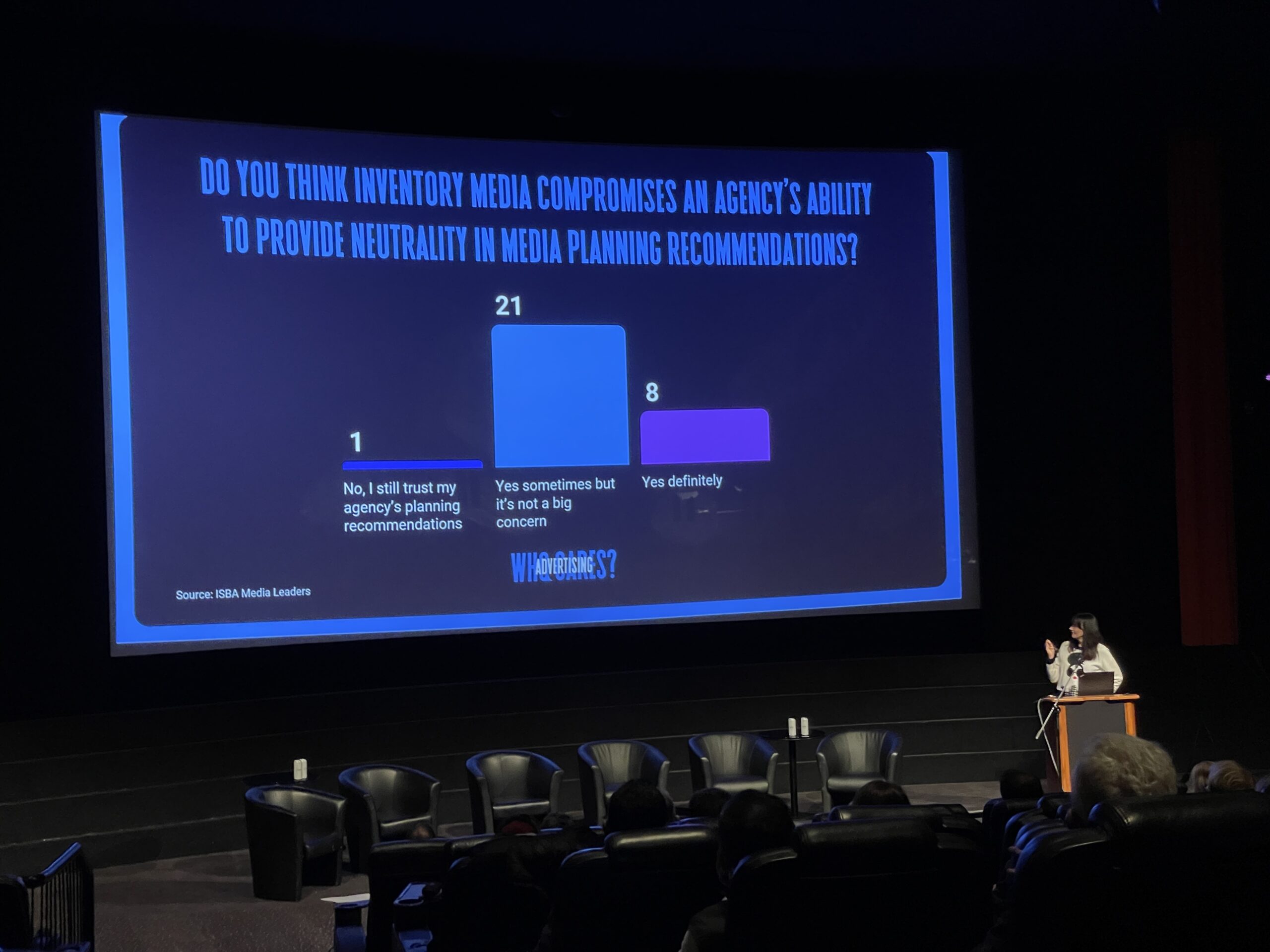
It is a sentiment widely shared by brand marketers. At last October’s second annual ‘Advertising: Who Cares?’ event, research presented from Isba’s Media Leaders group found that, of 30 marketers sureyed, just one indicated they believe principal media does not compromise an agency’s ability to provide neutral media planning recommendations, and just two indicated they felt “positive” about the practice.
Neil Harrison, head of media at Standard Life, agreed principal media “leads to a conflict of interest”.