



LLMs promise step-change in content discovery, once tamed
Pay-TV operators and streaming services are being promised the opportunity to become the most reactive, proactive and intuitive source of TV entertainment knowledge – reducing the need for Google searches and keeping viewers on-platform or in-app for longer.
The enabler is an agentic AI solution that combines the powerful inference capabilities of large language models (LLMs) with the professionally curated metadata and programme assets of Gracenote. This fusion is made possible with the Gracenote Video MCP Server, launched last month.
With this combination, LLMs could become the initial conduit for search queries – including voice search. Gracenote reckons this will improve the relevance of search results and enable complex and often badly articulated user requests to be unpicked.
Crucially, TV companies can configure the agentic workflow to ensure the LLM refers its initial thoughts to Gracenote to verify accuracy. Gracenote can also enrich the LLM suggestions with programme and movie cover artwork, more information about actors, directors and ratings, and information on where the content can be watched (and when).
These results are then presented to consumers.
Gracenote Video MCP Server can be used for all content discovery, including proactive recommendations that sit in a content rail on a personalised user interface.
Increased serendipity
The introduction of LLMs as a complement to existing search and recommendation engines and entertainment metadata will increase serendipity in content discovery, according to Tyler Bell, SVP of product at Gracenote, who has led the Video MCP Server initiative.
“It will reduce viewer frustration, increase joy and so increase engagement,” he declares. “We believe this will have revenue benefits for our customers.
“The use of LLMs is more than the next step on the journey towards better search and discovery. This is a step-change in capability affecting the entertainment stack.”
Gracenote is the content data business unit of Nielsen and provides entertainment metadata and content IDs (which uniquely identify all pieces of content) to a huge television customer base. Its programme metadata covers over 40 million titles.
The company’s data already underpins search and recommendation solutions, and Bell notes that Gracenote Video MCP Server is not designed to replace those.
Bell has not drunk the artificial intelligence Kool-Aid, either. He comments: “We do not believe LLMs are a panacea for the challenges in content discovery. We were inclined to examine the AI bandwagon for structural flaws rather than jumping on it.
“We created our product specifically to address the limitations of LLMs while leveraging their strengths.”
One key strength of large language models is the way they can interpret consumer needs and match those to an outcome.
“LLMs are awesome inference engines, trained on an exhaustive and unparalleled corpus,” Bell explains. “They are excellent at pulling together disparate and complex threads and articulating them in a coherent tapestry.
“This means they are great at understanding user intent and making strong recommendations based on requests, viewing history or other behavioural data.”
He offers a simple example of where an LLM would make a connection between concepts that content discovery engines would currently miss, relating to a request for a ‘warming movie’ for a cold day.
Most search engines would not know what represents ‘warming’, Bell says, but the vast training data behind an LLM allows it to make an association between warmth and Christmas sweaters and a holiday (Christmas) movie.
“Large language models are an unparalleled tool for consuming disparate and heterogenous data sources in mixed formats and making sense of them,” Bell adds. “Recommendations become more interesting and topical.”
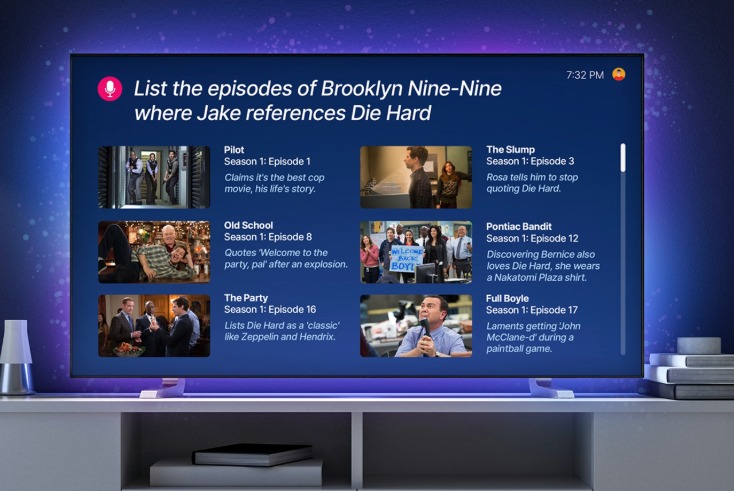
Gracenote says viewers will be able to ask their TV service for “weird and wonderful things and still get good results”, when an LLM is employed. The company gives the example of a search request relating to Brooklyn Nine-Nine, the American police procedural comedy series.
The request is: ‘Show me the episodes of Brooklyn Nine-Nine where Jake references Die Hard’ (see photo).
“Most search engines would fall over before they give you the result,” Bell suggests. “It is referencing another movie.”
Countering LLM limitations
The limitations that Gracenote is trying to counter, when using LLMs are:
- The danger of hallucinations, where the LLM generates a plausible but inaccurate response to a search query. Gracenote data is fact-based and human-vetted.
- The fact their knowledge goes up to the fixed point in time when they were trained. Gracenote data is constantly updated.
- Their lack of access to visual assets that typically accompany search or recommendation returns (like cover art or show imagery). A key part of what Gracenote does is metadata and asset ‘enrichment’.
The company provides an entertainment data service and not an inference engine, so Gracenote Video MCP Server enables these two worlds to combine while keeping the data secure.
MCP stands for Model Context Protocol, a standard for connecting AI assistants or agents to systems (or tools), where data is found. They are sometimes likened to an API (application programming interface).
A platform operator or streaming service can create an AI agent that connects its choice of LLM to one or more tools so the LLM can access and manipulate the data it needs. Tools describe to the LLMs when and how they should be used.
Gracenote believes an LLM will prefer to use authoritative sources when it can but, regardless of this, the agentic AI content discovery workflow could be configured so the LLM always checks with Gracenote before presenting results to the viewer.
All the Gracenote data is made available in real-time. “Our customers are rightfully cautious about trusting unvalidated LLM outputs,” Tyler notes.
LLM does not absorb the data
He points out that Gracenote data does not feed the LLM, in the sense that is used to fine-tune the model.
“LLMs do not integrate data via MCP; they work with it but do not store it. MCP is LLM-adjacent. The LLM can work with data on the periphery. The data provided by an MCP server does not move the neurons in the model’s ‘brain’.
“LLM providers do not change their model to accommodate an industry like entertainment but can become experts in entertainment when provided with the appropriate data via MCP.”
The LLM could be linked to multiple tools, of which the Gracenote Video MCP Server is one. The TV company may have its own tool or tools containing proprietary data, like their own content catalogue or behavioural data, which is also analysed but never absorbed.
“One way to think about this is making a soup,” says Bell. “An LLM, using MCP, combines data from the TV company’s users, their catalogue and Gracenote to create a delicious dish for the consumer.”
A pay-TV operator or streaming provider will license the Gracenote Video MCP Server to give them access to the Gracenote data. That data could also include trailers and reviews.
In the example of the Brooklyn Nine-Nine search request, Bell says the LLM would use its training data, which includes websites referencing the shows, to build a probability matrix with a list of episodes and why they are relevant to the query.
The LLM then asks Gracenote if these choices are correct and seeks content ID, cover imagery and information on where the user can watch the episodes.
“The LLM answers a complex query but also gives the user feedback on why the episodes are relevant. Users are more sympathetic to recommendations if they know why they are being recommended.”
The agentic AI content discovery workflow could be hosted in the cloud or on local customer infrastructure.
Bell acknowledges that an LLM search result takes longer to return than when using a standard discovery engine today – in the region of two-seconds. He believes it will be possible to reduce that to 0.5 seconds, “which is tolerable in the wild.”
Gracenote believes pay-TV operators and streamers are fighting for attention with YouTube, TikTok and social media – with the mobile phone providing a largely personalised entertainment universe that is just inches away.
The company believes the TV industry can take a greater share of total attention with better discovery, with LLMs offering the means for a significant upgrade. But first the LLMs must be tame and reliable.