



Only one-third of Brits consume information via news brands

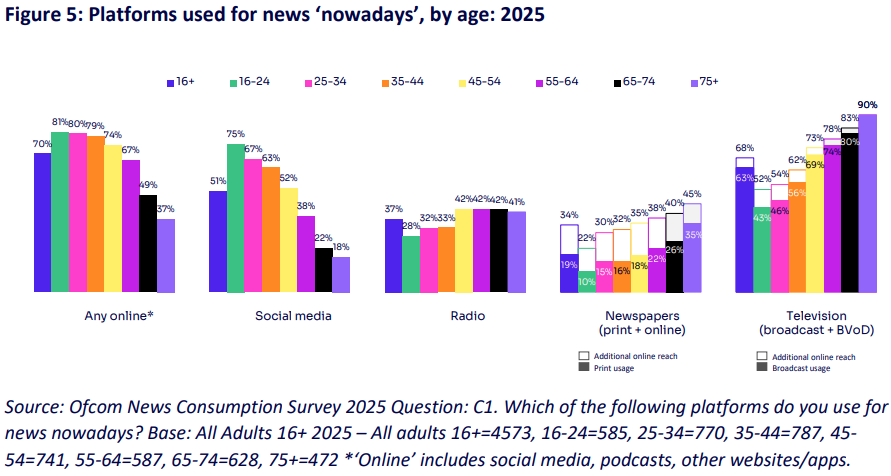
Just one-third (34%) of the UK public say they consume news “nowadays” via either print or online news brands, according to the latest Media Nations report from Ofcom.
While the young (16-24) are least likely to tune in to news brands (22%), even older cohorts surveyed by the media regulator did not turn to news brands for news in significant numbers. Only 45% of those aged over 75, for example, said they used either print or digital news brands for information.
If consumers aren’t reading news directly from publishers, where are they getting informed?
TV dominates news consumption, particularly among adults over the age of 34. Younger audiences, on the other hand, tend to prefer social media or “other online” forms of keeping track of the news, inclusive of podcasts, blogs or other apps.
Yet, as long observed, consumers also broadly do not rate social media highly for “trustworthiness” as a news source.
Whereas two-thirds said TV (68%) and radio (67%) are trustworthy channels for news, just 44% said the same of social media.
Advertising adjacent to quality news content is brand-safe regardless of topic
Rare readers
More broadly, ad investment has been following eyeballs elsewhere, particularly social platforms.
According to Advertising Association/Warc Expenditure Report data, news brands lost £534m in annual ad revenue between 2019 and 2024. Last year’s total revenue (£1.16bn) for news brands was less than 2020’s pandemic low (£1.2bn).
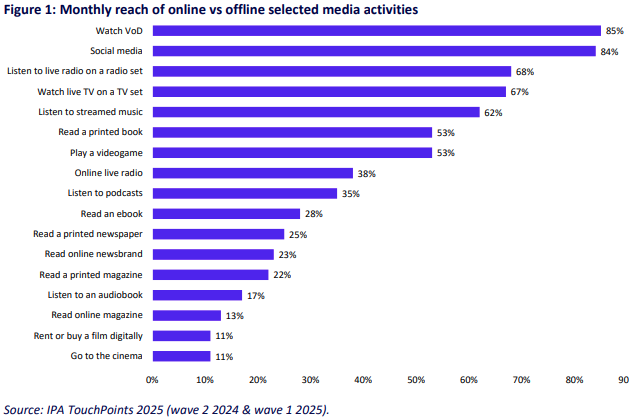
Citing IPA TouchPoints data, Ofcom noted that fewer than one in four Brits read an online news brand (23%) and just over one in 10 read an online magazine (13%).
Audience reach is marginally higher for print news brands (25%) and magazines (22%), driven by older (age 75+) readers.
For 15- to 24-year-olds, online news and magazine consumption is rare, with 23% reporting they read monthly. This group generally prefers social media (94%), VOD (87%) and streaming music (85%) for entertainment, while just under half (43%) also listen to podcasts.
Meanwhile, a Newsworks spokesperson said: “Ofcom’s report demonstrates today’s diverse media ecosystem but underestimates news brands’ high audiences.
“Using Ipsos iris data, our Youth research shows 72% of 15- to 29-year-olds read online news brand content every month.
“In addition, the latest Pamco data reports that 80% of UK adults read news brands in all formats every month.”
Young people don’t read news? Research from Newsworks suggests otherwise
Is a multimedia strategy the answer?
Ofcom’s data indicates shifting audience behaviour away from reading the news and towards encountering it via algorithmic recommendation in text or video form, such as on social platforms and YouTube.
Such changes have prompted publishers to increase their AV footprint, with titles including The New York Times increasingly turning opinion writers into podcasters and vodcasters, and pushing its culture section towards video.
As digital ad revenue has fallen, UK publishers have invested heavily in diversification efforts, with numerous brands creating AV production studios. Last year, Reach, the UK’s largest publisher, launched its branded content Studio, which chief revenue officer Emma Callaghan recently told The Media Leader has business potential via “quality long-form YouTube-first content”.
However, platforms like YouTube and TikTok do not themselves generally create sufficient revenue for publishers and so the strategy has been to sell new AV programming to advertisers looking to sponsor or develop branded content.
Apart from video, podcasting has also proven popular as a way for news brands to drive both incremental ad revenue and reach new audiences.
Yet podcasts produced by news brands and magazines only account for a 3% share of all podcast listening, according to TouchPoints data.
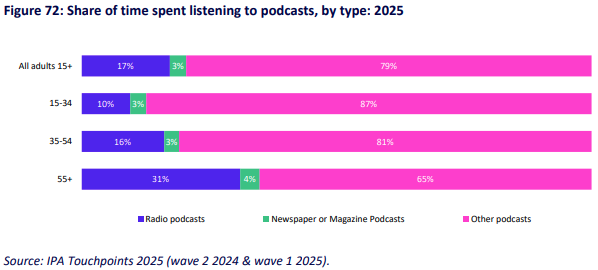
Rather, the vast majority of podcasts consumed by listeners are independently produced.
News and current affairs shows were nevertheless found to be the most popular type of podcast among 35-54s and those aged 55+, and the fourth most popular among 18-34s.
This implies listeners do use podcasts for news, but are approaching the medium with an open mind about receiving information from non-traditional sources, often without the same degree of editorial standards as one might find from a news brand.
‘Death of the website’: Publishers wrestle with the need to reinvent in AI era