



‘Social as a destination itself’: Inside Mail Metro Media’s two new social publishers
The Media Leader Interview
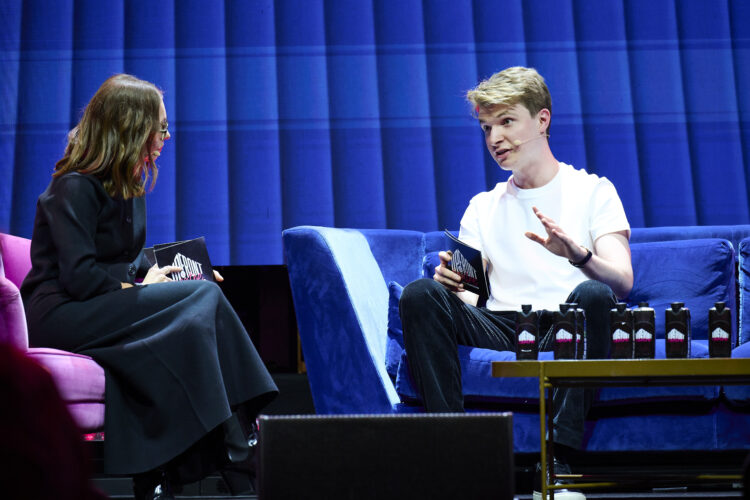
Hannah Blake and Nick Moar, leaders of the Daily Mail’s new social publishers, discuss their editorial and commercial visions for DMG Newmedia and Creator Media, and how social can be harnessed to build publishing brands in a new era.
“It’s about taking a brand, blowing it up on social because social really allows you to do that, and then thinking, where else can this live?”
For Hannah Blake, the new managing director of DMG’s two dedicated social publishers, social media platforms don’t pose threats to publishers but rather present business opportunities.
“It’s our job to build a brand beyond just those channels,” she says. “Using social as a great first touch point, getting that awareness out there, building that relationship, but then running in-person events, launching a newsletter. […] And the beauty of being in the Mail is we can do that within our existing platforms.”
Launched at last month’s upfront event in London, DMG Newmedia and Creator Media represent the Daily Mail‘s official foray into social-first publishing.
The former is an extension of its existing Mail channels, with a focus on news and entertainment across new additional verticals. The latter will house lifestyle and fashion brands.
Taken together, the two publishers are akin to a news brand and a magazine, developed for the social media age.
The Mail appears to be pinning its future growth potential on the new brands. They received outsized attention at Mail Metro Media’s upfront in October, with leadership stating they believe the publishers will “shape the future of news and entertainment for young people around the world”.
To lead the effort to reach Gen Z and younger Millennials, the team has appointed members of those cohorts: Nick Moar, a 23-year-old former head of the Daily Mail’s audience strategy, is head of Newmedia. Blake, just 36, already boasts a bevvy of experience at the BBC, WPP Media agency Wavemaker, and as founder of both podcast platform Entale, which the Mail acquired in 2022, and the social-first lifestyle brand Eliza, launched under DMG Media.
As Moar describes, DMG’s investment in the social-first publishers came as the wider business realised that “not only is there great value in using social platforms to direct traffic to our website, but also there’s a great opportunity on those platforms themselves to create compelling news and entertainment content in short-form and long-form video — and monetise that content.”
Speaking to The Media Leader alongside Blake at the Mail‘s under-renovation offices on Kensington High Street, Moar adds that Newmedia aims to “elevate the content” on the Mail‘s already-popular social media channels by hiring more young journalists and creators to develop original series and “treat social as a destination in itself.”
Journalism or content creation?
Moar’s growing team can already go from ideation to publication of a social video in six hours, and he aims to further shorten that time by increasing resource efficiency to be more reactive to breaking news.
New hires include both journalists and content creators, he tells The Media Leader. At Mail Metro Media’s upfront last month, he suggested that his interest was in hiring creators with a demonstrated ability to build audiences on social platforms, seemingly eschewing care toward hiring staff with journalism qualifications or university degrees.
Speaking this month, he clarifies that the Daily Mail is proudly a current affairs brand and therefore his team aims to include “some people with journalism degrees”; a “new type of journalist” with multimedia experience and comfort on camera.
“They’re a mix of journalists who are more multimedia and specific creators who maybe didn’t have that journalism background, but can still deliver certain elements of informative content,” he explains.
‘Trust us and test us’: Daily Mail launches two social publishers led by creator talent
Such a setup raises questions about remuneration, as journalists and creators traditionally operate under vastly different pay models. For Blake, “How do you value a creator?” remains an open question, with pricing models in flux amid a still-professionalising market.
“We need to be looking at how you work with content creators in a different way than how you would work with more traditional journalists,” she adds.
For creators, particularly those with talent but relatively meagre existing followings, the appeal of working with a publisher appears obvious: aspects of production, distribution and monetisation can be handled by a wider team, allowing for greater focus on creativity and greater reach through the Mail‘s extant social audience.
Mass market and niche
The team will endeavour not only to produce the type of explainer videos common among news influencers on short-form video platforms, but also original series and investigative reporting.
“We are already producing investigative content”, Moar says proudly, pointing to a series on Britain’s stolen car industry that received 3m views across Instagram and TikTok. “That’s something we want to do a lot more of.”
In addition, Moar’s team has unveiled several new talent-led formats for the Daily Mail‘s social channels. These include the vox pop series “Street Talks” as well as “Global Debate”, a series that gauges consumer reaction to international news stories.
@dailymail Car theft is one of Britain’s most widespread and costly crimes and it doesn’t seem to be letting up. Daily Mail Deep Dive went to Britain’s largest port as part of an investigation into what really happens to your stolen car. #deepdive #dailymail #stolencar ♬ original sound – Daily Mail
“We’ve been really building out our stable of creators and formats,” Moar continues. That includes launching new channels for different Newmedia verticals, such as This is Money (for personal finance), or adding resources to existing channels, The Respawn (gaming) and Spotlight (entertainment).
“Not only do we have the Daily Mail channels, which are obviously larger in scale with a mass market, we’re also developing a portfolio of niche passion-point brands […] where we can really focus in on what matters to young people,” he continues.
The focus is much the same at Creator Media. You Magazine, a Sunday supplement to the Mail, has been placed under its remit, and rather than using the channel to bring readers back to the print proposition, Blake envisions the brand as an opportunity to reach the 50+ female demographic on social media.
Tracey Lea Sayer, formerly of Fabulous Magazine, has been brought in to lead social content for the brand and build a team of content creators.
In the first month since going live with the new You social-first proposal, Blake says the title saw a 117% increase in engagement rate, 34% increase in shopping clicks, and 20% increase in video views.
The audience growth has led to an “overwhelming” commercial response, with more advertiser briefs coming in against You than originally expected in its first weeks under Creator Media.
Melding with the creator economy
Core to a social publisher’s strategy, according to Blake, is a focus on building “defensible formats” and original IP that offer differentiation from other social video channels and provide brand-safe spaces within social media for advertisers to attach themselves.
“[Advertisers] felt they could access the benefits of creator marketing without feeling like it was the Wild West”, she says of her experience running Eliza. “It was like a safety net.”
Indeed, beyond producing editorial content, the verticals and series formats open up commercial opportunities. The Respawn, for example, has worked with sponsors including Clash of Clans developer Supercell and chipmaker Nvidia.
Such videos are presented by the same talent who also deliver informative videos and news content. Blake admits that, on social platforms, the separation between church and state thus becomes blurry. Yet she doesn’t view this as a concern, as neither do audiences nor advertisers.
“I think the platforms make it so easy to indicate when something is sponsored,” she says. When pushed on the recent finding by the Advertising Standards Authority (ASA) that over two-fifths of influencer content fail to meet basic disclosure standards, Blake responds: “We label everything, so the audience is very clear that this is advertising.”
She continues: “[The audience] wants to be able to enjoy an ad. They want to feel like this is sponsored, but I rate the brand getting involved.”
@itstherespawn AD ‘The Clash of Clans Revenge Button is finally being fixed. Supercell is overhauling the Revenge Button and hyping it up with The Revenge Room — a special live stream where players vote on how they want to take revenge on the devs IRL. Head to the link in our bio where you can join the livestream via the Clash of Clans YouTube channel on 5th October from 10pm BST / 5pm EDT. #clashofclans #therevengeroom #mobilegaming #gaming ♬ original sound – The Respawn
Blake believes advertising has “sort of moved on” beyond issues around church and state in publishing, arguing that using presenters for commercial purposes opens up “a real opportunity to be super creative in that space” while “knowing that there isn’t any illusion that it’s been paid for.”
She explains that in conversations with brands, she’s often pushing to get clients to see that “it’s not about creating something entirely bespoke for a brand”, but rather “letting them integrate” into formats already developed for editorial purposes. “That’s where the true value is within social,” she adds.
Brand advertising in a performance channel
Much debate has been had over whether social media is a particularly effective medium to advertise within. Newsworks, the marketing body for national news brands, recently published research in concert with effectiveness expert Peter Field and attention measurement company Lumen Research that suggests the low-attention environments found on social platforms are driving lower profitability despite receiving a sharp increase in investment over the past decade. Field in particular has consistently warned against brands’ overinvestment in performance advertising as ineffective for long-term brand building.
For Blake, Newmedia and Creator Media can help enable brand advertising options within media channels more traditionally associated with performance marketing.
“That’s where a lot of people fall down,” she warns. “They’re expecting to see a performance outcome, but actually the real value is on the brand side.”
Better measuring how such advertising can drive brand growth is a key part of Blake’s remit. As opposed to vanity metrics like views and comments, she insists the “most exciting” metric for brands to understand is average watch time per view, which shows how long a user is spending actually watching a sponsored video.
“[Brands] think they want views, because they were so used to that as an industry standard,” she notes. On briefs, Blake often commits to delivering a certain number of views; but, she explains, when it comes time for the campaign wrap-up, “The follow-up question will be, ‘Okay, of those views, how much did they watch?'”
Blake continues: “It’s being aware of the opportunity of using this media… If it’s not measured immediately by one click, it doesn’t mean it hasn’t worked as a campaign.”
Social platforms have made their own changes in recent years that have meant measurement also needs to adapt. As Blake and Moar explain, it’s become relatively less pertinent to build large follower counts on platforms like TikTok because most users come across videos algorithmically on the For You feed rather than a following feed.
Traditional engagement rates — defined as the number of likes, comments or shares as a ratio of an account’s total followers — have therefore become a “redundant metric”, according to Blake, because today, “half of your followers aren’t seeing that content”.
Social media: friend or foe?
Sudden changes to platforms’ algorithms highlight the fact that Newmedia and Creator Media don’t fundamentally own their audience on social. One day, Instagram could be recommending lots of Mail content; the next, an opaque algorithm could change and suddenly halve its audience.
When asked whether this reality unsettles them, Moar says “we are confident we can adapt”, with Blake adding: “We’re constantly optimising for any changes in the algorithm. That’s our job. That’s what we have to do.”
Every week, the publishers hold a meeting to go over the latest social platform updates and changes to understand how they might need to adapt their content output to be tailored for virality. For example, Meta recently began algorithmically prioritising content on Instagram based on direct message shares rather than simply likes or comments. That “totally changes how you think about your content,” Blake admits, leading to adaptations in editorial output.
The effort gives further creedance to communication theorist Marshall McLuhan’s most-quoted phrase: “The medium is the message”.
But Blake notes that Newmedia and Creator Media can’t afford to merely chase after algorithmic virality. Some videos might need to be “attention-seeking”, she concedes, in the same way that headlines on the front page of a paper are designed to attract people in. But once they’re in — following the account — then they can “enjoy other bits of content”.
For Blake, being overreliant on platforms for brand growth thus need not be such a weakness.
“We have to be constantly thinking where else can we move into? How can we protect this brand?” she says. Long-term, the business model is to “create a universe” around publishing brands — with videos, newsletters, merchandise, and referral traffic back to the Daily Mail — that is diverse enough to survive even if changes are made to any individual platform.
Moar adds that the “beauty of building it as a publisher” is that the added resource afforded by the Mail can help elevate their effort through resources, marketing, and brand association.
He views his leadership role, despite his young age, as proof that social media is a meritocracy, providing a level playing field.
He adds: “Anyone can build their own audience.”
Editor’s note: This article has been updated after publication. A prior version of the article indicated that the Mail had acquired lifestyle brand Eliza. This is inaccurate, as Eliza was founded by Blake while she had already begun working for DMG Media.