



Stagwell CEO: There is a ‘perverse distortion’ in the news media ad market
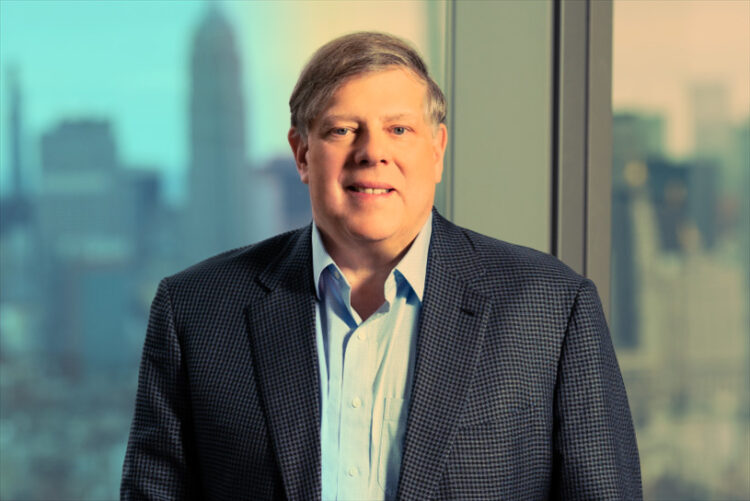
On Thursday, challenger media holding group Stagwell hosted its inaugural NewsFronts in Midtown Manhattan.
The upfront event, designed for news companies to showcase their offerings, comes as Stagwell is leading a global charge to convince brands that investing ad budgets in news is beneficial for their business. It featured programming with the likes of The New York Times’ Michael Barbaro, and Axios political journalist Mike Allen, among other commercial executives.
Since launching its Future of News initiative, Stagwell has sought to prove the business case in favour of news and against perceptions of brand safety concerns. A study released by the group last September found that advertising adjacent to quality news is brand safe, regardless of topic.
And yet, at Cannes Lions this summer, several brand leaders still admitted they were avoiding spending with news brands due to perceived risk.
“There’s still a basic notion out there to avoid news,” Mark Penn, Stagwell’s founder and CEO, tells The Media Leader from a cab en route to Stagwell’s offices in One World Trade Center, the day before NewsFronts. “I don’t think we’ve beaten that back.”
Penn says CMOs — often without the knowledge of the CEO — have been blocking news “for no real reason”, led astray by brand safety companies with “an interest in promoting” the concept of brand safety. He is keen to research CMOs to understand why the negative perception of news remains sticky.
The scale of the problem has had a severe negative consequence on publishers, many of whom have already been struggling amidst the shift to digital consumption and, more recently, the rise of AI search, which has undercut referral traffic.
Even The New York Times, Penn says, has at times had 40% of its articles demonitised, often by accident, thanks to overzealous use of keyword blocking.
“What we’ve seen here is there’s a perverse distortion in the marketplace built on a false notion of brand safety,” Penn continues. “We’re just saying, look, make intelligent business decisions for your business — support journalism at the same time, but do what’s right for your business.”
Taking a stake
At the NewsFronts event in New York, Penn revealed that Stagwell was backing up its rhetoric in support of news with its wallet: the group has taken a 35% stake in news publisher RealClear Holdings LLC, which owns RCP Poll Averages, RealClearPolitics, and 12 other news and analysis sites.
The investment is part of a broader interest in owned media platforms, including ReachTV, and, as Penn suggested, is evidence of Stagwell’s belief that news media is an undervalued business opportunity.
“It underscores our commitment to news and our being able to be a participant in the importance of news advertising,” he tells The Media Leader.
Is the message cutting through with clients? “I won’t say there has been a torrent or a flood or anything,” Penn admits, but he points to a number of key brands that have responded strongly to the Future of News initiative, including JPMorgan Chase. He is further optimistic about the apparent interest in NewsFronts, suggesting it as evidence that Stagwell is increasingly convincing C-suite leaders to reinvest in news.
To help, Stagwell rolled out its own private marketplace (PMP) this summer, which included eight publisher launch partners, including the Associated Press, Newsweek, Nexstar, National Public Media, RealClearPolitics, Ozone (itself comprising premium UK and global publishers), The Washington Post , and Time.
However, Penn admits, the initiative is “not something where we can push clients”. Rather, it is an effort where “we have to leave them to evaluate and test it and see if they get a good buy”.
He notes that while the CMO is ultimately the key potential change-maker for news budgets, lower-level employees are often the ones actually making the decision to block news from advertising by merely checking off certain boxes in their orders to demand-side platforms (DSPs).
What next for Stagwell?
NewsFronts is also notable for being the first high-profile event hosted by Stagwell since its London-based Festival of Stagwell was postponed due to “safety concerns” last month. It followed a leak that revealed Stagwell had conducted research into consumer perceptions of Israel on behalf of the Israeli government.
It was subsequently revealed that Havas had subcontracted Stagwell to conduct the work.
When asked whether he had any regrets over taking on the work, Penn flatly states: “No.” He adds that Stagwell had clarified that the work was conducted by an “advocacy group” within the business, which is separately maintained from its other agencies.
For Penn, while the Future of News initiative will remain an important tentpole for the challenger group (alongside its continued interest in sports investment), Stagwell’s business goals for the next year are primarily focused on the adoption of AI and building new technology products.
He warns that most media industry leaders are prioritising efficiency over other matters regarding AI — a short-sighted view, in his opinion.
“I think efficiency is important, but the real gain of a new technology is not going to be efficiency,” he says. “It’s going to be in doing new things that you could never do before.”
In the meantime, the group is committed to beating the drum on the importance of news. Smiling to himself, he notes that the businesspeople and journalists at news publications have rarely been as aligned as they are on the Future of News initiative.
“I’ve been very impressed that this initiative is bringing those two groups together,” he adds.