



The Future of Video Brussels: Top takeaways
After previous editions in Paris and London, The Future of Video took place for the first time this year in Brussels. Organised by The Media Leader and MediaSpecs, the event brought together over 160 media professionals from Belgium and abroad to explore the evolving landscape of television, streaming, and connected TV.
Bart De Pauw (CBIO, WPP Media & RD Choreograph) expertly guided the sessions, delivering a dynamic programme packed with panel discussions, interviews, and inspiring case studies.
Belgian and French examples were framed within a broader international perspective, highlighting the most significant trends in the video ecosystem. Key topics included growing audience fragmentation, the rise of “platformisation,” and the relentless quest for attention, ROI, and brand safety.
This article distills the most valuable insights and practical takeaways from the event.
Building local content communities
During the opening interview with Erwin Lapraille (media TV director, RTL Belgium), one message stood out: local content is a powerful lever for building engaged communities. In a market dominated by global platforms, it is the local stories that create recognition and foster meaningful audience connections.
According to Lapraille, successful programmes do more than entertain: they combine information, emotion and interaction, actively involving viewers in the narrative.
Local production remains a challenge, particularly under constrained budgets. Lapraille therefore advocated for faster, smarter, and more collaborative partnerships among media players. ‘This is Not a Crime’, a co-production with Proximus and VRT, exemplifies how pooled resources and shared expertise can produce compelling content that truly resonates with audiences.
Rethinking the TV narrative
Sofie Sue Rutgeerts, senior manager at egta, underscored the enduring power of local television. She highlighted the pressures facing the media industry: budgets are increasingly shifting to platforms that struggle to generate genuine attention, while audiences are saturated by a deluge of advertising.
In this context, she urged the sector to rethink the TV narrative, allowing television to leverage its unique strengths: attention, quality and connection.
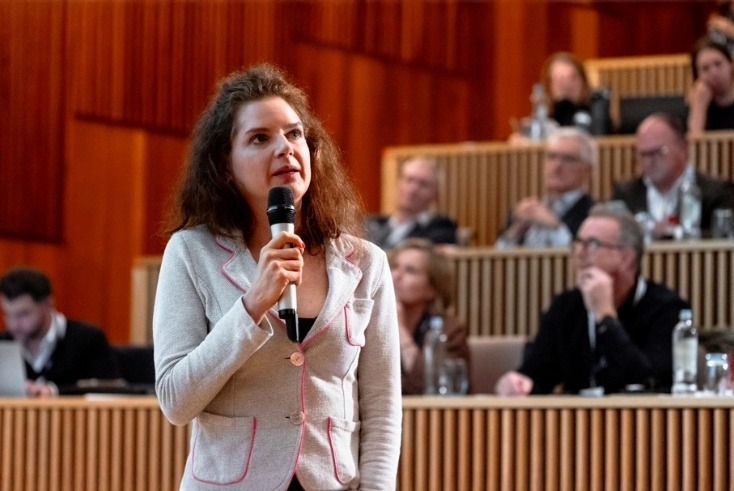
Rutgeerts (pictured) described television as the beating heart of the media landscape; a premium environment where community, engagement and impact converge. She stressed the importance of a clear USP, strong programming and compelling local content.
Her advice: keep it simple, communicate a credible message, and collaborate with pride.
Connected TV (CTV) continues to assert its importance, as reflected in WPP Media’s Belgian Stream Monitor, presented by De Pauw.
CTV is increasingly relevant for local broadcasters, with BVOD (broadcaster video on demand) on CTV platforms opening new opportunities in the digital era. While price and content offering remain key factors in streaming choice, local content is gaining prominence.
When taken together, leading BVOD providers such as VRT MAX and VTM GO have almost the same weekly reach as YouTube, underscoring the impact of strong local content.
The data further illustrates BVOD’s potential: daily reach stands at 16% for BVOD versus 14% for YouTube; weekly reach is 35% versus 28%; and total reach is 44% versus 38%.
These figures confirm that BVOD and CTV are not merely complementary to traditional TV but occupy a strategic role in the Belgian media landscape, with reach, engagement and impact as core brand values.
The power of the home screen
Julie Hervens, sales director at Teads, highlighted the tangible power of television for brands with the Teads CTV HomeScreen, an innovative ad format appearing on the first screen users see when switching on their smart TVs.
In a fragmented TV landscape, the home screen serves as a new gateway to television, offering brands a unique opportunity to capture attention and maximise reach.
On average, users spend 33 seconds on this start screen, making it a prime moment for brand messaging. The integration of OEM first-party data and Automated Content Recognition (ACR) enables advertisers to reach audiences beyond traditional targeting, leveraging signals from smart TVs, game consoles and streaming boxes.
Harnessing first-party data
The event highlighted the growing importance of first-party data in the Belgian media ecosystem.
Anne-Sophie Librecht, innovation manager at Ads & Data, explained that closed-loop measurement allows brands to go beyond clicks, gaining insight into the true impact of campaigns on sales. By linking campaign and purchase data, marketers can precisely determine which initiatives drive conversion.
Lookalike audiences further enable advertisers to reach new, relevant audiences resembling existing customers, enhancing both efficiency and effectiveness. Librecht emphasised that this data-driven approach empowers marketers to make strategic decisions and measure the full marketing funnel.
Data-driven technology was also pivotal in the Mobile Vikings campaign.
The Trade Desk and WPP Media leveraged the Identity Alliance, a sophisticated system that identifies users across devices and channels, even in a cookieless environment. This technology enabled precise targeting and personalised experiences, significantly boosting campaign performance and audience engagement.
Quinten Galle (business development manager, audiovisual, DPG Media) showcased how DPG strengthens its first-party data strategy through the DPG DataLab and new retail data partnerships.
DataLab allows advertisers to link their CRM data to DPG’s data assets for targeted, privacy-compliant campaigns. Partnerships with Carrefour (the food retailer) and Tom&Co via Unlimitail enrich this data with purchase insights, making media planning and activation even smarter.
Fragmentation driving innovation
During a panel discussion, Hugues Rey (CEO, Havas Belgium), Edouard Schmidt (country manager, France at Magnite), and Mathieu Réol (business director, The Trade Desk Belgium) emphasised that fragmentation and innovation go hand in hand.
They argued that the increasing complexity of the media landscape need not be a barrier; on the contrary, it can create opportunities to make advertising more efficient and effective.
Rey highlighted the importance of granular campaign measurement, saying that understanding the true ROI of each touchpoint, from linear TV to CTV, from BVOD to social video, elevates decision-making beyond guesswork.
Schmidt explained that through Magnite, local publishers gain access to advanced, interoperable adtech solutions without the high cost of building proprietary platforms, keeping technology accessible and efficient for both Belgian and French markets.
Koenraad Deridder, CEO of CIM (the local multimedia JIC) and Martyn Bentley, commercial director at AudienceProject, reinforced the need for cross-media measurement in a fragmented environment.
Deridder noted that CIM ONE adopts a consumer-centric approach, integrating multiple media channels to provide a comprehensive view of media consumption. Bentley added that cross-media measurement is crucial to understanding the combined effect of various channels – essential for effective planning and budget allocation.
Laurence Pera (head of strategic partnerships, TF1 Group) said the recent collaboration with Netflix demonstrates how fragmentation can spur innovative partnerships.
Rather than an obstacle, fragmentation creates opportunities to distribute premium content more widely, develop new advertising solutions, and facilitate collaboration between traditional broadcasters and streaming services.
Unite against monopolies
The keynote by Martin Andree, professor of media sciences at the University of Cologne, closed the first edition of The Future of Video Brussels.
Andree called for local forces to unite against the growing monopolisation of international players and the rise of populism in media, emphasising that only collaboration can protect society at all levels.
He said, “We have to end this everlasting mystery of why the media is not fighting back.”
He outlined concrete measures to foster a freer internet and media sector: freedom for outlinks on platforms, open standards and interoperability, economic separation of transmission and content, a maximum 30% market share for digital media, and a ban on monetising criminal content.
These initiatives aim to strengthen local media and ensure sustainable independence.
In Brussels, it became clear that focusing on collaboration, data, and local stories builds a video ecosystem ready for the future. Fragmentation need not be a threat; it can act as a driver of innovation, as long as media partners connect, share knowledge, and keep the viewer at the center.
This report is by Laura Van Baelen of The Media Leader Belgium (which launched in September) and was originally published in Dutch here and French here. The Media Leader is also published in France. Photo credit: Corentin Bonnin.