



‘We are a destination’: NYT’s global ads chief talks the Gray Lady’s international ambitions

The Media Leader Interview
Tom Armstrong speaks to The Media Leader about how The New York Times is adapting its output to become a daily habit for consumers — be it through news, games or personalised sports coverage — and what that means for its growing advertising model.
“We’re really trying to become that essential daily habit in their lives.”
For The New York Times‘ global ads VP Tom Armstrong, the success of the publisher’s business increasingly rests on its ability to foster a direct relationship with its audience.
“Audiences come and seek us out,” he tells The Media Leader over a video call. “If you look at our product strategy, it’s what the main objective is. Our journalism and our content is becoming more real-time […] we’re becoming more visual. It’s not just about reading the news now, it’s also about listening to and watching the news.
“We’re trying to make our journalism more human, so you’ve seen reporters report on camera now within the app and actively enage with readers in the comment section, answering questions. We’re trying to be more personal.”
The strategy appears to be working; Armstrong is speaking days after The New York Times Company reported impressive growth in Q3. Total revenue jumped 9.5% year on year to $700.8m, led by a 20.3% rise in ad revenue to $98.1m. Meanwhile the title added 460,000 net digital subscribers. In total, The New York Times now counts 12.33m total subscribers across its product verticals.
That includes more than 2m non-US subscribers, one-third of which are located in Europe.
According to Similarweb data cited by Armstrong, The New York Times reaches 55m unique readers outside the US each month, equivalent to around 40% of the title’s total readership. 12.2m of those monthly readers are based in the UK.
“It’s starting to become a big, meaningful number,” he tells The Media Leader.
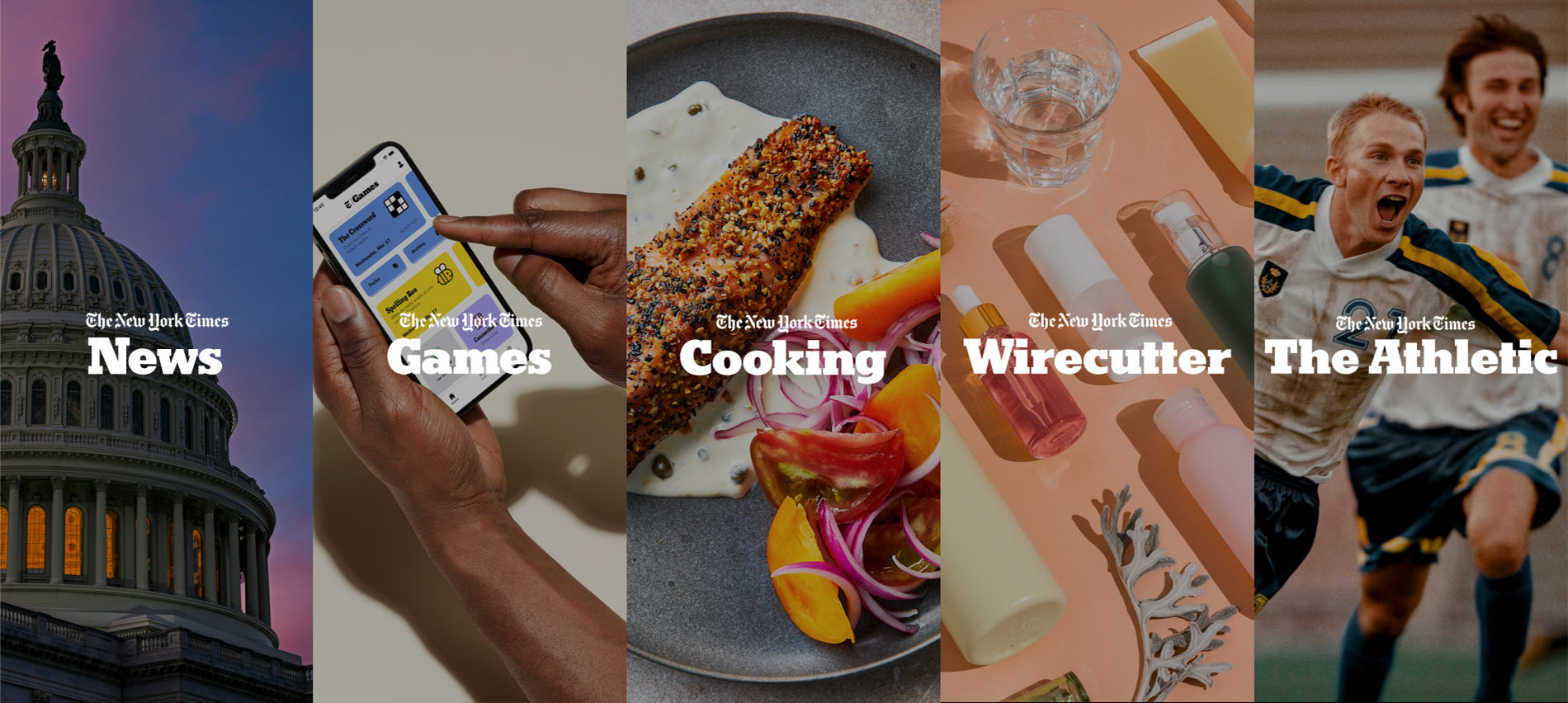
Two key verticals — Games and sports outlet The Athletic — are driving substantial growth in the market. Games has 4m weekly players in the UK, with Wordle alone drawing 2m daily users. Meanwhile, The Athletic now has 86 British journalists, with a beat reporter on every Premier League club.
Despite the strong user figures and a historic brand, Armstrong acknowledges the paper still has work to do commercially, pushing its message with new and existing clients that the title is “relevant outside the US”.
Earlier this month, the NYT hosted clients and partners at The Early Edition, an upfront-like showcase featuring talent from its podcasts and The Athletic at London’s 180 Studios.
Armstrong declined to answer how much revenue is derived from its international business, offering instead: “We’ve got very ambitious plans over the next five years to keep growing that”.
Bucking the trend
The NYT’s recent success stands out in a global publishing industry fighting against what at times feel like insurmountable headwinds. Changes to AI search, driven by Google’s AI Overviews and AI Mode as well as competitor models like ChatGPT, have led to a mass reduction in referral traffic to news organisations, including both big publishers like Mail Online as well as smaller independent titles. Social media platforms have likewise dropped their support for news in recent years.
Many advertisers, meanwhile, have become news averse, perceiving hard-hitting journalism on socially important topics like politics, war and international affairs as not “brand safe”, despite emerging evidence to the contrary.
Brands and their agencies are also commonly use overzealous keyword blocklists on programmatic ad campaigns, accidentally blocking ads from appearing against well-trafficked premium publisher web articles.
“We’ve seen a bit of that,” Armstrong admits. Mark Penn, CEO of Stagwell, previously told The Media Leader that he understood the NYT has, at times, had up to 40% of its articles demonitised due to keyword-blocking practices.
Stagwell CEO: There is a ‘perverse distortion’ in the news media ad market
“It’s an ongoing conversation,” Armstrong continues. “We see it most at the operational level. When you speak to the brands directly, or the agencies directly, they don’t intentionally want to blocklist The New York Times. But sometimes you do end up on these blocklists.”
The confluence of factors has broadly led to at-risk publishing business models, often leading to layoffs and paywalls. But for The New York Times, the diversity of its revenue model and content output, as well as its strong internationally recognisable brand, has insultated it from the worst of the market impacts. Programmatic advertising — generally the most impacted by changes to referral traffic and keyword blocklists — is “one of the fastest growing areas” for NYT, according to Armstrong.
How? “I think it’s a combination of the scale that we have, the ad formats — we have these custom-made ad formats that we design in house — and it’s the audience targeting capabilities that we have,” Armstrong posits.
He notes that ads on The New York Times‘ website perform twice as well as IAB benchmarks, suggesting that the outlet’s “comparatively low ad load” creates a “premium” and “non-disruptive” ad experience, improving effectiveness.
Innovation has also spurred growth. BrandMatch, an AI-powered targeting tool launched last summer, has led to “huge increases on clickthroughs and performance”, Armstrong says. The tool “ingests” a client’s brief and then automatically pairs it with the most relevant NYT content.
Portfolio growth
Armstrong also notes that the success of the NYT‘s subscription business is “helping fuel” its advertising business.
Between gift articles, family plans, and a desire to access games like Spelling Bee or Wordle, football coverage on The Athletic, product reviews on Wirecutter, recipes on Cooking, or plain old news reporting, users can be lured into subscribing or otherwise creating an account through a number of avenues. Once registered, the title’s commercial team can then leverage first-party data.
The New York Times is a “subscription business first,” Armstrong says, and while the outlet is “very careful” to design a light-touch ad experience (for subscribers, portions of its website are entirely ad-free), he argues that its consumer-facing product development has opened up new commercial opportunities.
“The growth of our portfolio — the move into sport with The Athletic, the move into Games with Wordle or Connections, Cooking — has given us the ability to go to different advertisers in different categories that wouldn’t necessarily have advertised with us before,” he continues.
“People are paying to consume our content, and they’re being very intentional about it. And that gives us a lot of first-party data signals, which makes us very valuable to advertisers.”
International advertisers, notably, have also not shied away from advertising against “hard news” like politics and investigations, Armstrong adds.
Taking a lesson from creators
The New York Times‘ commercial growth has come amid a broad shift in news consumption habits. In the US, readers have increasingly turned to national news, often subscribing to NYT over their local paper; in the UK, NYT has emerged as an international alternative to national papers, let alone local titles.
Meanwhile, news audiences are fragmenting. For as many subscribers as The New York Times has added, plucky upstarts like Semafor and Zeteo, and individual creators on Substack, YouTube and TikTok, are also offering new alternatives to challenge traditional papers and broadcasters.
Leveraging personality-driven content and direct interactions with communities of subscribers, such indie creators often attack traditional press for being neutral in their coverage to a fault. One of The New York Times‘ own columnists, Nobel laureate Paul Krugman (who now writes a Substack), has accused the paper of “sanewashing” US President Donald Trump. So has its former public editor, Margaret Sullivan (who also now writes a Substack).
The New York Times has apparently sought to head off such competition by taking a book out of the creator economy — a seemingly bold move for a paper with the nickname The Gray Lady.
While not exactly acting with the same vim of some news influencers, NYT journalists are being given more opportunities to be themselves on the Times‘ platform, be it through short- and long-form videos, podcasts, and in comment sections. The goal: use personality to build community.
For Armstrong, developing those direct relationships is at the core of what publishers must do going forward to thrive in an adapting news market. Hence why The New York Times‘ own consumer experience is also becoming more personalised; users now have a You tab on NYT‘s app, a customisable section that highlights articles of likely interest.
Personalisation. Community building. Short-form video. Real-time reporting. Whether it’s a borrowed strategy or something new, the proof of success has been in the results.
“You can see it in the numbers,” says Armstrong. “People are coming back every single day.”
The Guardian promotes its creative canvas amid US investment drive