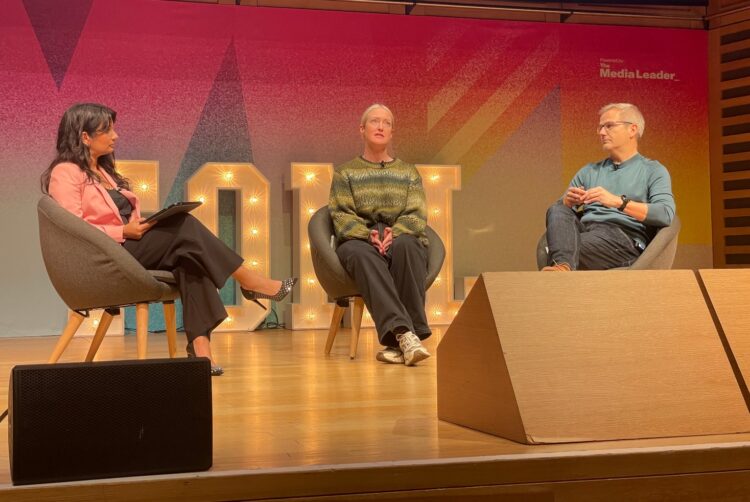
The Future of Media London 2025
“It’s just time. The advertising industry needs to have a sensible discussion about whether the rapidly increasingly spend on social media is good for the nation’s mental health”.
Simon Kilby, MD of Bauer Media Advertising, did not mince words in his plea for the industry to finally begin, in earnest, to take the mental health risks of social media seriously.
Sitting alongside Esther Ghey, the mother of the murdered teenager Brianna Ghey, the pair placed responsibility for the ongoing teen mental health crisis squarely on tech platforms and the dark web. They noted that it is unlikely that Big Tech will self-regulate or be forced to regulate by a Trump administration, which the tech players are actively courting.
Instead, advertisers must “put their wallets where their heart is” to impart change.
“[Through] withdrawal of revenue — or sensible investment of revenue, rather than what’s happening now — you can impact change,” said Kilby.
‘Everybody has a story to tell’
Kilby approaches the subject of mental health from both a personal and professional perspective: as he acknowledged publicly at the Future of Media last year, his own sons — like Brianna Ghey — have suffered from mental health issues in recent years, spurred on, he said, by social media use.
Citing stats from the British Medical Association, Kilby noted that mental health disorders have increased from one in 10 to one in four between 2017 and 2023 for individuals aged 17-19.
“This is happening everywhere,” he said. “Everybody has a story to tell.”
Bauer commercial chief urges action over social media and mental health ‘deterioration’
Ghey indicated that her daughter’s declining mental health, which preceded her murder, was “being exacerbated by what she was accessing online”. She also noted that one of Brianna’s killers regularly accessed the dark web, viewing videos of torture and murder.
Brianna, her mother continued, had behavioural issues in school because of her mobile phone use. She was at risk of child sexual exploitation and was regularly served social media posts that encouraged anorexia and self-harm. Ghey’s eldest daughter, Alicia, who is 21 years old and has a “healthy” social media diet, is also being served videos encouraging anorexia on TikTok, she said.
The anecdotes align with recent research produced in partnership with the Molly Rose Foundation, which found that half of girls aged 13-17 saw high-risk suicide, self-harm, depression or eating disorder content in the week prior to the Online Safety Act taking effect this summer.
“As a parent, at one point I felt like I failed Brianna,” said Ghey. “But because they’ve got these devices in their pockets 24/7, it’s so hard to monitor what they’re accessing online. Under-13s shouldn’t be on social media in the first place, but so many are already on there.”
Ghey is currently advocating for a statutory ban on phones in schools. Though she also believes more should be done to help improve teens’ socialisation in school, she expressed optimism that the campaign would be politically successful.
‘Something must change’
Kilby placed responsibility for the ongoing crisis on the advertisers’ funding of tech platforms’ continued growth. Despite a decline in content moderation standards announced by Meta this year, the tech giant’s revenue jumped 26% year on year in Q3 to $51.2bn.
“The advertising industry funds these platforms,” said Kilby.
While he acknowledged he cannot “uninvent” social media and noted that good-faith actors can use it in a safe and responsible way, he doesn’t believe current tech leadership is taking sufficient responsibility for the social harms they cause through the content algorithms that recommend content to teens.
“Agencies and clients have sons, daughters, nieces, nephews, friends who’ve got family,” he continued. “They must be seeing this in their lives. But somehow, when they get into their professional life, it seems to be forgotten about.
“For me, the overwhelming requirement for the advertising industry and the media industry is not just to say something must change. They’ve got to understand that we are the change that has to happen.”
Ghey added that the balance of power need not be so in favour of tech companies, but can be reasserted by their patrons.
As she summarised: “Social media companies need you more than you need them.”
Platforms’ teen safety efforts amount to ‘broken promises’ — with Andy Burrows and Harriet Kingaby