



Why do so many AI company websites feel wrong? The overlooked storytelling problem in the age of AI
Partner content
AI hasn’t just changed how people search. It has changed what people expect from a corporate website, as smartclip explains.
Corporate websites were designed for a behaviour that’s quietly disappearing.
They assume visitors will browse. They assume people are willing to assemble understanding for themselves — navigating menus, scanning pages, piecing together meaning.
AI hasn’t just changed how people search. It has changed what people expect from any interaction with knowledge: ask a question, receive a response, decide what to do next.
Corporate websites, by contrast, still expect visitors to work their way towards understanding. That assumption no longer matches how people actually engage.
This disconnect became impossible for us to ignore
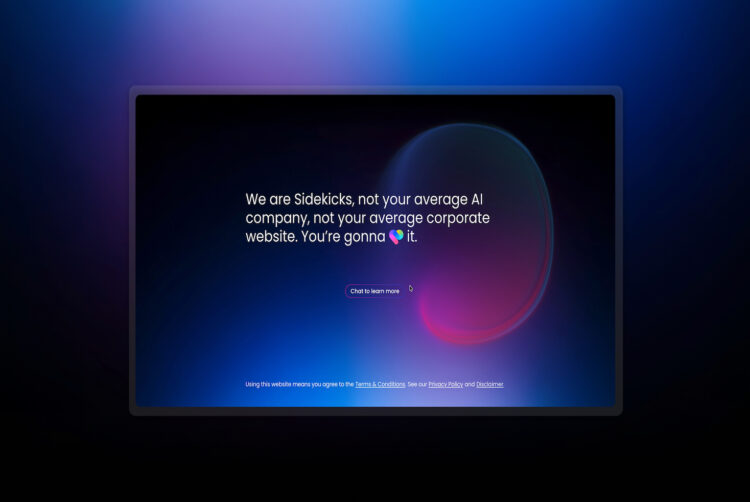
When I started shaping the strategy for Sidekicks’ corporate website — the front door to RTL Group’s new agentic AI company for the media industry — every conventional starting point felt wrong. I couldn’t even get to the point of briefing my team.
Business objectives. User journeys. Information architecture. Content hierarchies. I wasn’t creatively blocked. I was structurally blocked.
Sidekicks builds agentic AI: autonomous systems designed for a world where people no longer browse for information, but ask for it.
Yet, I was trying to force a new behaviour into an old container. So I stopped asking, What should our website say?
And instead asked something more uncomfortable — one that meant questioning conventions that still felt safe, and making a call without precedent.
“What if the website were partly the product?”
Once you accept that people expect an answer rather than search, the implication is unavoidable.
The website can’t be static.
It has to be fundamentally different.
That realisation forced a decision: I made the call to build something we hadn’t planned for — an agent-first corporate website.
Not a chatbot bolted on for lead capture. But a conversational interface, designed as the primary way people engage with the company.
Visitors arrive and are greeted with a simple prompt: Ask me about our company, agents, or people. From there, the experience unfolds through dialogue.
This wasn’t about abandoning marketing intent, quite the opposite. As marketers, we still believe in leading users. The difference is how that shows up. Instead of guiding users through menus and linear storylines, we embedded priorities, strategy, and narrative logic into the agent itself.
The user chooses the entry point. We design the momentum.
It’s still a journey, just one that doesn’t require users to work for clarity.
Design wasn’t supporting the strategy. It became the strategy.
This was where the work became genuinely difficult.
There were a few meaningful references: the closest were consumer tools like ChatGPT or Copilot, which were exactly what we didn’t want to build. This wasn’t a tool; it was a corporate website.
In an agent-first world where interaction models converge, differentiation no longer comes from functionality. It comes from design. Visual identity and UI/UX had to carry that weight — signaling trust, legitimacy, and brand recall.
And in our case, it also had to make it immediately clear this was a company website, not just another generic assistant that can help you plan dinner or debug code.
From brand guidelines to brand judgment
The most profound shift came later.
Instead of writing brand voice guidelines for writers, I found myself briefing an agent — not only on tone but on judgment.
How do we explain without oversharing?
How do we protect ideas without sounding evasive?
Brand voice stopped being static. It became behavioural.
When your brand speaks in real time, the risk profile changes. Prompt manipulation, misuse, inaccurate answers, overconfident explanations, or poorly judged responses aren’t abstract technical failures; they’re communication risks.
In a conversational interface, every response carries the weight of published copy. Security, reputation, and brand integrity collapse into the same problem — and knowing when not to answer becomes as important as knowing what to say.
Marketing suddenly requires capabilities many of us weren’t trained for, and are now having to learn quickly.
A harder brief — and the advantage of moving first
AI will change marketing work. Some tasks will disappear. Most roles will be reshaped beyond recognition. What this project clarified is what grows more valuable as everything else accelerates.
Creativity. Design. Judgment.
When average marketing becomes easier and cheaper, distinctive marketing becomes harder and more important. Differentiation no longer comes from output alone, but from decisions: how something looks, sounds, behaves, and responds.
We didn’t build Sidekicks’ website this way to make a statement. We built it because the traditional approach no longer matched how people behave, or how we wanted to show up as a company building AI for the future.
This model will be copied. It should be.
But in an era where interfaces and ideas are replicated quickly, one thing can’t be taken: the advantage of having been first.
Nobody can steal the decisions made before there was precedent, or the conviction it takes to abandon an old model before it collapses.
 Shira Leffel is the VP of marketing at smartclip