



Channel 4, ITV and Sky commercial chiefs ask advertisers to ‘turn down the toxic’
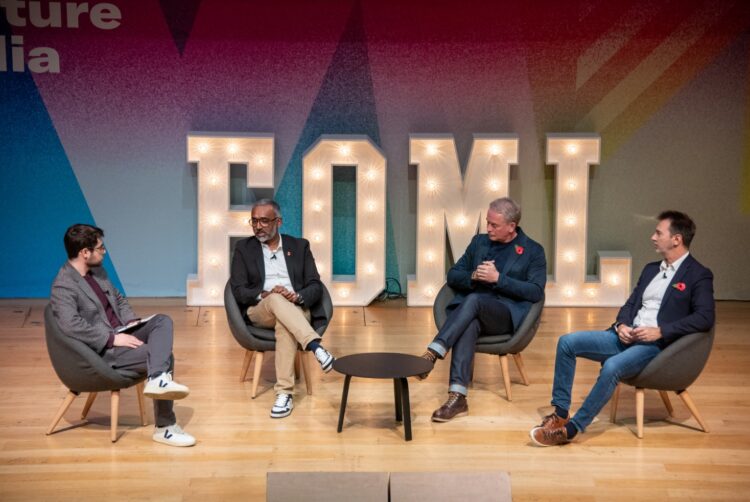
The Future of Media London
Turn down the toxic. Because it’s really important for our society that somebody makes a stand against this.
Kelly Williams, ITV
Commercial leaders representing Channel 4, ITV and Sky have called for advertisers to disinvest from Meta and other Big Tech platforms and reinvest that adspend with “trusted” media owners.
“When I speak to agencies, I do come across a lot of planners and buyers that feel conflicted in having to buy Meta, given what it stands for today,” Kelly Williams, ITV’s commercial managing director, told a crowd at last month’s The Future of Media London event.
He argued Meta’s ad experience and content experience are reliant on fraudulence and harmful content, respectively, pointing to scam financial ads and the graphic viral video of Charlie Kirk’s assassination as reasons for brands to be uneasy about spending on platforms like Facebook and Instagram, as well as their competitors.
“Look, I don’t think we are naive enough to think that advertisers are going to stop spending on Meta,” Williams continued. “But I guess what we’re saying is, just turn it down a bit. Take 30% out, just have a look at what that does. Turn down the toxic. Because it’s really important for our society that somebody makes a stand against this.”
Williams was flanked by Channel 4 chief commercial officer Rak Patel and Sky Media managing director Brett Aumuller. Patel acknowledged that “the balance has gone in the wrong direction” with regard to brands growing budgets with tech platforms relative to other media channels.
That development over the past decade has animated recent efforts by the UK’s public-service broadcasters to become more attractive to small- and medium-sized enterprises (SMEs), which collectively appear to be driving the majority of growth in the overall ad market.
The broadcasters have collaborated on a forthcoming SME marketplace based on Comcast’s Universal Ads solution, as well as a new outcomes-based measurement panel, Lantern, both of which are set to launch next year. In addition, ITV and Channel 4 have each this year released new generative AI production services, with Aumuller telling The Media Leader Sky is in the “early stages” of developing a similar product of its own.
“Even as we talk about AI tools, even as we talk about what we’re going to be doing in the SME space, Clearcast and all the regulation and what we have to answer to from an Ofcom perspective will not change,” Patel said. “That is super critical. That regulation, that friction, is the super power of TV. Every platform is trying to remove friction, and what removing friction does is it doesn’t create a level of trust with whatever platform you’re on. TV has implicit trust.”
Asking rhetorically whether global society is moving in the right direction, Patel emphatically answered: “No, it’s fucking not.” Placing responsibility for social harms on tech platforms, he made a moral case for investing in trusted media.
“We don’t have fake news,” he said. “We don’t have videos of killings. We don’t have extreme porn. We don’t affect childrens’ mental health.
“We’re not ‘legacy’, we’re not ‘traditional’. We’re trusted.”
The benefits of TV — beyond TV?
Patel, Williams and Aumuller were speaking just days before the UK TV market was turned on its head by news that Sky is in “preliminary discussions” to acquire ITV’s Media & Entertainment business. Since the event, ITV and Sky have held their annual Palooza and Showcase events, respectively.
Those upfront events highlighted the challenging position TV companies find themselves in. One of the key announcements made during ITV’s Palooza was that it had joined TikTok’s Pulse Premiere programme; during Sky’s Showcase, the vast majority of time was dedicated to promoting Sky’s role within the wider creator economy.
To some degree, each example demonstrated the same cognitive dissonance advertisers are accused of: the apparent desire to show up in the very same spaces that are maligned for negative social externalities they are perceived to cause.
In the case of the broadcasters, however, the pitch to advertisers has been that they can offer trusted, brand-safe content within the confines of environments full of otherwise unregulated media.
‘Sky is a creator’: Sky Media leans into curation on platforms
Aumuller expressed that it is important that the likes of Sky, Channel 4 and ITV are not viewed by the market as merely broadcasters, noting that each has “streaming products and have our content on multiple platforms”, which helps lends credence to the argument that they can “service all budgets”, whether it be through brand-building or performance marketing.
The need for a presence on the platforms is part of the wider strategy to reach smaller advertisers. As Patel outlined, TV companies work with a “universe of 7,000” advertisers, compared to the 2.5m brands that market in the UK. “What’s important for us,” he continued, “is are we creating the right tools to get the whole raft of thousands of advertisers to get the benefit of TV?”
He continued: “We’re the most mass-market media channel in the UK. So what shouldn’t happen is that TV becomes something that is exclusive, or something that’s up on a shelf. It should be there for every brand to get the benefit out of it.”
‘Guys, wake up’
Williams acknowledged that many advertisers, particularly smaller brands with substantial downward pressure on budgets, can easily become “seduced” by short-termist marketing strategies, and that it is incumbent upon the broadcasters to adapt to the needs of those businesses.
“Lots of small businesses that have grown up on paid search and social are at a scale now that they’re ready to scale up. And to scale up, you have to build a brand,” he said.
The “fat end of the long tail”, as Williams has coined it, is a segment of the market that the broadcasters have a long history in dealing with. Even before the launch of its AI tool suite, ITV already employed a production team that makes 1,000 ads a year for brands, mainly smaller, regional businesses. While AI can help make that process cheaper and more efficient, Williams emphasised that targeting these businesses is “not a new thing”.
“We’ve been doing it forever, particularly in the regions,” he said. “What we’re just trying to do here is scale it.”
Aumuller noted that new-to-TV advertisers with Sky have increased their total marketing spend by 2.5x because they’ve seen strong results from making the leap from search and social to TV.
“First and foremost, removing the barriers that people have had to TV for a long time is the thing we need to do,” he added.
Hence the focus on collaboration this year — something that hasn’t occurred in other markets like the US. As Williams explained, the important objective is less about proving the effectiveness of advertising with ITV than it is the effectiveness of telly more generally.
Relaying that the trio visited New York City in late October to meet with their counterparts at major US networks, Williams said it was clear to him that American companies are “a little behind” on collaborating to compete with Big Tech.
“Guys, wake up. You are not competing with each other,” he said. “You’re competing with Google, Meta and Amazon. They are the three big players that are taking about 90% of all new ad revenue coming into the market.”
In the UK, the go-to-market strategy for attracting new-to-TV advertisers will look much like what the platforms currently do well.
“It’s going to be automated, it’s going to be integrated, it’s going to show up where Meta shows up,” Williams said of the forthcoming SME marketplace, which he added could launch as soon as the end of Q1 2026.
“We’re starting to get real momentum in working together as an industry to effectively compete properly with the big global platforms.
“Let’s face it, they’re big, they’re global, they’re powerful, they’re smart. It’s the most important thing we do: collaborate in order to thrive against those players.”